

Pharmaceutical Excipients and Recalls: Managing Impurity Risks
Lakshmi, Editorial Team, Pharma Focus America
Excipients make up most of a typical dosage form, yet they rarely receive the strategic attention given to active ingredients. A string of contamination events and nitrosamine-related recalls has exposed that blind spot. This article explores how impurities enter drug products through excipients, why U.S. regulatory expectations are tightening, and how pharmaceutical leaders can build supplier, testing and governance systems that prevent costly recalls.
The Overlooked Ingredients Driving Pharmaceutical Recalls
For decades, the pharmaceutical industry has organized its quality systems around the active pharmaceutical ingredient. It is the molecule that earns the patent, anchors the clinical program and dominates the regulatory dossier. Excipients, the fillers, binders, solvents, coatings and preservatives that turn a molecule into a usable medicine, have often been treated as commodities. They are purchased on price, accepted on a certificate of analysis and rarely discussed in the boardroom.
That mindset is becoming expensive. Excipients frequently account for the majority of a tablet's mass and nearly all of a liquid formulation's volume. When they carry an impurity, it travels directly into every dose a patient takes. Recent years have shown how quickly this can escalate: toxic glycol contamination linked to patient deaths in several countries, waves of nitrosamine-driven recalls, and benzene findings that pulled widely used products from American shelves. For U.S. pharmaceutical executives, managing excipient impurity risk has moved from a technical quality topic to a matter of patient safety, supply continuity and corporate reputation.
Why Excipient Impurities Have Become a Boardroom Recall Risk
The excipient supply chain was not built with modern impurity science in mind. Many excipients are produced in facilities that primarily serve the food, cosmetics or industrial chemical markets, where pharmaceutical volumes represent a small fraction of sales. Their manufacturers may not apply the same controls, change notification practices or analytical rigor that drug makers expect. Material often passes through distributors and repackages before reaching a pharmaceutical plant, and each handoff adds an opportunity for substitution, mislabeling or contamination.
At the same time, the definition of an unacceptable impurity has expanded. Analytical methods can now detect contaminants at parts-per-billion levels, and regulators have learned that trace substances once considered harmless can react with active ingredients during manufacturing or storage. An excipient that met every compendial specification can still contribute to a product failure if it contains a reactive trace component that no monograph was designed to measure.
An excipient that meets every compendial specification can still trigger a recall if it carries a reactive trace component no monograph was designed to measure.
The financial consequences are significant. A recall can involve product destruction, lost revenue, remediation costs, regulatory inspections and litigation. It can also create long-term damage in a market where prescribers, pharmacies and payers have alternatives. For generic manufacturers operating on thin margins, a single impurity event can turn a profitable product into a discontinued one.
Inside the Excipient Impurity Threat Map for Pharmaceutical Manufacturers
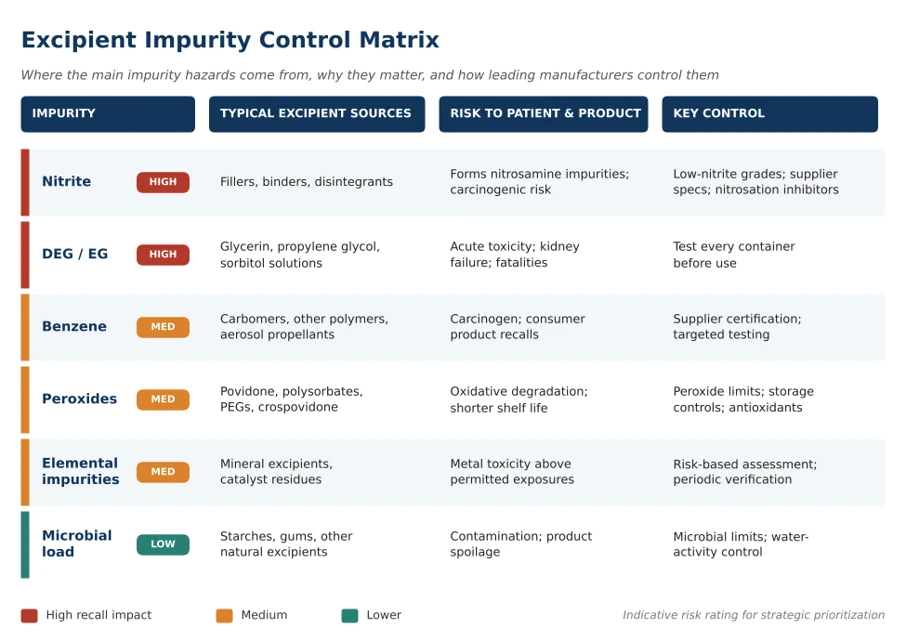
Figure 1: Excipient impurity control matrix: sources, risks and key controls for pharmaceutical manufacturers
Nitrosamines remain the most strategically disruptive concern. Many investigations have traced their formation to trace nitrite in common excipients, which can react with vulnerable amine structures in an active ingredient to form nitrosamine drug substance-related impurities. The U.S. Food and Drug Administration has published recommended acceptable intake limits for these impurities and set expectations for manufacturers to assess and control them. This has placed excipient nitrite levels firmly on the formulation agenda.
Diethylene glycol and ethylene glycol contamination represents a different kind of risk: rare, but potentially lethal. These industrial chemicals have repeatedly been substituted for or mixed into glycerin, propylene glycol and sorbitol solutions, with tragic consequences in several countries. In response, the FDA issued guidance calling for testing of every container of high-risk liquid components before use, rather than relying on supplier documentation alone.
Other hazards deserve steady attention. Benzene has been detected in certain polymers and aerosol propellants, prompting FDA alerts and voluntary recalls in the consumer health sector. Peroxides in polymeric excipients and surfactants can degrade sensitive active ingredients and shorten shelf life. Elemental impurities, governed by international risk-based guidelines, and microbial contamination in naturally sourced materials round out a risk landscape that is broader and more interconnected than most organizations recognize.
Regulatory Pressure Is Rewriting Excipient Control Expectations in America
U.S. current good manufacturing practice regulations have always required manufacturers to test components, including at least one identity test, and to qualify suppliers before relying on their certificates of analysis. What has changed is the level of scrutiny applied to those obligations. FDA investigators increasingly ask how a company determined which excipients are high risk, how it verified the reliability of supplier data, and whether its testing is capable of detecting the impurities most likely to cause harm.
The nitrosamine experience has reshaped regulatory thinking in a lasting way. Manufacturers are expected to understand the chemistry of their formulations well enough to anticipate impurity formation, not simply to test for known contaminants after the fact. This shifts accountability upstream. A drug maker that cannot explain the nitrite content of its excipients, or the variability between suppliers and lots, may struggle to justify its control strategy during an inspection or application review.
Quality agreements are also receiving closer attention. Regulators expect clear provisions on change notification, audit rights and data sharing between drug manufacturers and their excipient suppliers. A supplier that quietly changes a raw material source, manufacturing site or processing aid can alter an excipient's impurity profile without changing its compendial test results. Without contractual visibility, the drug maker may not discover the change until a stability failure or a recall reveals it.
An Illustrative Excipient Impurity Case: How a Nitrite Problem Was Contained
Consider a composite scenario that reflects challenges many U.S. generic manufacturers have faced. A company markets an immediate-release tablet whose active ingredient contains a secondary amine. During a routine risk assessment, its analytical team detects a nitrosamine impurity approaching the recommended acceptable intake limit in aged stability samples.
The investigation traces the source to one of two approved suppliers of a widely used filler, whose material contains several times more nitrite than the alternative supplier. Rather than waiting for a regulatory finding, the company moves quickly. It shifts production to the lower-nitrite supplier, introduces a supplier-specific nitrite specification, and adds a small quantity of an antioxidant shown to inhibit nitrosation. It then shares its data and remediation plan with regulators before any out-of-specification product reaches the market.
The outcome is a controlled change rather than a recall. The lesson for leadership is that the decisive factor was not testing capability alone. It was a governance culture that treated excipient chemistry as a strategic risk and empowered teams to act before a problem became public.
Building a Recall-Resilient Excipient Strategy: The Pharmaceutical C-Suite Playbook
Preventing excipient-driven recalls begins with visibility. Many organizations cannot quickly answer a basic question: which excipients, from which manufacturers and sites, are used in which products? Building a complete map of the excipient supply chain, including distributors and repackagers, is the foundation for every other control. Without it, a contamination alert becomes a weeks-long investigation instead of a same-day assessment.
The next step is risk-based supplier management. Excipients should be ranked by their potential to introduce harmful impurities, their criticality to product performance and the reliability of their supply chain. High-risk materials justify on-site audits, enhanced incoming testing and dual sourcing where feasible. Lower-risk materials can be managed more efficiently, freeing resources for the areas that matter most.
Formulation science must also become part of risk management. Development teams should consider excipient impurity profiles, particularly nitrite and peroxide levels, when selecting ingredients for new products. Designing out a reactive pathway at the formulation stage is far less costly than reformulating a commercial product under regulatory pressure. Mature products deserve periodic review as new impurity concerns emerge.
Finally, governance must reflect the stakes. Excipient risk should appear in enterprise risk registers and board-level quality reviews, with clear ownership across quality, procurement, regulatory and research functions. Procurement incentives that reward lowest-cost sourcing without regard to quality history can quietly undermine every other control. Leaders who align commercial decisions with quality priorities will see fewer surprises.
Smarter Excipient Testing and Data: Pharmaceutical Quality Beyond the Certificate
Traditional incoming inspection was designed to confirm that an excipient is what its label claims. Today's risk landscape demands more. Leading manufacturers are supplementing compendial testing with targeted methods for the impurities most likely to cause harm in their specific products, such as nitrite, peroxides or glycols. They are also verifying supplier certificates periodically against their own results, rather than accepting them indefinitely once a supplier is approved.
Rapid technologies are making this more practical. Handheld spectroscopic tools allow identity checks on every container at the receiving dock, which is especially valuable for high-risk liquids where a single contaminated drum can cause catastrophic harm. Laboratory methods with lower detection limits help teams understand lot-to-lot variability, not just pass or fail results.
The greatest gains, however, come from treating excipient data as a strategic asset. When impurity results, supplier audit findings, deviations and stability trends are brought together in a single view, patterns emerge long before they become recalls. A gradual rise in peroxide levels from one supplier, or a shift in nitrite content after a supplier changes its raw material source, becomes visible early. For executives, this kind of integrated quality intelligence turns excipient oversight from a reactive compliance activity into an early-warning system.
Conclusion: Turning Excipient Impurity Control into a Pharmaceutical Advantage
Excipients are no longer the quiet background of drug manufacturing. They sit at the center of some of the most consequential safety events and recalls of recent years, and U.S. regulatory expectations have risen accordingly. The organizations best positioned for this environment are those that see excipient quality not as a cost to minimize but as a capability that protects patients, revenue and reputation.
For American pharmaceutical executives, the path forward is clear. Map the supply chain, rank excipient risks honestly, invest in testing where it matters, embed impurity science into formulation decisions and hold suppliers to transparent standards. Companies that make these investments now will spend less time managing recalls and more time earning the trust of regulators, prescribers and patients.
Frequently Asked Questions on Pharmaceutical Excipients and Impurity Risk
Q. Why are excipients a growing source of pharmaceutical recalls?
Excipients often make up most of a dosage form, and their supply chains frequently serve other industries with less stringent controls. Trace impurities can also react with active ingredients, creating new contaminants during manufacturing or storage.
Q. How do excipients contribute to nitrosamine impurities?
Trace nitrite in some excipients can react with amine groups in an active ingredient to form nitrosamines. Selecting low-nitrite excipients and adding inhibitors such as certain antioxidants can reduce this risk.
Q. What does the FDA expect for high-risk liquid excipients?
The FDA expects manufacturers to test high-risk components such as glycerin and propylene glycol for diethylene glycol and ethylene glycol contamination before use, rather than relying solely on supplier certificates.
Q. Can a compendial-grade excipient still cause an impurity problem?
Yes. Compendial monographs may not test for every reactive trace substance, so an excipient can meet its specification while still contributing to impurity formation in a specific formulation.
Q. Where should pharmaceutical leaders start in reducing excipient risk?
Start with full visibility of the excipient supply chain, then apply risk-based supplier qualification, targeted testing and formulation design that avoids known impurity pathways.

Lakshmi is a science writer with a foundation in the laboratory. She earned her master's in biotechnology and trained through research internships at ICGEB (JNU) and DIPAS, DRDO, with her work appearing in the Egyptian Journal of Veterinary Sciences. Now APCRM-certified and part of the editorial team at Pharma Focus America and Pharma Focus Europe, she reports on pharmaceutical technology, research, and innovation — giving complex science a clear and confident voice for industry leaders.