


Precision Medicine Commercialization: Strategic Pathways to Global Market Access
Lakshmi, Editorial Team, Pharma Focus America
Precision medicines now dominate US oncology approvals, yet a large share of eligible patients never reach the therapy matched to their biology. For American pharmaceutical leadership, commercialization has become an exercise in diagnostic infrastructure, coverage architecture and evidence design rather than promotion. This article maps where value leaks between approval and sustained treatment, and how US-headquartered companies can build a global market access pathway that holds.
Introduction: Approval Is the Cheapest Milestone
Precision medicine has won the scientific argument. More than sixty percent of new cancer drugs approved in recent years have been targeted therapies dependent on a companion diagnostic to identify the patients who should receive them, and the model is now spreading beyond oncology into neurology, immunology, cardiology and rare metabolic disease. The global precision medicine market, valued at roughly USD 93 billion in 2025, is forecast to approach USD 243 billion by 2034, with North America holding close to half of it and the United States serving as both the innovation engine and the pricing benchmark for the rest of the world.
What has not been won is the commercial argument. A precision therapy that is approved, priced and stocked can still fail to reach most of the patients it was designed for, because the pathway between a diagnosis and a matched prescription runs through laboratories, coding systems, coverage policies and turnaround times that no commercial organization fully controls. In published US practice data, only around a third of eligible advanced lung cancer patients end up receiving the biomarker-matched medicine appropriate for their tumor. That is not a market-share problem to be solved with more sales representatives. It is an infrastructure problem, and for American C-suites it now sits at the center of the growth plan.
The Leakage Curve: Where Precision Medicine Revenue Disappears
Every biomarker-defined launch has a leakage curve, and most companies cannot draw their own. It begins with the patients whose diagnosis makes them eligible and ends with those still receiving the matched therapy ninety days later. Between those two points sit a series of attrition steps that are individually forgivable and collectively fatal: insufficient tissue at biopsy, a narrow single-gene test ordered instead of a comprehensive panel, a molecular result that arrives after first-line treatment has already started, a result that is filed but never acted on, a prior authorization that stalls, and a patient who discontinues before benefit appears.
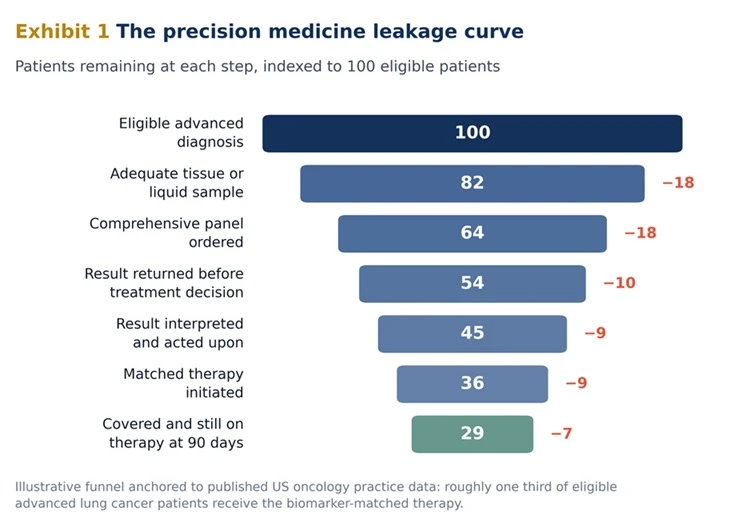
Exhibit 1: Attrition compounds across seven steps; the loss between diagnosis and testing is larger than anything a payer decision removes later.
The strategic insight buried in that curve is that the largest single loss usually occurs before any payer is involved. Testing is where the funnel narrows hardest, and testing behavior is driven by pathology workflow, reimbursement for the assay itself and physician habit, none of which respond to conventional brand promotion. Companies that instrument this curve with real testing and claims data can quantify exactly what a five-point improvement in reflex testing rates is worth in revenue, and can make the case for investment in diagnostic infrastructure with the same rigor applied to a media plan. Companies that do not instrument it are left explaining a forecast miss they cannot decompose.
Diagnostics Are a Commercial Channel, Not a Regulatory Chore
The American diagnostic environment has moved substantially in the last eighteen months, and much of the movement has been favorable to sponsors willing to read it. A federal court vacated the agency rule that would have brought laboratory-developed tests under medical device oversight, and the rule was formally rescinded in September 2025, restoring enforcement discretion and leaving these tests regulated primarily under clinical laboratory law. In parallel, a proposed order published in November 2025 would reclassify nucleic acid-based oncology companion diagnostics, including sequencing panels and polymerase chain reaction assays, from the most stringent premarket approval pathway to a clearance pathway with defined special controls. The comment period closed in January 2026 and the final order remains pending.
The commercial consequences are considerable, and they are the reason this belongs on an executive agenda rather than a regulatory one. Medicare's national coverage policy for sequencing in cancer attaches automatically to tests that are cleared or approved as companion diagnostics, and sole-source tests that carry that status become eligible for advanced diagnostic pricing treatment. A lighter submission pathway therefore widens the population of tests that arrive with coverage already attached. Against that, the historical gap between approval of a tissue-agnostic therapy and approval of its companion diagnostic has approached two years. Every month of that gap is a month in which an approved medicine cannot be prescribed to patients who qualify for it.
The diagnostic is not a compliance deliverable attached to the label. It is the distribution channel, and in most launches it is the narrowest point in the entire commercial system.
Pricing a Small Denominator: The US Economics of Precision Therapy
Precision therapeutics invert the traditional pharmaceutical economic model. The eligible population is small, often deliberately so, while development costs remain conventional and the diagnostic ecosystem must be funded alongside the drug. The resulting price points attract scrutiny that a broad primary-care product never faces, and American payers have responded with utilization management calibrated to the biomarker rather than the indication: coverage conditioned on a specific test, a specific result and increasingly a specific laboratory.
Two consequences follow for pricing strategy. The first is that outcomes-based agreements have moved from novelty to working tool in this segment, precisely because small, biologically defined populations make performance measurable in a way that broad chronic-disease contracts never allowed. The second is that the biomarker itself becomes a pricing instrument: a narrower, better-validated selection criterion supports a higher price per patient by concentrating benefit, whereas an expansive definition invites the payer to treat the product as a general-purpose therapy and price it accordingly. Deciding how tightly to define the population is therefore a commercial decision taken during development, not a regulatory outcome accepted at approval.
This makes the payer conversation a technical one. The negotiation is no longer only about price and rebate; it is about which test result qualifies, who pays for the test, what happens when a patient is treated on the basis of an unapproved assay, and how outcomes will be verified if the contract is performance-linked. Executive teams that arrive with a value dossier but without a diagnostic reimbursement position are answering half the question.
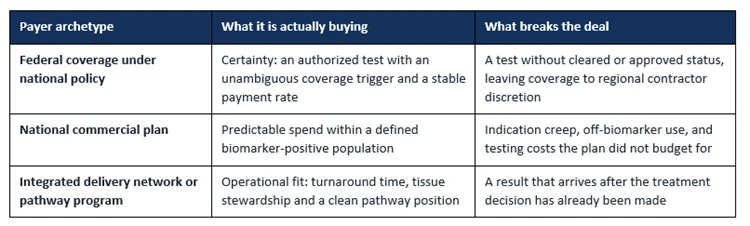
Exhibit 4: Three American payer archetypes buy three different things; a single value story addressed to all of them satisfies none.
Sequencing the World: Global Access After the US Launch
For US-headquartered companies, international expansion in precision medicine has become materially harder in the past two years, and materially more predictable for those who prepare. Since January 2025, new oncology medicines and advanced therapies entering Europe have been subject to a joint clinical assessment conducted at European Union level in parallel with regulatory review, expanding to orphan medicines in 2028 and to all centrally authorized products by 2030. Roughly fifty such assessments were anticipated during 2026, including around thirty-five new oncology active substances.
The mechanism that matters commercially is scoping. Member state bodies define the populations, comparators and outcomes that the assessment will address, and a sponsor must answer those questions with data generated years earlier. The first published assessment, covering a therapy for a pediatric brain tumor, demonstrated the risk vividly: for want of comparative data, seven of the eight defined research questions could not be assessed at all. For precision medicines studied in single-arm trials against small biomarker-defined populations, this is the central strategic exposure of the next five years.
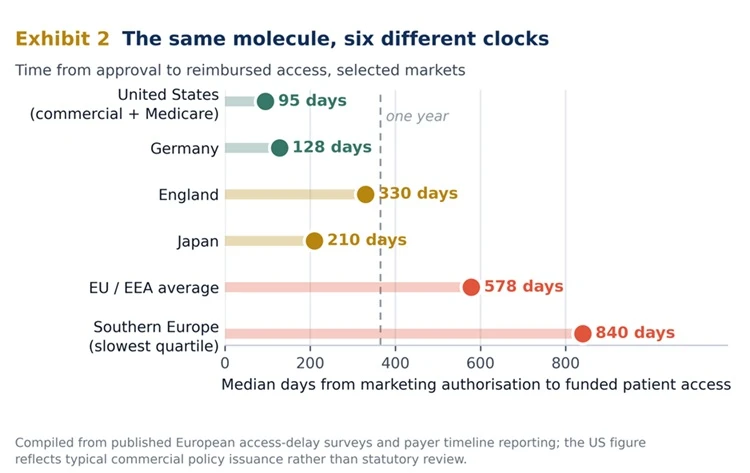
Exhibit 2: European access timelines diverge by a factor of six between the fastest and slowest markets, independent of the regulatory decision.
Timing compounds the problem. Innovative medicines wait an average of roughly 578 days for reimbursement across European Union and European Economic Area countries, ranging from about 128 days in Germany to around 840 days in the slowest markets. Sequencing launches by expected reimbursement speed rather than by market size, and generating comparative or real-world evidence early enough to satisfy joint scoping, is worth more to net present value than any pricing concession negotiated later.
Four Gates, One Owner: Building the Commercialization Architecture
The organizational failure in precision medicine is rarely a lack of capability. It is the distribution of capability across functions that do not share a scoreboard. Diagnostics sits in medical affairs or partnerships, evidence sits in clinical development, coverage sits in market access, and delivery sits with the field organization. Each function reports success against its own metric while the patient funnel leaks between them.
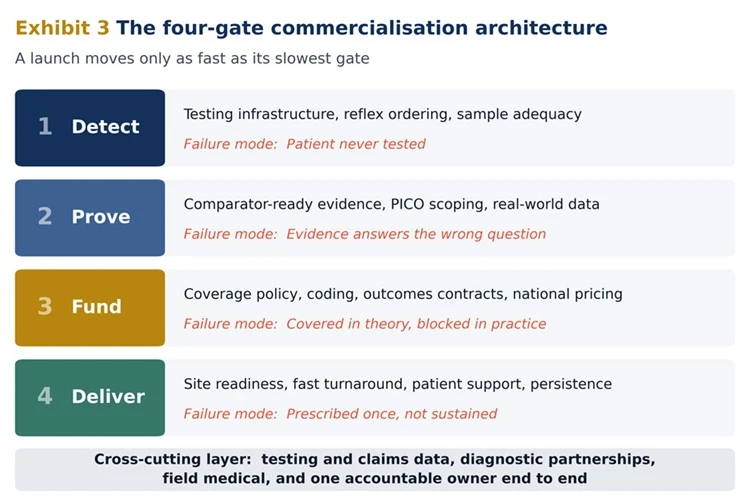
Exhibit 3: Four gates, four distinct failure modes, and a data layer that must be shared for any of them to be managed.
The structural remedy is to name a single accountable owner for the end-to-end pathway from detection to sustained treatment, with authority over the diagnostic partnership budget as well as the promotional one, and to hold that owner to a metric expressed in matched patients treated rather than prescriptions written. That change alone tends to surface investment cases that a conventional structure suppresses, because the returns on faster turnaround time or broader reflex testing accrue to a function that did not pay for them.
Case in Point: A Tissue-Agnostic Launch That Bought Its Own Runway
Consider a mid-cap developer that secured a tissue-agnostic oncology approval for a rare fusion, addressing perhaps a few thousand patients a year spread across a dozen tumor types with no single specialist audience to target. Conventional launch planning would have concentrated spending on prescriber promotion. Instead, the company funded a sequencing subsidy program with a network of pathology laboratories, negotiated inclusion of its biomarker in existing panels rather than commissioning a bespoke assay, and staffed a small team whose only job was reducing the interval between biopsy and reported result.
Uptake tracked testing rates almost exactly, with a predictable lag. The lesson generalizes beyond that molecule: in a tissue-agnostic or low-prevalence setting, the company is not competing with another therapy. It is competing with the possibility that the patient is never identified at all, and money spent on identification returns more than money spent on persuasion.
Conclusion: Commercialization Is an Infrastructure Discipline
Precision medicine has moved past the phase in which scientific differentiation alone determined commercial outcomes. The molecules work, the regulatory pathways are maturing on both sides of the Atlantic, and the diagnostic rules in the United States are loosening in ways that reward sponsors who engage early. What separates a strong launch from a disappointing one is now almost entirely a question of infrastructure: whether the patient is tested, whether the result arrives in time, whether coverage attaches automatically, and whether the same evidence package can satisfy an American payer and a European joint assessment without being rebuilt from scratch.
For American pharmaceutical and biotech leadership, three commitments follow. Treat the companion diagnostic as a commercial asset with its own investment case and its own coverage strategy, not as a regulatory obligation discharged at approval. Design evidence for two audiences from the first protocol, because a single-arm study that satisfies a regulator may leave a European assessment unable to answer most of its own questions. And give one executive ownership of the whole pathway, measured in matched patients treated. The companies that industrialize patient identification will define this category; the companies that continue to treat it as somebody else's problem will keep launching excellent medicines into populations that never find them.

Lakshmi is a science writer with a foundation in the laboratory. She earned her master's in biotechnology and trained through research internships at ICGEB (JNU) and DIPAS, DRDO, with her work appearing in the Egyptian Journal of Veterinary Sciences. Now APCRM-certified and part of the editorial team at Pharma Focus America and Pharma Focus Europe, she reports on pharmaceutical technology, research, and innovation — giving complex science a clear and confident voice for industry leaders.