


R&D Strategies for First-in-Class and Best-in-Class Therapeutics
Lakshmi, Editorial Team, Pharma Focus America
First-in-class and best-in-class therapeutics are not two speeds of the same strategy. They carry different risk profiles, demand different R&D capabilities and now face different pricing clocks under US policy. This article examines what order of entry genuinely buys, where each archetype tends to fail, and how American R&D leaders should govern the balance between the two across a portfolio.
Introduction:
The Two Bets Hiding Inside Every American R&D Portfolio
Ask a US pharmaceutical executive whether their company pursues first-in-class or best-in-class assets, and the answer is almost always both. Ask how the portfolio is governed, resourced and measured, and the answer is almost always as though there were only one kind of program. The same stage gates, the same probability-of-success assumptions, the same commercial forecasting templates and the same development timelines get applied to a molecule opening a biological category nobody has drugged before and to a molecule entering a category with three approved competitors and a defined standard of care.
Those are not variations on a theme. They are structurally different businesses that happen to share a laboratory. One is a bet that a biological hypothesis is correct. The other is a bet that an execution advantage can be built and defended against companies that already proved the hypothesis. Confusing them is expensive in a specific and recurring way: first-in-class programs get starved of the translational investment that would have de-risked them, and best-in-class programs get launched without the head-to-head evidence that was the entire point of being second.
First-in-Class or Best-in-Class: Two Archetypes, Two Entirely Different Businesses
The definitions matter more than they appear to. A first-in-class therapeutic acts through a mechanism with no approved precedent. A best-in-class therapeutic acts through an established mechanism but delivers a materially better outcome on efficacy, safety, dosing convenience, durability or a combination of them. The distinction is mechanistic, not chronological, and it is not a ranking. Plenty of first-in-class approvals are commercially unremarkable, and plenty of fourth entrants have taken the majority of a category.
What separates the two archetypes in practice is where the uncertainty sits. In a first-in-class program, the central unknown is whether modulating the target changes the disease in humans at all, and no amount of operational excellence resolves that question before the clinic does. In a best-in-class program, the biology is largely settled and the central unknown is whether the molecule can demonstrate separation from an incumbent that has spent years accumulating data, prescriber familiarity and formulary position. The first is a science problem. The second is an evidence and access problem wearing a lab coat.
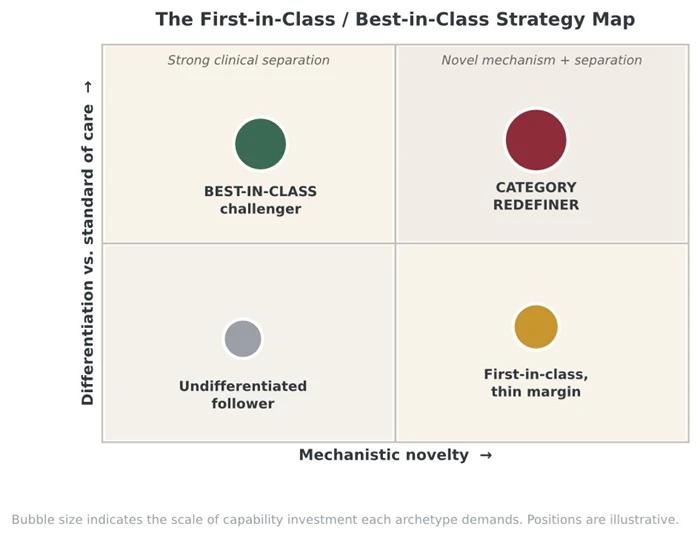
Figure 1: The two archetypes occupy distinct positions, and the most valuable quadrant demands the heaviest capability investment.
The First-in-Class Premium Is Not What Most Boards Assume
The strategic folklore of the industry holds that being first is decisive. The evidence is considerably more conditional. Priority of entry reliably confers an early revenue lead, because for a period the pioneer is the only option, and that lead can be substantial while it lasts. What priority does not confer is durability. Once a differentiated competitor arrives with data showing superiority on an endpoint physicians and payers care about, the pioneer's advantage erodes at a rate determined almost entirely by the size of that clinical gap.
The practical implication for American R&D leaders is that first-in-class status should be treated as a time-limited asset that must be converted into something more durable before the second entrant arrives. That conversion takes specific forms: rapid indication expansion, generation of long-term outcomes data no follower can match for years, biomarker-defined subpopulations where superiority is defensible, and next-generation molecules developed against one's own incumbent. Companies that treat first approval as the finish line rather than the starting position tend to be the ones later described as having created a market for someone else.
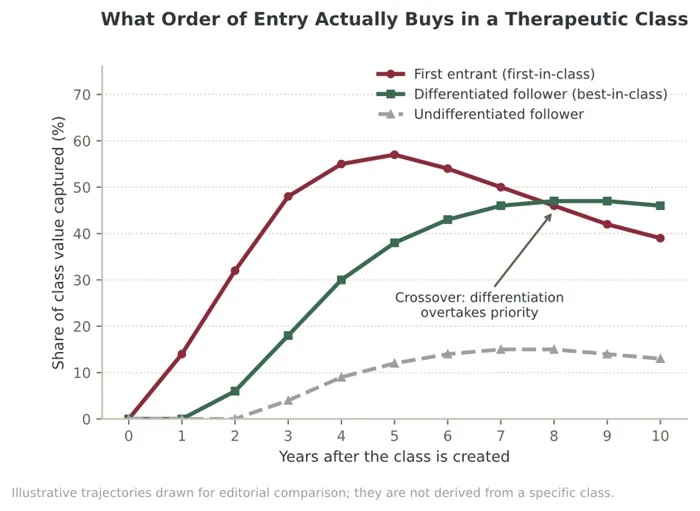
Figure 2: Priority of entry buys an early lead, but differentiation determines who holds the class over time.
Where the Risk Actually Sits in First-in-Class and Best-in-Class Programs
Because the two archetypes fail for different reasons, they should be governed with different instruments. First-in-class attrition is dominated by target and translational failure: the mechanism does not behave in human disease as the preclinical model suggested. This risk is front-loaded and only partially reducible, but it responds well to disciplined investment in human-derived evidence, genetic validation and early proof-of-mechanism readouts designed to kill the hypothesis quickly and cheaply.
Best-in-class attrition looks nothing like that. The molecule usually works. What fails is the margin: the improvement proves real but too small to shift prescribing, or the comparator moves during development, or the program reaches approval with data that satisfies a regulator but not a pharmacy benefit manager. This risk is back-loaded, sits mostly outside the laboratory, and is highly reducible through decisions made early about comparator selection, endpoint choice and the willingness to run a genuine head-to-head study rather than a placebo-controlled trial that avoids the question.
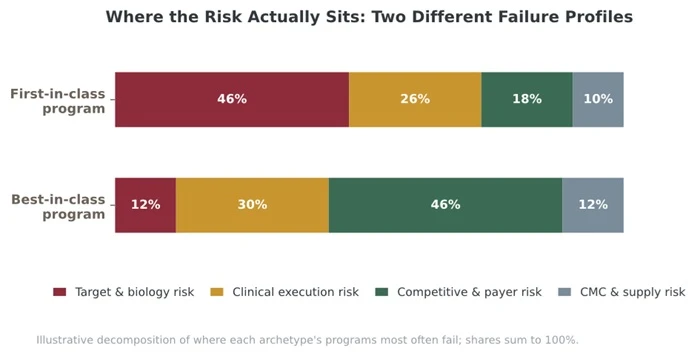
Figure 3: Each archetype carries a distinct failure profile, which argues for distinct governance rather than a common stage gate.
A best-in-class asset that never faced its competitor in a randomized trial has not been differentiated. It has only been described as differentiated.
The Best-in-Class Playbook: Winning a Therapeutic Class You Did Not Create
Entering an established class successfully depends on a decision most organizations make far too late: defining, before the pivotal program is designed, exactly what claim will justify a switch. That claim has to be specific enough to be tested, meaningful enough to change behavior, and durable enough to survive the incumbent's response. Vague ambitions to be better tolerated or more convenient rarely survive contact with a formulary committee.
The strongest best-in-class programs commit early to the uncomfortable trial. They design head-to-head studies against the actual standard of care rather than against placebo, accept the elevated risk of a negative result, and in exchange earn a label and an evidence base that a competitor cannot argue with. They also invest disproportionately in the population where their advantage is largest, using biomarkers or clinical characteristics to define a subgroup in which superiority is unambiguous, then expand outward from a defensible position rather than diluting the effect across an undifferentiated population.
Timing is the third discipline, and the least discussed. A best-in-class program launching into a class whose incumbent is approaching loss of exclusivity is competing not against a branded product but against a generic, and the differentiation required to justify a premium rises accordingly. Reading the incumbent's patent position, anticipated biosimilar entry and negotiation eligibility should shape the development timeline as directly as any scientific consideration. A superiority claim that would have commanded a premium in year six of a class may command nothing in year eleven.
Case in Point: The Program That Changed Archetypes at Phase II
The following is a composite, assembled from patterns recurring across US mid-cap developers and presented without identifying details.
A company advanced an oral agent against a novel inflammatory target with genuine first-in-class positioning. Midway through Phase II, two things happened. A larger competitor published convincing data on a different mechanism in the same indication, resetting the standard of care. Simultaneously, the company's own biomarker analysis showed that its effect was concentrated in a patient subgroup representing roughly a third of the enrolled population, with a substantially larger effect size than the overall result suggested.
The reflexive response would have been to defend the first-in-class narrative and run a broad Phase III against placebo, preserving the story for investors. Instead the leadership reframed the asset. They redesigned the pivotal program as a head-to-head study in the biomarker-defined subgroup, against the new standard of care, accepting a smaller addressable population and a materially higher risk of failure. They also rebuilt the commercial case around superiority in a defined segment rather than around novelty.
The program read out positive, with a clear separation in the target population, and secured formulary positioning that a broad placebo-controlled win would not have delivered. The instructive point is what the company gave up. It abandoned the more flattering first-in-class positioning in favor of a best-in-class claim it could actually prove, and it made that decision at Phase II rather than after a disappointing launch. Most organizations discover the same information two years later and several hundred million dollars poorer.
The Washington Clock: How US Pricing Policy Now Prices Both Strategies
American R&D strategy can no longer be set without reference to the Medicare negotiation timetable created by the Inflation Reduction Act, whose first negotiated prices took effect in January 2026 and whose subsequent cycles are expanding to cover both pharmacy-benefit and physician-administered products. Two structural features matter for the first-in-class versus best-in-class decision.
The first is that eligibility runs from the date of a product's own approval, not from the maturity of its class. A follower entering an established category still starts its own clock at its own approval, which means late entrants can retain pricing freedom after the pioneer has lost it. The second is the differential treatment of small molecules and biologics, which face negotiation eligibility on different timelines. That gap, the subject of continuing legislative debate in Congress, tilts the economics of long-development small-molecule programs and should be modeled explicitly rather than treated as a policy footnote. Neither feature makes one archetype right. Both make the revenue-window assumptions inside a first-in-class business case considerably more fragile than they were a decade ago.
Building the R&D Capability Stack Behind Both Bets
The capabilities that make a company good at one archetype are not the capabilities that make it good at the other, which is why organizations attempting to switch strategies mid-portfolio so often underperform at both. Pioneering demands depth in translational biology, target validation and regulatory precedent-setting, since there is frequently no established endpoint or approval pathway to follow. Displacing an incumbent demands comparative trial design, real-world evidence infrastructure and sophisticated payer value modeling.
Few organizations are genuinely strong across all of it, and the honest response is to decide which stack to own and which to access through partnership. What does not work is assuming that a company built to pioneer can execute a comparative-effectiveness program on the same timeline and budget, or that a disciplined fast-follower organization can absorb the ambiguity of a first-in-human study in an undrugged pathway.
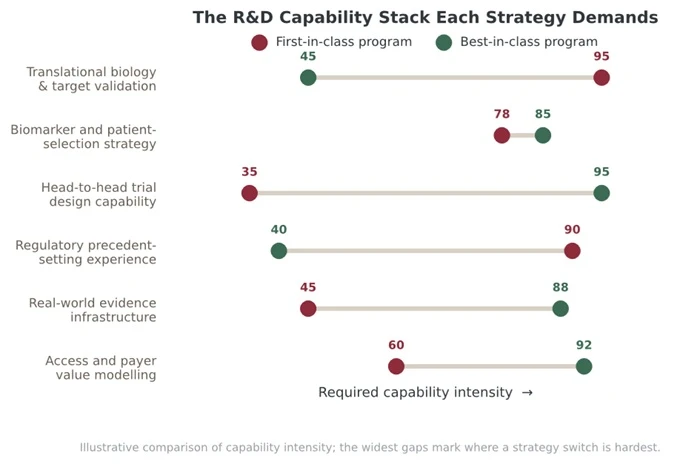
Figure 4: The widest capability gaps mark the points where switching between the two strategies is most costly.
Conclusion: Stop Choosing Between the Two — Start Governing the Ratio
The most useful reframing available to an American R&D leadership team is that first-in-class and best-in-class are not a choice to be made once, but a ratio to be managed continuously. A portfolio weighted entirely toward pioneering carries correlated scientific risk and a punishing failure rate. A portfolio weighted entirely toward following carries little scientific risk and almost no pricing power, competing in categories where the terms have already been set by someone else.
What separates the companies that do this well is not the ratio they land on. It is that they set it deliberately, at the portfolio level, with different stage gates and different success criteria for each archetype, and they revisit it as competitive and policy conditions change. They accept that a first-in-class asset must convert priority into durable evidence before its window closes, and that a best-in-class asset must earn its claim in a comparative trial rather than assert it in a launch deck. Being first and being best are both defensible strategies. Being unclear about which one a given program is pursuing is not.

Lakshmi is a science writer with a foundation in the laboratory. She earned her master's in biotechnology and trained through research internships at ICGEB (JNU) and DIPAS, DRDO, with her work appearing in the Egyptian Journal of Veterinary Sciences. Now APCRM-certified and part of the editorial team at Pharma Focus America and Pharma Focus Europe, she reports on pharmaceutical technology, research, and innovation — giving complex science a clear and confident voice for industry leaders.