
Regulatory Harmonization: Bridging Global Standards in Pharmaceutical Development
Lakshmi, Editorial Team, Pharma Focus America
Global pharmaceutical development still runs on a patchwork of national rules, even as shared standards steadily advance. For American executives, regulatory harmonization now influences launch sequencing, trial design and capital allocation. This article examines the evidence on review times and submission delays, the growth of regulatory reliance, and the lessons of a collaborative oncology review program, and shows why harmonization has become a strategic lever rather than a technical exercise.
A new medicine may be developed on one continent, manufactured on another and tested across dozens of countries, yet each regulator retains the final word over its own market. For decades, the industry has worked to narrow the gaps between those regulators. The results are substantial, but the job is unfinished, and the unfinished part now carries real commercial weight.
For American pharmaceutical leaders, regulatory harmonization is often treated as the concern of specialist teams. That view undervalues it. Common standards shape how many trials a program needs, how quickly a dossier can travel, and how soon patients abroad can receive a therapy first filed in the United States. With a major overhaul of European pharmaceutical law moving through Brussels and regulators in emerging markets gaining capability, the map is changing quickly. Executives who understand where global standards truly converge, and where they do not, will make better decisions about sequencing, capital and risk.
One Molecule, Many Rulebooks: The Real Price of Regulatory Fragmentation
The most useful recent evidence comes from a peer-reviewed analysis of 241 new drugs approved by US or European regulators from 2014 to 2018, tracked through December 2022 across five agencies. Its central finding should reshape how leaders discuss global access. Median review times clustered fairly closely, from 9.2 months in Japan to 14.1 months at the European Medicines Agency, with the FDA at 9.6 months. Median submission delays, by contrast, ranged from zero at the FDA to 18.5 months in Australia.
In other words, differences in availability mostly reflected when companies chose to file, not how long regulators took to decide. Seventy percent of these drugs were submitted to the FDA first. Higher launch prices and larger markets were associated with shorter delays, while orphan drugs were filed about four months later on average.
This changes the executive question. Harmonization does not simply make regulators faster. Its greater value lies in lowering the cost of each additional filing, so that a smaller market no longer has to wait for its turn in a company’s queue. Every duplicated study, reformatted module and country-specific query raises that cost.
The same study offers a useful nuance. Drugs with moderate to high therapeutic value were submitted about six months earlier on average than low-value drugs, and the US lead was smallest for those higher-value medicines. The delay abroad, then, is not uniform. It tends to narrow where the clinical stakes are highest, yet it still reflects commercial priorities that harmonization can influence but not dictate.
Regulatory Harmonization’s Engine Room: Inside the Global Standards Machine
The International Council for Harmonisation remains the central forum. Established in 1990 by regulators and industry from the United States, Europe and Japan, it now counts 25 members and 43 observers, after adding regulators from Pakistan and New Zealand as observers in June 2026. That breadth matters because a guideline’s value grows with every authority that implements it.
Recent work shows the council moving from technical alignment towards the design of modern development itself. Its updated good clinical practice guideline, E6(R3), promotes quality by design, oversight proportionate to risk and stronger data governance. The European Medicines Agency applied it from July 23, 2025, and the FDA published it on September 9, 2025. At the time of publication, the agency had set no formal US compliance date, leaving sponsors to judge their own pace, although those running multinational trials have little reason to wait. In June 2026, the council’s assembly in Rio de Janeiro adopted Annex 2, covering decentralized elements, pragmatic elements and real-world data.
The pipeline is equally relevant to the C-suite. Working groups reported progress on the common technical document’s quality module, bioequivalence, biosimilars, real-world evidence, and medicines for pregnant and breastfeeding individuals. Each could influence program cost and portfolio choices. The assembly next meets in Prague on November 17 and 18, 2026.
One caveat deserves attention. FDA guidance is not legally binding, and adoption of a shared text does not guarantee identical interpretation. An inspector or reviewer in one region may still weigh the same trial differently from a counterpart elsewhere. Harmonized language is the start of alignment, not proof of it.
From Harmonization to Reliance: The Quiet Shift in Global Regulatory Power
If harmonization aligns the rules, reliance reuses the work. Under this model, one authority draws on the assessments of a trusted counterpart rather than repeating them, while keeping its own decision. The World Health Organization calls reliance central to its approach to strengthening regulatory systems, and said in August 2025 that around 70% of countries still face significant challenges from weak regulatory systems.
Two developments stand out. First, the agency’s framework for WHO Listed Authorities reached 39 agencies with its August 2025 designations, giving other regulators a clearer reference for whom to trust. Second, capability is spreading. Ten African countries have reportedly reached WHO maturity level 3, which denotes a stable, well-functioning regulatory system, with Mozambique the latest in August 2026. The African Medicines Agency is also reported to have become operational.
For US companies, this points to a practical opportunity. A high-quality FDA or European review package may increasingly serve as a passport into markets once considered too costly to enter. That advantage, however, depends on dossier consistency. A product that differs between markets in specification, labeling or manufacturing site can lose the benefit of reliance altogether, so lifecycle discipline becomes a market access asset.
Case Study: How Project Orbis Turned Regulatory Collaboration into Patient Access
The clearest real-world test of collaborative review comes from oncology. The FDA’s Oncology Center of Excellence launched Project Orbis in May 2019 with Canada and Australia. Singapore and Switzerland joined that December, Brazil in May 2020, the United Kingdom in January 2021 and Israel in July 2021, and Japan is now also listed as a partner. The framework allows concurrent submission and review of oncology products, aiming to bring earlier access to countries where filings would otherwise lag.
Its growth has been considerable. In its first year, the program handled 60 oncology marketing applications and produced 38 approvals. By July 2025, the FDA reported 633 applications covering 79 products.
Switzerland provides the best evidence of impact. A peer-reviewed comparison of 31 Orbis applications with 41 non-Orbis applications submitted in 2020 and 2021 found a median submission gap of 33 days under Orbis, compared with 168 days otherwise (Figure 1). Median Swiss review time was also shorter, at 235.5 days against 314 days.
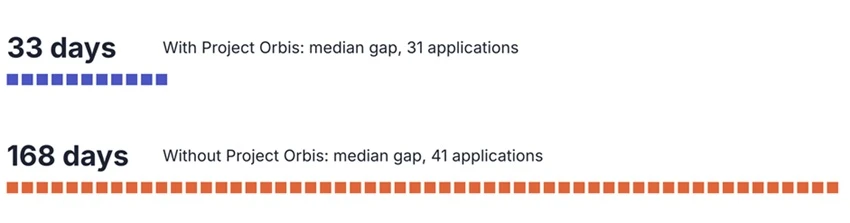
Figure 1: Pictograph of the median submission gap for oncology applications in Switzerland; each square equals three days. Source: Swiss regulator’s summary of a 2024 peer-reviewed study of 72 oncology applications.
Three lessons travel beyond oncology. Early planning is decisive, because sponsors must prepare a global submission plan and authorization letters for participating agencies. Confidentiality commitments between agencies are essential groundwork, and the FDA has acknowledged they can take time to put in place. Finally, the program does not erase national autonomy: FDA approval dates do not necessarily match partner approval dates. Collaboration shortens the road but does not remove the destination’s own gate, and pricing and reimbursement remain separate hurdles.
Where Regulatory Harmonization Stops: The Borders That Global Standards Cannot Erase
Convergence has clear limits. Manufacturing offers a good example. The mutual recognition agreement between the United States and the European Union, fully implemented in 2019, was designed to avoid duplicate inspections. Yet its scope is limited: it applies primarily to routine inspections, not all products are covered, and for-cause inspections remain possible, so the FDA continues to inspect in Europe. Boards should not assume that recognition removes inspection risk.
Legislation can also pull regions apart, even when the science aligns. The Council of the EU adopted its pharma package on September 28, 2026, with Parliament’s final vote still pending at the time of writing. It introduces eight years of data protection plus one year of market protection, and allows member states to require supply of protected medicines. It would also cut the European Medicines Agency’s standard assessment time from 210 to 180 days. These are European policy choices that a global technical guideline cannot harmonize. US leaders should expect lifecycle and launch models to keep diverging, even as development standards converge.
The Boardroom Agenda: Making Regulatory Harmonization a Strategic Advantage
The first shift is to plan global filing at the start of development rather than after US approval. Since submission timing, not review time, explains most of the access gap, leaders should challenge the default of sequential launches and ask what each market’s delay truly saves. Trial design matters too, as a study built to satisfy several regulators from the outset is usually far easier to reuse.
The second shift is to treat dossier consistency as a corporate asset. Reliance and collaborative review reward companies whose quality, labeling and supply information remain aligned across markets. That requires global ownership of post-approval changes, rather than a collection of country-level decisions. It also means asking, before any site transfer or specification change, how the decision will affect filings already under review elsewhere.
The third shift is to engage in the standards process early. Draft guidelines from the council and its regulators invite comment before they are finalized, and companies that follow them closely can adapt programs before requirements settle. Regulatory policy intelligence, in that sense, belongs in portfolio reviews and not only in compliance reports. This matters especially for smaller companies without local affiliates in many markets. For them, reliance routes and collaborative programs may offer the most realistic path beyond a US launch, provided that they are built into the plan from the start.
Conclusion
Regulatory harmonization will never produce one global rulebook, and it need not. Its real promise is more modest and more valuable: fewer duplicated studies, faster movement of trusted evidence, and a lower cost of reaching each additional patient population. The evidence suggests that regulators are no longer the main bottleneck. Company filing decisions matter just as much, which places much of the opportunity in executive hands. American pharmaceutical leaders who build development plans around shared standards, invest in consistent dossiers and take part in shaping new guidelines can turn a compliance obligation into a lasting competitive advantage, and bring medicines to more patients, sooner.

Lakshmi is a science writer with a foundation in the laboratory. She earned her master's in biotechnology and trained through research internships at ICGEB (JNU) and DIPAS, DRDO, with her work appearing in the Egyptian Journal of Veterinary Sciences. Now APCRM-certified and part of the editorial team at Pharma Focus America and Pharma Focus Europe, she reports on pharmaceutical technology, research, and innovation — giving complex science a clear and confident voice for industry leaders.