


Revolutionizing Healthcare: The Latest Innovations in Pharma Tech
Kate Williamson, Editorial Team, Pharma Focus America
In this article, the author discusses new tendencies of the pharmaceutical industry such as precision medicine, artificial intelligence in development of new drugs, wearable technology, 3D printing technology, CRISPR gene engineering, blockchain and robotic technology. These advancement offers are bringing a shift in how healthcare is being delivered based on advanced drug development, patient specific treatment, better patient treatment, and safe efficient healthcare delivery systems globally.
Introduction:
Pharmaceutical industry has been a key player of modern health care over many decades, contributing with medications and therapies necessary to prolong lives and increase their quality. Today, due to technological developments, permission of ‘pharma tech’ is reshaping the methodology of medical science, drug formulation and treating the patients. This article will only disclose the latest trends in the pharmaceutical technology as game-changers and improve people’s lives.
1. Precision Medicine: Tailoring Treatment to Individuals
Precise medicine has been identified as one of the most innovative fields of pharma technologies. In traditional medicine, there is a “standard practice” in where one medication is used for all patients suffering from a specific illness. Yet, it fails to take in account such factors as psychosocial factors that may influence how a person would respond to a given form of Whereas, precision medicine, delivers treatment based on patients’ genetic, environmental as well as lifestyle. For instance, in precision medicine, a physician investigates a patient’s DNA to establish the right course of treatment. For example, some forms of cancer are now treated depending on the genes that cause cancer cells to divide. This way minimizes side effects and improves the likelihood of a successful outcome. In other words, precision medicine can be completed summed up as patient-oriented or individualized medicine of the future healthcare.
2. Artificial Intelligence (AI) and Machine Learning in Drug Discovery
The most prominent and vibrant area which is considered as a branch of AI is Machine learning is the area that is profoundly transforming the pharma industry and drug discovery. The chronology of creating a new drug is generally a slow and costly one which can sometimes span over several years and cost billions of dollars to develop a single drug. AI accelerates this even faster since it involves the screening of big data in order to discover potential drug candidates quickly.
In order to determine how various compounds are likely to behave around biological targets, machine learning algorithms are employed. It aids scientists in picking out which compounds are most likely to work while lessening the need for a lot of experiments. AI is also useful in estimating side effects and toxicity of a medicine before the drug development process enters the stage of clinical trials making drug development safer and more efficient.
Furthermore, through the application of Artificial Intelligence, pharma tech can contribute to a process of drug repositioning. Specifically, based on immense data sets in the medical field, application of AI helped in emerging new indications for medications already on the market, thus reducing development costs and time. For instance, in the case of COVID-19, AI was helpful, in that it could assist in establishing which of the existing medications might be effective in treating the disease quicker than traditional approaches.
3. Digital Health Records and Data Analytics
Information is the core of present day heath care. Electronic health records or commonly referred to as EHR has become more popular allowing recording, accessing, and utilizing patient data.
They enhance the flow of information within the health care system since all the information involving a specific patient is acquired then shared hence negating the need of having information that may have been forgotten to be run a second time.
In addition, reams of figures are used in pharma tech to understand the results of treatments, efficacy, and effects of adverse reactions. Using EHR, researchers are able to uncover trends and make prognosis of future health related occurrences. This in turn, allows pharmaceutical companies to develop better drugs, healthcare decision makers make correct choices, and patients are then given better treatment.
Another aspect where data analytics is helpful in pharma technology is on clinical trials. Big data also makes it easier to filter for appropriate trial participants and guess how likely a specific demographic is to react to a specific medication. Essentially, this cuts the time and expenses required to reach trial, therefore making it simpler to develop new drugs.
4. Wearable Devices and Remote Patient Monitoring
Technology within the wearable segment has revolutionized the health and pharma tech sectors; from fitness trackers; smart watches; to medical grade wearable devices monitor patients’ biometrics, activity and are even capable of alerting caregivers when something is amiss. This real-time information is useful to the patients as well as the health care givers.
For example, wearable devices can record and track pulse, blood pressure, glucose level and other important parameters giving the doctor a means to monitor the condition of a patient without having to see him in person quite often. It has been most beneficial in chronic diseases where the patient conditions can be supervised and immediate action taken should the general health status of the patient worsen.
In a sector of pharma tech, wearable devices support the patient compliance with medication and treatment regimens. For example, some wearables encourage patients to consume their dose or record if they did it, to generate statistics health care managers can use to see if patients take their medication. Patients benefit from this innovation as it improves their individual health outcomes; besides, it helps trial cases in that the participants stay in line with the trials.
5. 3D Printing in Drug Manufacturing
3D printing is becoming increasingly popular in the pharmaceutical industry especially in drug production. What this technology achieves is an ability to produce medications with high precision, and hence an ability to provide specific dosages of a particular medicine or even develop different drugs individually for each patient.
For instance, patients who require a particular dose that cannot be administered through common, solid dosage forms can require 3D printed pills intended to release their medications gradually. The new medication is called Spritam and was recently approved by the FDA; this medication is a 3D printing that works for epilepsy and dissolves easily for patients with swallowing disorders.
In addition, 3D printing also has the ability to produce intricate structures of the drugs, which enhances the production of the composite tablets that contain different drugs in one tablet. This allows a patient to take fewer pills in a day therefore increasing compliance and easing treatment plans.
6. Gene Editing and CRISPR Technology
Pharmacogenomics is gradually being adapted due to advanced technologies like gene editing or specifically (Clustered Regularly Interspaced Short Palindromic Repeats (CRISPR) technology that open the opportunity to edit the gene that caused the disease. CRISPR allows for the precise editing of DNA, the knowledge of which can be applied to treat or even eradicate hereditary disorders.
In the field of pharma tech, CRISPR is being researched for its applicability in diseases such as, cystic fibrosis, sickle cell anemia and some types of cancer. This technology is a permanent one hence once the treatment has been effected, the disease has no permanent cure hence the DNA can be altered forever to overcome the disease.
The post defines CRISPR to mean a lot in the society, however, has some drawbacks in terms of ethics and such safety measures. Scientists and other agencies continue to come up with guidelines for that will guarantee safe as well as appropriate use of the new technologies.
7. Blockchain for Secure and Transparent Supply Chains
Blockchain technology is emerging in pharma tech because of its ability to foster safe and open supply chains.
Drugs particularly pharmaceuticals can easily be faked and this makes patients receive wrong and at times dangerous medication. Blockchain technology means that every movement of a drug is recorded and cannot be tampered with, making it easier to monitor a drug’s trail from the manufacturing companies to the various drugstores.
Transparency is also improved through blockchain in clinical trials. Because the information placed in a blockchain cannot be changed in one way or another, it is less possible that the results of clinical trials will be a result of data manipulation. This technology increases public confidence on the pharma sector and guarantees that patients and clinicians access genuine and genuine medications.
8. Robotics and Automation in Manufacturing
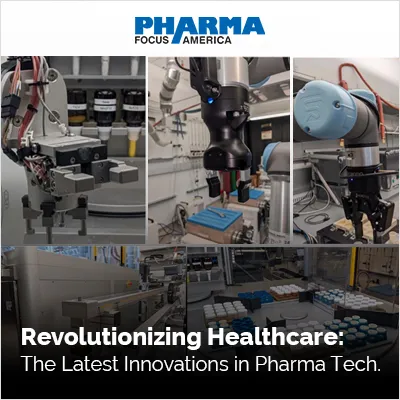
Originally, robotics and automation were applied in manufacturing industries, and they are slowly extending their use in pharmaceutical technologies Pharms use robots for processes that are repetitive thus requiring utmost accuracy to avoid errors. Functioning such as measuring, mixing, and packaging can be efficiently handled by the automated process apart from expediting the production process the costs on production are also decreased.
Apart from manufacturing, robotics is being applied in institutions especially in laboratory where experiments are being conducted, sample analyzed and in the discovery of new drugs. This makes it possible for researchers to perform tasks that require higher skills while robots perform repetitive tasks increasing research and development.
Conclusion:
The advancements in pharma tech are revolutionizing many aspects of the health care industry based on the approaches to treatments, outcome, and delivery. Including precision medicine, AI in drug discovery, wearable devices, 3D printing, gene editing, and blockchain, robotic are some of the examples of technologies that is changing the pharma industry. All of these developments respond to the particular problems in the field of healthcare, including patients’ treatment outcomes and pharmaceuticals creation as well as supply chain risks.
So, with the advancement of pharma tech day by day we will be able to provide better patient care, disease control, and effective management of health care facilities as well. They bring to focus a day that is not too far away when treatment will not only be more efficient but also closer to individual and patient centered resulting in better health of the people.

Kate, Editorial Team at Pharma Focus America, leverages her extensive background in pharmaceutical communication to craft insightful and accessible content. With a passion for translating complex pharmaceutical concepts, Kate contributes to the team's mission of delivering up-to-date and impactful information to the global Pharmaceutical community.