


Strategic Capacity Planning for Biologics and Next-Generation Therapeutics
Lakshmi, Editorial Team, Pharma Focus America
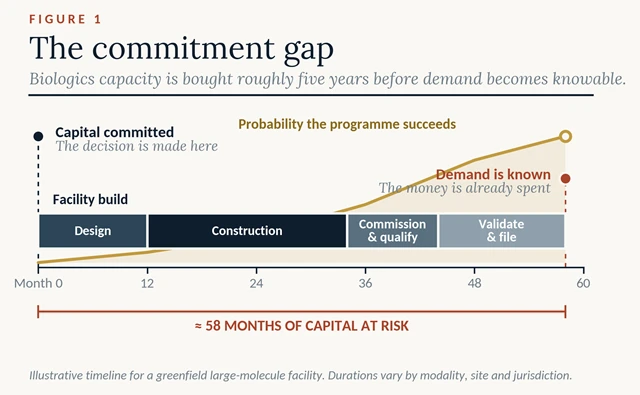
Biologics capacity must be committed roughly five years before demand becomes knowable, and cell and gene therapies invalidate the scale economics that once justified large facilities. This article reframes capacity as a portfolio of real options rather than a forecasting exercise, examines build, buy and borrow trade-offs, presents an anonymised case study, and identifies the qualified-talent constraint that most capital models ignore.
Introduction: The Bet Every Biologics Executive Places Before the Data Arrives
Almost every major decision a pharmaceutical chief executive makes can wait for evidence. Capacity cannot. A large-molecule facility takes somewhere in the region of five years to move from board approval to validated commercial supply, and the capital is committed at the front of that period — at a point when the asset it will serve may still be in mid-stage development, with the majority of its technical and regulatory risk unresolved. By the time demand is genuinely knowable, the concrete has cured, the suites are qualified, and the money is spent.
This is a structural mismatch, not a planning failure, and it is worsening. The industry’s pipeline is shifting toward modalities — bispecifics, antibody-drug conjugates, autologous cell therapies, gene therapies, and increasingly personalised products — whose manufacturing economics do not behave like the monoclonal antibodies on which a generation of capacity doctrine was built. Executives are being asked to apply a planning framework designed for predictable, high-volume, scale-driven production to a portfolio that is none of those things.
The response is not better forecasting. Forecasting accuracy at a five-year horizon has hard limits that no additional analytical rigour will overcome. The response is a different way of holding the decision: treating capacity not as a number to be estimated, but as a portfolio of commitments with deliberately staged reversibility.
Why the Old Biologics Capacity Doctrine No Longer Holds
For two decades, capacity planning in biologics rewarded scale and patience. Titres improved steadily, stainless steel bioreactors grew larger, and cost per gram fell with volume. Building ahead of demand was defensible because a well-designed facility could absorb multiple products across a platform, and unused capacity found a tenant.
Three developments have eroded that logic. Rising titres mean that the same clinical demand now requires materially less installed volume than it did a decade ago — a technical success that quietly stranded capacity built on older assumptions. Single-use and modular systems have lowered the entry threshold, compressing the advantage that came from owning large fixed assets. And the contract manufacturing market has deepened enough that access to capacity is, for many modalities, purchasable rather than proprietary.
The combined effect is that the strategic value of owning capacity has narrowed to specific circumstances: platform products with confirmed multi-asset demand, modalities where process knowledge is itself the competitive asset, and situations where supply resilience carries a premium that a balance sheet can justify. Outside those cases, ownership is increasingly a cost decision dressed as a strategic one.
Scale-Up Versus Scale-Out: How Next-Generation Therapeutics Break the Cost Curve
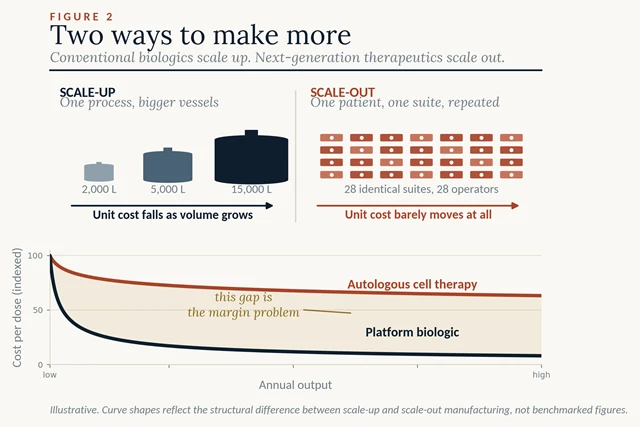
The sharpest discontinuity concerns cell and gene therapies. A conventional biologic scales up: a larger bioreactor produces more doses at a lower unit cost, and installed capacity is meaningfully expressed in litres. An autologous cell therapy scales out. Each patient is a batch. Doubling output means doubling clean room suites, trained operators, batch records, quality oversight, and vein-to-vein logistics. The learning curve flattens quickly, and the cost per dose stubbornly refuses to fall in the way capital committees expect.
This inverts several familiar assumptions. Capacity is measured in patient slots per week rather than volume. The binding constraint is often quality release and qualified staff rather than equipment. And the risk profile changes shape: an underused bioreactor is an inefficiency, whereas an underused cell therapy suite is a fixed cost with almost no alternative use. Allogeneic approaches promise to restore scale economics, but planning a facility today on the assumption that a company’s allogeneic programme will succeed is precisely the kind of bet the commitment gap punishes.
Build, Buy or Borrow: Reframing the Capacity Decision as a Portfolio of Options
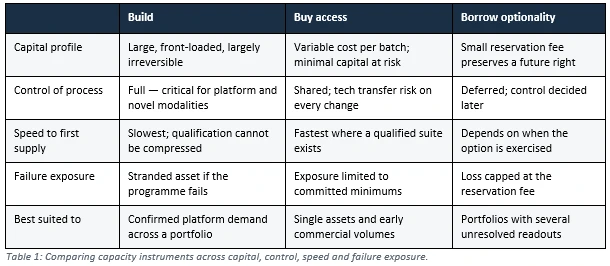
The most useful shift available to a pharmaceutical board is to stop asking how much capacity to build and start asking how much optionality to hold, and at what price. Framed this way, three instruments are available, and mature organisations use all three simultaneously across a portfolio rather than choosing one.
Building purchases control and long-run unit economics at the cost of irreversibility. Buying access through contract manufacturing converts capital into variable cost and speed, at the price of shared control and tech transfer risk on every process change. Borrowing optionality — reserving future slots, negotiating capacity rights contingent on clinical milestones, taking staged commitments on modular trains — buys the right to decide later. The reservation fee looks like waste on a spreadsheet until a Phase III programme fails, at which point it is revealed as the cheapest insurance the company bought that year.
“The reservation fee looks like waste on a spreadsheet until a Phase III programme fails — at which point it is revealed as the cheapest insurance the company bought that year.”
The Resilience Premium: When Domestic Biologics Capacity Is Worth Overpaying For
For a US audience, one further variable now sits inside the capacity equation that a purely financial model will price incorrectly. Policy attention to pharmaceutical supply chain security, procurement preferences favouring domestic manufacture, and heightened scrutiny of foreign contract manufacturing relationships have all made the location of capacity a strategic attribute rather than a logistics detail.
The temptation is to treat this as a compliance overlay — something the government affairs function monitors. That underestimates it. Where a purchaser, whether a federal programme or a large integrated health system, attaches preference or requirement to domestically manufactured supply, geography becomes a determinant of market access. Capacity sited outside that perimeter may be cheaper per gram and still commercially inferior.
The discipline, however, is to name the premium rather than absorb it silently. Boards should be able to state, in dollars, what they are paying for domestic siting and what specific exposure that payment retires: a procurement preference, a single-source dependency on a geopolitically concentrated input, or a regulatory inspection risk. Resilience arguments that cannot be expressed this way tend to expand until they justify every proposal put in front of a capital committee.
The most defensible posture for most mid-sized companies is neither full onshoring nor indifference. It is deliberate dual-sourcing on the inputs and steps that would halt supply entirely, combined with honest acceptance that some concentration risk is uneconomic to remove. Resilience, like capacity itself, is bought in increments and should be justified increment by increment.
Case Study: How One US Biotechnology Company Staged Its Way Out of a Capacity Trap
A US-headquartered mid-cap biotechnology company, with a bispecific antibody and an autologous cell therapy advancing in parallel, had a recent institutional memory of getting this wrong. Several years earlier it had approved a single purpose-built facility sized to its then-lead programme. That programme failed at Phase III. The facility was completed on schedule, was too specialised to repurpose quickly, and ran at a fraction of its design capacity for three years before a partial write-down was taken.
For its next cycle, the company replaced the single-facility decision with three staged commitments. It installed a modular single-use train sized to clinical and early commercial demand only, deliberately under-building against the internal base case. It negotiated reserved commercial capacity with two external manufacturers, structured so that volume commitments stepped up automatically at defined clinical milestones and lapsed for a modest fee if those milestones were missed. And for the cell therapy programme, it deferred any owned suite entirely, running early commercial supply through a qualified external site while its own process was still changing.
Two features of the governance mattered more than the structure. Capacity decisions were moved out of the annual capital cycle and tied instead to data readouts, so commitments were made when information arrived rather than when the budget calendar demanded. And the company began reporting capital at risk against unresolved programmes as a standing board metric, which changed the conversation from how much capacity is needed to how much of this bet is currently unhedged.
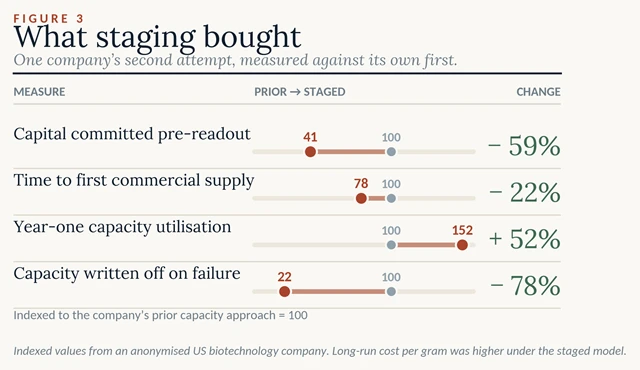
The outcomes, indexed against its prior approach, appear in Figure 3. Capital committed ahead of the pivotal readout fell by close to sixty per cent, first commercial supply arrived roughly a fifth sooner because qualification ran in parallel with external supply rather than after construction, and first-year utilisation of owned capacity rose by half. When one portfolio programme subsequently failed, written-off capacity was a small fraction of the prior episode. Management’s internal assessment was blunt about the trade-off: long-run cost per gram is higher under this model, and that premium is the price of not repeating the earlier mistake.
The Constraint No Capital Model Captures: Qualified People and Qualified Time
Capacity plans are built in square feet, litres and suites. The constraint that most often binds in practice is none of these. It is the availability of people qualified to operate, deviate, investigate and release — and the availability of quality organisation bandwidth to support them.
This is especially acute in next-generation modalities, where the pool of experienced operators is shallow, geographically concentrated, and actively competed for. A facility can be mechanically complete and still not produce releasable material because the trained staff and validated procedures are eighteen months behind the steel. Boards rarely see this, because headcount ramp appears in operating plans while capacity appears in capital plans, and the two are reviewed separately.
The practical correction is unglamorous: model workforce qualification on the same timeline and with the same seriousness as construction, and treat a shortfall in qualified release capacity as a capacity shortfall, because that is exactly what it is. Companies that build talent pipelines in parallel with facilities consistently reach reliable supply sooner than those that treat staffing as a commissioning-phase problem.
Conclusion:
Capacity Strategy as the Discipline of Staying Wrong Cheaply
Strategic capacity planning for biologics and next-generation therapeutics is not, at root, a forecasting problem. Forecasts at a five-year horizon will continue to be wrong, and the modalities entering the pipeline will continue to break the scale assumptions inherited from the monoclonal antibody era. The question worth putting to a management team is not whether the demand estimate is accurate. It is what happens to the capital if it is not.
The organisations handling this well share a recognisable posture. They deliberately under-build against their own base case and purchase optionality for the upside. They tie capacity commitments to data readouts rather than to budget cycles. They hold a genuine portfolio of build, buy and borrow positions rather than defending a single doctrine. And they treat qualified people as installed capacity, because unqualified capacity produces nothing.
None of this eliminates the commitment gap; nothing will. But it changes what the gap costs. The objective is not to be right about demand five years out — an ambition the industry has consistently failed to achieve. It is to be wrong cheaply, repeatedly, and without stranding the capital that the next programme will need.

Lakshmi is a science writer with a foundation in the laboratory. She earned her master's in biotechnology and trained through research internships at ICGEB (JNU) and DIPAS, DRDO, with her work appearing in the Egyptian Journal of Veterinary Sciences. Now APCRM-certified and part of the editorial team at Pharma Focus America and Pharma Focus Europe, she reports on pharmaceutical technology, research, and innovation — giving complex science a clear and confident voice for industry leaders.