Strategic Investments in Continuous Manufacturing for Competitive Advantage
Lakshmi, Editorial Team, Pharma Focus America
Continuous manufacturing has passed the point where pharmaceutical executives can treat it as an engineering experiment. This article examines why the investment case has been persistently mispriced, arguing that the durable returns sit in cycle time, supply resilience and speed to regulatory approval rather than in unit cost. It analyses the shape of the payback curve, the uneven readiness of different dosage forms, the regulatory incentives that remain underused, the data architecture that constitutes the real competitive asset, and the questions an investment committee should put to any proposal before capital is released.
Introduction: The Argument That Stopped Being Theoretical
Continuous manufacturing has been discussed in American pharmaceutical boardrooms for well over a decade, usually as a promising technology that someone else would prove first. That posture is no longer defensible. Commercial approvals covering continuously manufactured products now exist, the regulatory framework has been formalised in international guidance, and a generation of process engineers has been trained on integrated lines rather than on discrete unit operations.
What has not kept pace is the way the investment is justified. Too many business cases still open with a cost-per-unit comparison, which is precisely the metric on which continuous production is least likely to win, and least likely to matter. A modern batch facility running a mature small molecule at high volume is an efficient machine. Displacing it on unit cost alone is a difficult argument and frequently a losing one.
The stronger argument is strategic. Continuous production changes what a manufacturing network can do: how quickly it can convert raw material into released product, how much inventory must sit idle to protect supply, how rapidly a process can move from clinical to commercial scale, and how confidently a company can respond when demand or the supply chain shifts without warning. Those are chief executive concerns, not plant manager concerns, and they are where the capital case should be made.
There is also a policy dimension that has moved from background noise to boardroom agenda. Sustained attention to domestic production of essential medicines, active ingredient concentration in a small number of overseas suppliers, and the shortage episodes that have repeatedly disrupted American hospital supply have made manufacturing location and manufacturing flexibility matters of corporate reputation as well as operational planning. Continuous production is directly relevant to that conversation, because its smaller footprint and lower labour intensity narrow the cost penalty historically associated with producing domestically. An investment case built only on internal economics misses the part of the argument that boards now find most persuasive.
Why the Business Case Was Mispriced from the Start
Consider what an integrated continuous line actually compresses. The interval between raw material receipt and released product contracts from weeks to days, because material moves through the process rather than waiting in quarantine between discrete steps. Work-in-progress inventory falls correspondingly. Scale-up largely disappears as a distinct exercise, since increased output is achieved by running longer rather than by requalifying a larger vessel. Process variability narrows because the system is under continuous instrumented control rather than sampled after the fact.
Each of these translates into a financial effect that rarely appears in a cost-per-tablet model. Shorter cycle time releases working capital. Reduced scale-up requalification shortens time to market for a follow-on product. Narrower variability reduces the probability of the deviation investigation that quietly consumes quality resources and delays supply. None of these show up in a comparison of conversion cost per unit, which is why that comparison keeps producing the wrong answer.
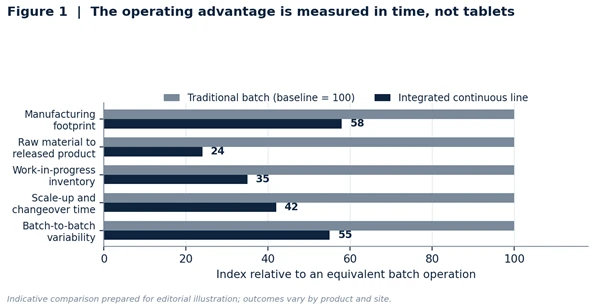
Figure 1: Against an equivalent batch operation, the advantages of an integrated continuous line concentrate in time, inventory and variability rather than in nominal output cost.
Reading the Payback Curve Honestly
Advocacy inside a company tends to fail for a predictable reason: the curve is uncomfortable before it is attractive. Continuous investment front-loads capital, then adds a second trough as process characterisation, control-strategy development and validation consume resource before a single commercial batch is released. Incremental batch expansion, by contrast, is cheaper, faster and demonstrably safe. Judged over a three-year horizon, batch usually wins.
Judged over eight, it usually does not. The crossover typically arrives somewhere in the fourth or fifth year, after which the operating advantage compounds while the batch alternative merely persists. The strategic question, therefore, is not really about technology. It is about whether the organisation's planning horizon and executive incentive structure can accommodate a return profile that looks poor precisely during the period when its sponsors are being evaluated.
Boards that want this investment to succeed should say so explicitly in how they govern it. That means ring-fencing the programme from annual cost-reduction targets during the validation years, defining milestones in terms of control-strategy maturity rather than output, and accepting that the first line will be slower and more expensive than the second.
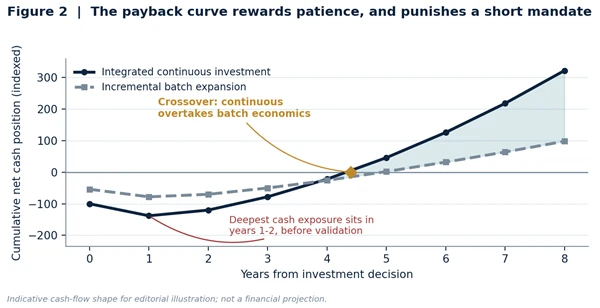
Figure 2: The characteristic shape of the continuous investment case — deeper early exposure, later crossover, and a materially steeper trajectory thereafter.
Judged over three years, batch usually wins. Judged over eight, it usually does not. The real question is which horizon governs the decision.
Not Every Molecule Deserves a Continuous Line
The most credible executives on this subject are the ones prepared to say where continuous production does not belong. Oral solid dosage is comfortably the most mature application, with commercial precedent, established equipment platforms and a regulatory pathway that is now well travelled. Small-molecule drug substance is close behind, particularly where flow chemistry improves the handling of hazardous intermediates.
Biologics occupy a more nuanced position. Perfusion-based drug substance production has strong momentum and a compelling case where facility footprint and titre economics matter. Continuous or connected downstream processing is advancing but remains harder to close as an integrated system. Sterile fill and finish and personalised advanced therapies sit further out, constrained less by ambition than by the physics of the products themselves.
The practical implication is that continuous manufacturing should be evaluated as a portfolio decision, not a plant decision. The right question is not whether the company should adopt continuous production, but which three products justify it, and whether those products will still be commercially significant when the line reaches its productive years.
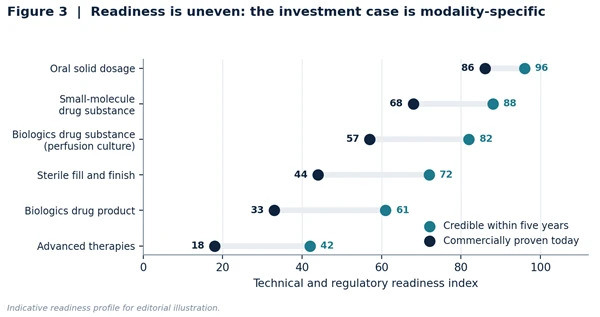
Figure 3: Readiness varies sharply by modality; a portfolio-level assessment prevents a technically sound investment from being attached to the wrong product.
The Regulatory Tailwind Executives Are Underusing
Regulatory conservatism is the reason most often given for delay, and it is increasingly out of date. American regulators have actively encouraged continuous adoption, published dedicated guidance, established an internal advisory capability for emerging technology, and accepted the international harmonised standard that now governs continuous manufacture of drug substances and drug products.
The practical advantage available here is timing. Early engagement with the agency, before the control strategy is frozen, converts regulatory risk from an unquantified threat into a managed workstream. Companies that have done this describe review interactions that are demanding but predictable. Companies that have not tend to discover their control strategy assumptions late, when redesign is expensive.
There is a related opportunity that receives too little executive attention. Real-time release testing, where the process data itself supports the release decision, removes a substantial waiting period from every batch. It requires a level of analytical and statistical rigour that many organisations underestimate, but the payoff is a supply chain that responds in days rather than weeks.
Case Study: The Retrofit That Bought Back Eighteen Months
Consider a mid-sized American manufacturer with a high-volume oral solid product and a second-generation formulation approaching pivotal trials. Two constraints defined the decision. The existing batch train had no spare capacity for the new presentation, and a single-source intermediate supplier had already caused one near-miss on supply continuity.
A greenfield batch expansion was costed and rejected, not on price but on schedule: qualified output would arrive after the anticipated launch window. The alternative selected was a continuous line installed inside an existing shell, sized for the new formulation and specified so that the legacy product could be transferred later if the economics justified it.
Three results shaped how the company now evaluates capital. The compressed cycle time cut finished goods inventory by roughly half, releasing working capital that offset a meaningful share of the incremental capital cost. Because scale-up between clinical and commercial supply was eliminated, the launch schedule pulled forward by close to eighteen months against the batch alternative. Least anticipated, the continuous line proved to be the more flexible asset during a subsequent raw material disruption, because output could be throttled rather than committed in fixed batch increments. The investment was approved as a capacity project; it has been defended since as a resilience project.
The Data Architecture Is the Real Asset
A continuous line generates an uninterrupted stream of process data, and that stream is where the durable competitive advantage accumulates. Equipment can be purchased by any competitor with a balance sheet. A validated control model, a residence time distribution characterised across years of operation, and a historian containing every deviation the process has ever produced cannot be purchased at all.
This has consequences that reach well beyond the plant. Data must be captured in a form that is queryable rather than merely archived, governed to a standard that survives inspection, and connected to quality systems so that a signal becomes an action rather than a report. Organisations that treat the control system as an engineering deliverable rather than an enterprise asset consistently find, three years later, that they own an efficient line and very little institutional knowledge about it.
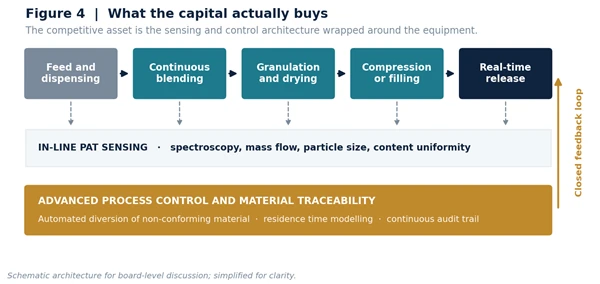
Figure 4: The equipment is the visible part of the investment; the sensing, control and traceability architecture wrapped around it is the part competitors cannot replicate quickly.
The Constraint on the Plant Floor
Continuous operation asks something different of the workforce. A batch operator executes a defined sequence; a continuous operator supervises a system, interprets trend data and intervenes before a drift becomes a deviation. That is a different skill set, and in most American manufacturing regions it is genuinely scarce.
The organisations managing this well have stopped treating training as a commissioning activity. They rotate operators through process development, they run simulated upset scenarios, and they involve quality personnel in control-strategy design rather than presenting it to them for approval. Attrition among trained continuous operators should be tracked at executive level, because it is a leading indicator of the operational reliability on which the entire investment case depends.
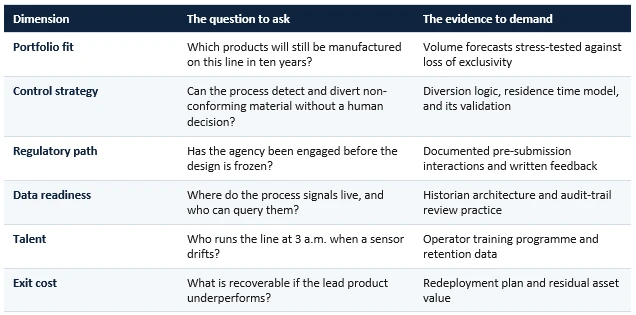
The Investment Committee's Six Questions
Capital proposals for continuous manufacturing tend to be technically dense and strategically thin. The following questions have proved more effective than a detailed engineering review at separating a serious proposal from an enthusiastic one.
Conclusion: Buying Optionality, Not Just Output
Continuous manufacturing is best understood as the purchase of optionality in a business that has learned, repeatedly and expensively, what rigidity costs. It shortens the distance between decision and supply, compresses the interval between a clinical result and a commercial launch, and converts a manufacturing network from a fixed constraint into a variable one. Companies that continue to evaluate it on conversion cost will keep concluding, correctly and irrelevantly, that batch is cheaper. Those that evaluate it on time, resilience and regulatory speed will hold an advantage their competitors cannot install quickly.

Lakshmi is a science writer with a foundation in the laboratory. She earned her master's in biotechnology and trained through research internships at ICGEB (JNU) and DIPAS, DRDO, with her work appearing in the Egyptian Journal of Veterinary Sciences. Now APCRM-certified and part of the editorial team at Pharma Focus America and Pharma Focus Europe, she reports on pharmaceutical technology, research, and innovation — giving complex science a clear and confident voice for industry leaders.