The Commercial Future of Personalized mRNA Cancer Vaccines
Lakshmi, Editorial Team, Pharma Focus America
Personalized mRNA cancer vaccines are approaching the point at which their future will be decided by commercial architecture rather than immunology. Manufacturing a distinct medicine for every patient dismantles assumptions about scale, pricing and distribution that the industry has relied on for a century. This article examines the turnaround clock, cost structure, reimbursement design and site-of-care economics that will determine whether individualized cancer vaccines become a durable American market.
Introduction:
When Every Dose of an mRNA Cancer Vaccine Carries a Patient’s Name
There is no such thing as a batch in this therapeutic class. An individualized neoantigen vaccine begins with a fragment of one patient’s resected tumor, is designed against mutations that exist nowhere else, and is manufactured, released and shipped for a single person who is already on the calendar to receive it. The dose cannot be forecast, stockpiled, substituted or resold. If it arrives late, it has partially failed; if it fails release, there is no second unit on the shelf.
Randomized data in resected melanoma has already shown that an individualized mRNA vaccine paired with checkpoint blockade can extend recurrence-free survival, and larger trials across lung, kidney, bladder and pancreatic cancer are now reading out on that thesis. American executives should assume the science will continue to advance. The strategic question is different and considerably less comfortable: whether commercial infrastructure in the United States can deliver a bespoke biologic to tens of thousands of patients a year, at a cost and cadence that oncology practices and payers will accept.
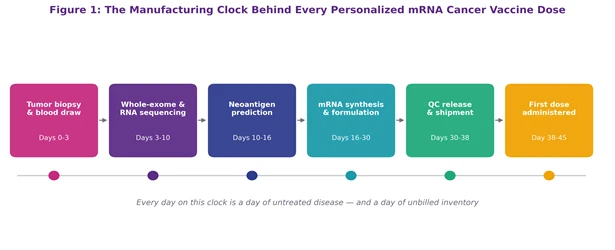
Figure 1: From biopsy to first dose, the manufacturing clock runs while the patient waits.
Batch Size of One: How Personalized mRNA Cancer Vaccines Break Pharma’s Oldest Assumption
Every commercial model in the industry rests on the separation of production from demand. Product is made in advance, held as inventory, and drawn down as prescriptions arrive. Personalized mRNA vaccines invert that relationship completely. Demand creates the product, and it does so patient by patient, with a manufacturing order triggered by a surgical procedure rather than by a sales forecast.
The consequences reach into functions that rarely think of themselves as manufacturing-dependent. Capacity planning becomes a question of parallel production slots rather than annual tonnage. Gross margin stops improving with volume in the familiar way, because a substantial share of the cost is incurred separately for every patient. Commercial forecasting shifts from prescription share to procedural volume: how many eligible resections occur, in which institutions, and how many of those tumors yield sequenceable tissue.
This is closer to the economics of cell therapy than to those of a conventional biologic, but with an important difference. Autologous cell therapies are administered at a small number of certified centers to patients with advanced disease. An adjuvant cancer vaccine is aimed at patients who have just had surgery, are otherwise well, and are treated across a far wider and more dispersed network of American oncology practices.
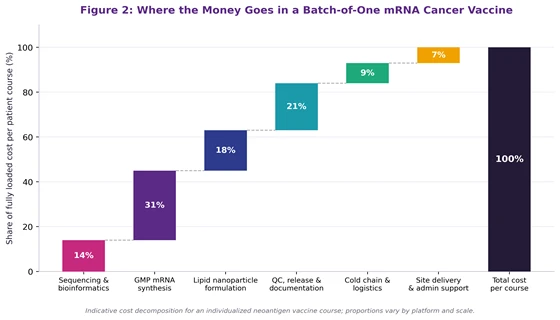
Figure 2: Cost accrues per patient, not per batch — which is why scale alone does not rescue the margin.
The Forty-Day Clock: Why Turnaround Time Is the Real Product
For an individualized vaccine, turnaround time is not an operational metric. It is a clinical variable, a commercial differentiator and, ultimately, the product specification that matters most. Time from tissue collection to first dose determines whether a patient can be treated within the window in which micrometastatic disease is most vulnerable, and whether the therapy fits alongside the standard adjuvant regimen rather than competing with it.
It also determines the shape of the business. A shorter clock means fewer patients lost between consent and administration, less inventory value sitting in process, and a smaller manufacturing footprint required to serve the same population. Each week removed from the cycle improves conversion, capital efficiency and the clinical proposition simultaneously — a rare alignment, and one that argues for treating cycle-time reduction as a strategic program with executive ownership rather than as a continuous improvement exercise inside operations.
The molecule is no longer the asset. The network that can design, build, release and deliver it in thirty days is.
Follow the Biopsy: Diagnostics Decide Who Ever Reaches a Personalized mRNA Vaccine
The commercial funnel for these therapies begins in the operating room and the pathology laboratory, long before an oncologist writes anything. Tissue must be collected in sufficient quantity and quality, handled to preserve nucleic acid integrity, sequenced, and analyzed to predict which mutations will generate a usable immune target. Every one of those steps is a point of attrition, and most of them sit outside the manufacturer’s direct control.
American health systems vary widely in how they handle resected tissue. Some route specimens through molecular pathology as a matter of routine; others fix and archive tissue in ways that make downstream sequencing marginal. A commercial strategy that assumes the biopsy will simply be available is a strategy that will discover its real conversion rate the hard way. The organizations positioned to win in this space are those investing in surgical and pathology workflow support with the same seriousness that earlier generations invested in the sales call.
Minimal residual disease testing adds another dimension. As circulating tumor DNA assays become embedded in adjuvant decision-making, they offer a way to identify precisely the patients whose recurrence risk justifies a personalized vaccine. That convergence is strategically significant: it narrows the treated population, strengthens the value argument, and makes the diagnostic partner an unavoidable participant in the commercial model.
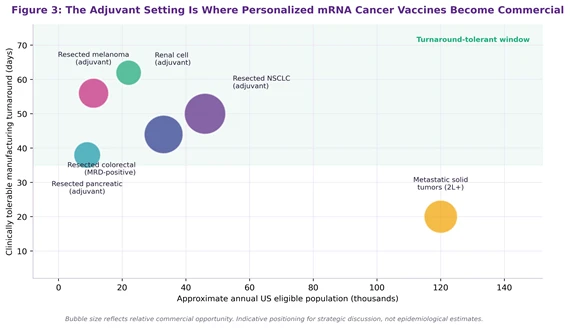
Figure 3: Adjuvant settings combine meaningful patient volume with tolerance for a manufacturing wait.
Who Pays for a Medicine Made for One Person? US Reimbursement for Individualized Vaccines
American reimbursement infrastructure was built to pay for products, not for processes executed on behalf of an individual. A personalized vaccine sits awkwardly across that divide: part biologic, part diagnostic service, part logistics operation. Coding, benefit categorization and site-of-care determination all become live commercial questions rather than administrative ones, and the answers materially change which practices can afford to offer the therapy.
Community oncology, which treats the majority of American cancer patients, operates on buy-and-bill economics with thin margins and real working-capital exposure. A practice asked to acquire a high-cost, patient-specific product that cannot be returned or reassigned is carrying a risk it has never carried before. Manufacturers that solve this — through consignment models, direct billing arrangements, or replacement guarantees when a patient becomes ineligible before dosing — will reach a materially larger share of the eligible population than those that do not.
Payers, for their part, will scrutinize the adjuvant proposition closely, because it involves treating patients who currently have no detectable disease. Outcomes-based contracting is likely to feature heavily, and durable recurrence-free survival will be the evidence that matters. Building the data infrastructure to support those agreements should begin during pivotal trials, not after approval.
The Adjuvant Prize: Where the Commercial Value of mRNA Cancer Vaccines Actually Sits
The instinct to launch in advanced disease, where unmet need is greatest and trials are fastest, works against this modality. Patients with progressing metastatic cancer often cannot wait five or six weeks for a manufactured dose, and their disease may evolve away from the targets selected at biopsy. The adjuvant setting is the natural commercial home: patients are clinically stable after surgery, the treatment window is defined, and the population is large enough to support a real market.
That reframing carries strategic implications. Adjuvant use means longer trials, harder endpoints and a heavier burden of proof on duration of benefit. It also means competing for a place in a treatment sequence already occupied by checkpoint inhibitors and targeted agents, which makes combination positioning and payer economics inseparable from clinical design.
Case Study: What One American Cancer Network Learned Preparing for Personalized Vaccine Delivery
The operational reality is best illustrated by a composite drawn from the experience of large multi-site oncology networks in the United States that have participated in individualized vaccine trials. One such network, spanning an academic hub and eleven community sites, set out to prepare for routine delivery of a personalized mRNA vaccine in resected disease and treated the effort as a supply chain project rather than a clinical one.
The first audit was sobering. Roughly a third of resected tumor specimens submitted in an initial cohort proved unsuitable for sequencing, largely because of fixation practices optimized for histology rather than molecular analysis. Median time from surgery to specimen shipment was eleven days, most of it spent waiting for a pathology sign-off that no one had identified as rate-limiting. Financial clearance and scheduling ran sequentially after manufacturing had already begun, so patients occasionally reached the point of dosing without authorization in place.
The redesign addressed workflow rather than technology. Surgical teams adopted a dedicated collection protocol with a defined tissue allocation for molecular use. A single coordinator was made accountable for the interval between operation and shipment. Financial clearance was moved to run in parallel with manufacturing rather than after it, and community sites were given a standardized cold-chain receipt and thaw procedure so that dosing was not concentrated at the academic center.
Within four quarters, specimen failure fell from roughly a third to under one in ten, surgery-to-shipment time dropped to three days, and the share of patients who began treatment after consent rose substantially. Notably, the network reported that the largest single gain came not from any technical intervention but from making one person accountable for a handoff that had previously belonged to no one. For manufacturers, the lesson is that commercial performance in this class is decided inside institutional workflow, and that field investment should be directed accordingly.
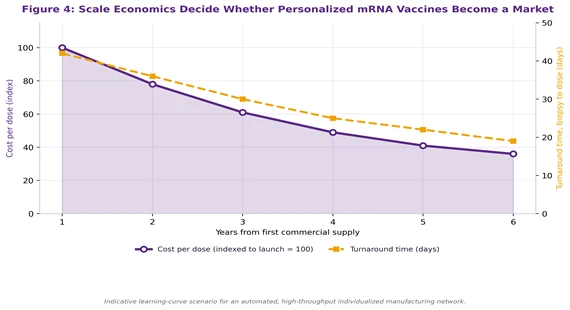
Figure 4: Cost and cycle time fall together as individualized manufacturing networks mature.
Building the Commercial Operating Model for Personalized mRNA Cancer Vaccines
A conventional launch organization is poorly shaped for this work. What the modality requires looks less like a sales force and more like an orchestration layer: a system that connects surgical scheduling, pathology, sequencing, manufacturing slots, payer authorization and infusion appointments into a single tracked pathway with a named owner at every handoff. The commercial asset is that system, and it is far harder to replicate than a molecule.
Three executive decisions follow from this. The first concerns manufacturing footprint: whether to centralize for control and cost or distribute for speed and resilience, a choice with a decade-long capital horizon. The second concerns partnerships, since sequencing capacity and diagnostic reach are unlikely to be built internally at the pace the market will demand. The third concerns talent, because the skills that determine success here — logistics engineering, clinical operations design, health-system workflow expertise — are not the skills most commercial organizations currently reward.
Conclusion:
The Commercial Future Belongs to the Best-Run Pipeline
Personalized mRNA cancer vaccines will not succeed or fail on immunogenicity. They will succeed if a tumor removed on a Tuesday in a community hospital can be sequenced, designed against, manufactured, released and administered inside a window that keeps the patient’s clinical opportunity open — reliably, thousands of times a year, at a cost the American system will absorb.
For senior leaders, that reframes where advantage is created. The differentiating investments are in cycle time, diagnostic access, payer architecture and institutional workflow, and they must be made years before approval, when they still look like operational overhead rather than commercial strategy. The organizations that treat individualized manufacturing as a capability to be built rather than a constraint to be managed will define this category. The rest will hold impressive clinical data and no reliable way to deliver on it.

Lakshmi is a science writer with a foundation in the laboratory. She earned her master's in biotechnology and trained through research internships at ICGEB (JNU) and DIPAS, DRDO, with her work appearing in the Egyptian Journal of Veterinary Sciences. Now APCRM-certified and part of the editorial team at Pharma Focus America and Pharma Focus Europe, she reports on pharmaceutical technology, research, and innovation — giving complex science a clear and confident voice for industry leaders.