


The Evolution of Sterile API Manufacturing for Advanced Injectable Therapies
Lakshmi, Editorial Team, Pharma Focus America
Sterile active pharmaceutical ingredient manufacturing has become the quiet constraint on America's most valuable injectables. Antibody-drug conjugate payloads, peptides at metabolic-disease scale and long-acting suspensions demand containment and sterility in the same suite, a combination legacy plants were never designed to deliver. This article traces how sterile API process design evolved, why US injectable supply fragility begins upstream, and which capacity decisions American boards face now.
Introduction:
The Bottleneck Nobody Toured: Sterile API Manufacturing Moves to the Boardroom
Almost every conversation about US injectable capacity is a conversation about fill-finish. Lines, isolators, vials, prefilled syringes, robotic filling: that is where the investment announcements and the plant tours happen. The step immediately upstream attracts far less executive attention, and it is increasingly where programs stall. Sterile active pharmaceutical ingredient manufacturing, the production of a drug substance that is itself sterile before it ever reaches a filling line, has quietly become a gating capability for the most valuable therapies in the American pipeline.
Two forces converged to put it there. Pipelines shifted toward molecules that cannot tolerate terminal sterilization and, in several formats, cannot be sterile filtered as a finished product at all. At the same time, US injectable supply demonstrated how little slack the system carries. The American Society of Health-System Pharmacists counted 227 active national shortages in the second quarter of 2026, a third consecutive quarterly increase, while FDA reported 93 ongoing shortages at the close of 2025. Injectables have long been overrepresented in those counts: among drugs that entered shortage between 2013 and 2017, 63 percent were administered by injection.
For chief executives and their boards, sterile API is where product strategy, manufacturing risk and capital allocation meet. It is also where the answer takes four years to arrive.
Three Molecules That Rewrote the Rulebook for Sterile API Manufacturing
The first is the antibody-drug conjugate and its relatives. Cytotoxic payloads sit at the most stringent end of occupational exposure banding, and as payload potency has increased the industry has moved deeper into the highest containment bands. Volumes are counterintuitive: a successful conjugate may require only a few kilograms of payload a year, while a targeted protein degrader can demand hundreds or thousands. Capacity planning for this class has almost nothing in common with traditional API scheduling.
The second is peptides. Metabolic-disease demand has pushed synthetic peptide manufacturing to volumes the sector has never attempted, and the sterile finishing steps, isolation, drying and packaging under aseptic conditions, scale far less gracefully than synthesis does.
The third is the growing family of suspensions, crystalline depots, lipid nanoparticle systems and other complex parenterals. Here the constraint is physical rather than chemical. Because the finished product cannot pass through a sterilizing filter, sterility has to be established in the drug substance and then preserved through crystallization, drying, milling and packaging. The API is no longer an input to a sterile process; it is the sterile process.
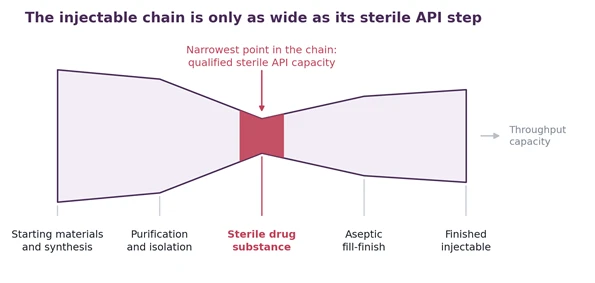
Figure 1: Capacity across the injectable value chain, and where it narrows.
Sealed, Not Swept: Sterile API Processes Leave the Cleanroom Era Behind
The classical route for sterile bulk API is familiar: dissolve, sterile filter, crystallize, isolate, dry, mill and pack, with every operation after filtration performed in an ISO 5 environment. What has changed is not the sequence but the philosophy behind it.
Open transfers have given way to closed systems. Filter-dryers that sterilize in place allow isolation and drying without breaking containment. Aseptic crystallization is now controlled as a quality-determining step rather than a purification convenience, because particle size distribution and polymorphic form dictate what the downstream formulation can do. Bulk lyophilization has expanded for heat-labile molecules that cannot be crystallized at all. Milling, historically the operation most likely to reintroduce contamination, has moved inside classified isolators. Single-use assemblies and rapid transfer ports have replaced manual charging wherever the chemistry permits.
The underlying shift is that sterility is now engineered into a closed process rather than defended at the boundary of a cleanroom. That reframing matters commercially, because it changes what a facility can be retrofitted to do and what has to be purpose-built.
Two Masters, One Suite: The Containment Bind in Potent Sterile API
The hardest engineering problem in this field is that its two requirements pull in opposite directions. Aseptic processing protects the product and favors positive pressure with unidirectional airflow outward from the critical zone. Potent compound handling protects the operator and the environment, and favors containment that pulls inward. A suite that must do both cannot simply pick one.
Reconciling them means cascading pressure regimes, isolators engineered for containment and aseptic integrity at once, split butterfly valves and closed charging systems, validated decontamination cycles that work on both microbial and chemical residues, and increasingly gloveless or robotic handling to remove the operator from the critical zone. Cleaning validation becomes materially harder, since acceptance limits driven by payload potency sit orders of magnitude below traditional thresholds while endotoxin control still applies. Even environmental monitoring becomes a design problem, because sampling a contained isolator without compromising either containment or sterility requires planning at the drawing stage rather than the qualification stage.
This is the practical reason why headline capacity numbers mislead. Sterile API capacity is heavily segmented, and a suite qualified for a peptide cannot necessarily accept a cytotoxic payload.
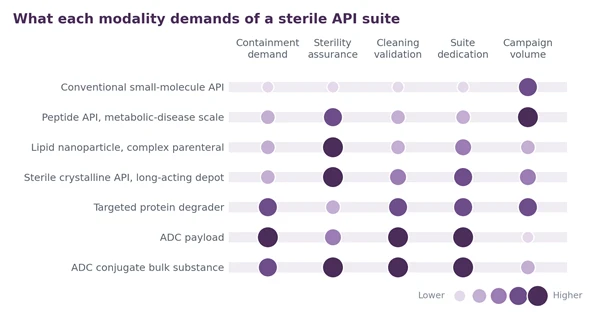
Figure 2: How the demands placed on a sterile API suite differ by molecule class.
Sterile API capacity is a call option on a launch, on a supply interruption and on a competitor's failure. Judged as a plant, it will usually look underused.
The Shortage Nobody Traces: Injectable Supply Breaks at the Drug Substance
Shortage analysis in the United States generally stops at the finished dose, which is where the data is cleanest and the conclusions are least useful. Sole-source dependency accounted for 48 percent of new shortages in 2026, and that dependency frequently extends further back than the finished-product label suggests: several nominally independent suppliers can rely on a single qualified sterile API source, which makes apparent redundancy a statistical illusion.
The economics reinforce the fragility. Generic sterile injectables carry margins thin enough to discourage investment in redundancy, second sources and quality system maturity, so a single site disruption propagates through the market rather than being absorbed by it. The same logic applies in reverse at the innovative end of the portfolio: an advanced injectable with one qualified drug substance suite anywhere in the world carries a launch risk that rarely appears in a commercial forecast.
The executive action here is unglamorous. Supply chain mapping needs to run to the drug substance and its critical starting materials, dual qualification needs a budget line rather than an aspiration, and inventory strategy needs to reflect how long a sterile API requalification actually takes.
FDA Has Opened a Door for Sterile API Innovation. Almost Nobody Has Walked Through It
American regulators have built a pathway for exactly this kind of modernization, and it explicitly covers active ingredients as well as finished drugs and biologics. The Advanced Manufacturing Technologies Designation Program, created by section 506L of the Federal Food, Drug, and Cosmetic Act under the 2022 Food and Drug Omnibus Reform Act, was finalized in guidance issued at the end of 2024. It offers early engagement and the ability to rely on designated technology across applications.
Uptake tells a more sobering story. As of October 16, 2025, FDA had received 18 designation requests and granted three, with nine under active review. The biologics center received 13 requests and granted all three designations, averaging 157 days to a determination; the drugs center received five and granted none, averaging 179 days against a 180-day statutory limit. The stated reasons for refusal are instructive for anyone preparing a submission: incomplete data packages lacking critical quality attributes or at-scale quality data, unsubstantiated claims of process or supply improvement, and insufficient novelty relative to existing industry practice.
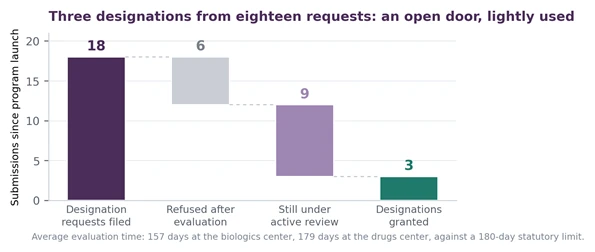
Figure 3: What has happened to Advanced Manufacturing Technologies designation requests.
The lesson for executives is that the constraint is evidence rather than technology. A company that cannot demonstrate at-scale quality data for its closed sterile process will not convert an engineering advance into a regulatory one. For sites that also supply Europe, the contamination control strategy expected under the revised Annex 1 raises the documentation bar again.
Case in Point: The Sterile API Plant That Bought Capacity Without Pouring Concrete
The pattern is best conveyed through a composite of American programs of this type rather than a single named site. Consider a mid-sized manufacturer supplying a sterile crystalline drug substance for a long-acting injectable, operating a conventional suite with manual isolation, tray drying and open transfer into a milling room.
Its problem was not capacity on paper. It was variability. Environmental monitoring excursions clustered around manual transfer steps, a media fill investigation had suspended production for several weeks, and rejected batches were concentrated in the operations where product was exposed. The instinctive response, a larger cleanroom, would have taken years and addressed none of it.
The chosen path was to remove exposure rather than expand the space around it. A closed filter-dryer with sterilization in place replaced the isolation and drying sequence. Milling and packaging moved into a classified isolator with rapid transfer ports. Process analytical measurement was added at the crystallization endpoint so particle size was controlled rather than inspected after the fact. Excursions fell sharply because the operations that generated them no longer existed, and the released capacity came from higher first-pass yield rather than new square footage. The strategic lesson is that in sterile API, the cheapest capacity is usually the batch you stop losing.
Four Years and One Signature: The Capital Clock on Sterile API Capacity
Sterile drug substance capacity is expensive, specialized and slow to create. A realistic sequence from investment decision to commercial supply runs beyond three years once design, construction, qualification, aseptic process simulation, process validation and regulatory review are counted honestly. A decision deferred this year is a supply position surrendered at the end of the decade.
Three postures are available, and most portfolios need more than one. Building dedicated internal capacity makes sense where a molecule is strategically central and the containment profile is unusual. Reserving dedicated capacity with a partner has become more common as scarcity has pushed contract manufacturing toward capacity reservation and dedicated-suite pricing rather than fee-for-service. Dual sourcing costs more per kilogram and is justified by the value of the product it protects, not by unit economics.
The framing that works at board level is optionality rather than utilization. Sterile API capacity is a call option on a launch, on a supply interruption and on a competitor's failure. Judged as a plant, it will usually look underused. Judged against the revenue that cannot be recognized without it, the comparison is rarely close.
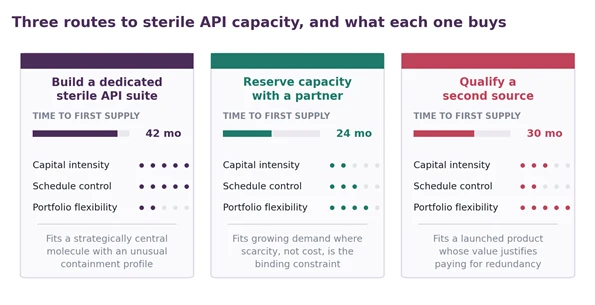
Figure 4: Three ways to secure sterile API capacity, compared on time, capital and control.
Conclusion: Sterile API Mastery Is America's Next Injectable Advantage
The therapies driving American pharmaceutical growth are increasingly injectable, increasingly potent and increasingly dependent on a drug substance that must arrive sterile. That makes sterile API capability a strategic asset rather than a technical service, and it makes the sophistication of a company's containment and closed-process engineering a genuine competitive variable.
The conditions are unusually favorable for moving now. A federal designation pathway exists and covers active ingredients directly, yet remains lightly used, which means early and well-evidenced submissions are meeting an agency with capacity to engage. Shortage pressure has made supply resilience a subject that regulators, payers and health systems all want to discuss. And the engineering has matured to the point where closed, contained, aseptic drug substance processing is a design choice rather than a research project.
What remains is the decision itself, taken with an accurate view of how long it takes to reach first commercial supply. In sterile API manufacturing, the companies that will be supplying the advanced injectables of 2030 are the ones drawing up their basis of design this year.

Lakshmi is a science writer with a foundation in the laboratory. She earned her master's in biotechnology and trained through research internships at ICGEB (JNU) and DIPAS, DRDO, with her work appearing in the Egyptian Journal of Veterinary Sciences. Now APCRM-certified and part of the editorial team at Pharma Focus America and Pharma Focus Europe, she reports on pharmaceutical technology, research, and innovation — giving complex science a clear and confident voice for industry leaders.