


The Future of mRNA Therapeutics: From Rare Diseases to Chronic Conditions
Lakshmi, Editorial Team, Pharma Focus America
mRNA therapeutics are moving beyond vaccines into intracellular protein replacement, in vivo cell engineering and chronic disease management. The clinical proof now exists, but so does an unusual American paradox: federal support for mRNA has narrowed while the platform's therapeutic value has widened. This article examines what US pharmaceutical leadership must decide about mRNA as it crosses from rare disease into chronic conditions.
What Are mRNA Therapeutics, and Why American Pharma Is Rethinking the Platform
An mRNA therapeutic delivers a synthetic messenger RNA sequence into a patient's cells so that the body itself manufactures a specific protein. In a vaccine that protein is an antigen and the goal is an immune response. In a therapeutic the protein is something the patient cannot make enough of, or a receptor that reprogrammes a cell, and the immune response is the problem rather than the point. Same molecule class, same lipid nanoparticle delivery, entirely different commercial proposition.
That distinction is the most underappreciated fact in the American mRNA market today. Public conversation still treats mRNA as a vaccine technology, and US federal policy has moved accordingly. Meanwhile the platform has produced its first clinical evidence of repeat systemic dosing to replace a missing human enzyme, and has become the leading route to in vivo cell engineering. The scientific centre of gravity has shifted from prophylaxis to chronic therapy while the political conversation stayed where it was in 2021.
For US pharmaceutical executives, the strategic question is no longer whether mRNA works. It is whether an organisation can build a therapeutics franchise on a platform whose reputation, reimbursement logic and federal funding environment were all shaped by a product category it is now leaving behind.
From Vaccines to Chronic Therapy: How the mRNA Platform Changes When Dosing Never Stops
The mRNA application spectrum runs from single-exposure prophylaxis to lifelong administration, and almost every commercially relevant parameter changes along the way. A vaccine is engineered to provoke innate immune activation. A chronic therapeutic must be engineered to avoid it, because a patient receiving infusions every few weeks for decades cannot tolerate the reactogenicity that a two-dose vaccine series makes acceptable. Delivery changes too: intramuscular injection into muscle and draining lymph nodes is a fundamentally easier problem than repeatedly reaching a specific cell population elsewhere in the body.
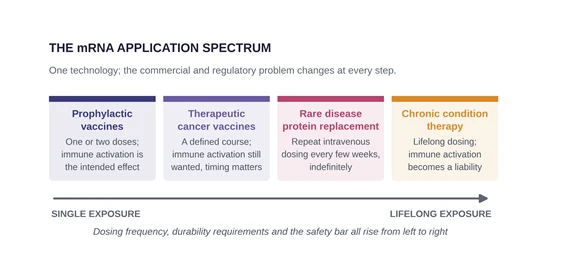
Figure 1: The mRNA application spectrum. One platform, four very different commercial and regulatory problems.
Durability is the third axis. mRNA produces transient protein expression, which is an advantage for a vaccine and a constraint for protein replacement. It sets an unavoidable dosing frequency, and dosing frequency sets the cost of goods, the infusion infrastructure burden and ultimately the payer conversation. Every element of an mRNA therapeutic business case flows from how often the patient must be dosed.
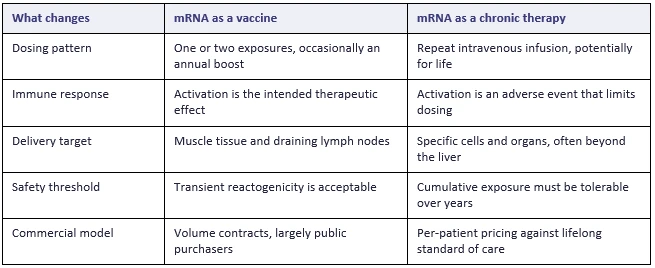
Table 1: What changes when mRNA moves from a vaccine to a chronic therapeutic.
The US Policy Split: Federal Retreat From mRNA Vaccines, Private Momentum in mRNA Therapeutics
In August 2025, the Department of Health and Human Services announced a coordinated wind-down of mRNA vaccine development under the Biomedical Advanced Research and Development Authority, terminating 22 projects worth approximately $500 million and directing the associated venture fund to cease mRNA-based equity investments. The stated rationale was that the data did not support the platform's effectiveness against upper respiratory infections and that funding would move toward alternative vaccine technologies. Prominent RNA scientists and former agency officials publicly disputed that assessment and warned of a loss of American competitive position in biotechnology. In February 2026 the FDA initially declined to review an mRNA influenza vaccine application over trial design, then reversed the decision two weeks later.
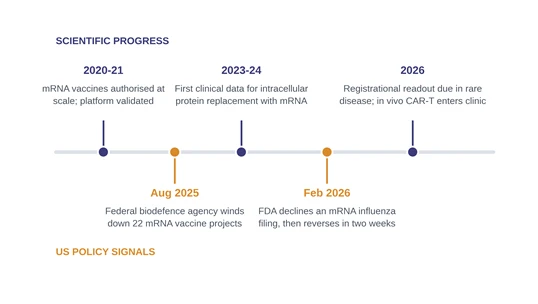
Figure 2: Scientific progress and US policy signals for mRNA have diverged since 2020.
Executives should read the scope of these actions carefully, because it is narrower than the headlines suggest. The federal wind-down targeted prophylactic vaccine development contracts within a biodefence procurement agency. It did not restrict mRNA protein replacement therapy, mRNA oncology programmes, or in vivo cell engineering, none of which depend on that funding channel. The practical consequence is a repricing of risk rather than a closure of the field: capital and government partnership have become harder to secure for mRNA vaccines in the United States, while the therapeutic applications continue on private and venture funding.
The political conversation is about a product category the platform is already leaving. Companies that conflate the two will misprice one of the most valuable assets on their balance sheet.
mRNA Case Study: The First Clinical Proof That mRNA Can Replace a Missing Human Enzyme
The pivotal evidence came from a first-in-human phase 1/2 study in propionic acidaemia, a rare inherited metabolic disorder in which a deficient enzyme allows toxic metabolites to accumulate, producing life-threatening metabolic decompensation events. There is no approved therapy. The investigational product was a dual mRNA therapy encoding both subunits of the missing enzyme, delivered by lipid nanoparticle and administered by repeat intravenous infusion.
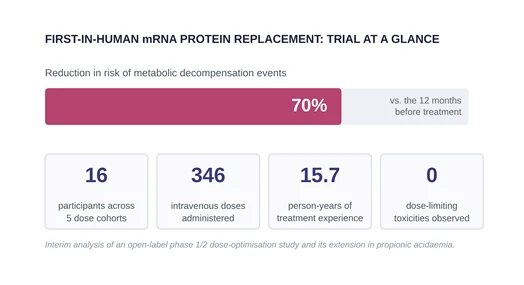
Figure 3: Interim results from the first clinical trial of mRNA used for intracellular protein replacement.
Sixteen participants were enrolled across five dose cohorts. A total of 346 intravenous doses were administered across 15.7 person-years of treatment, with no dose-limiting toxicities. Among the eight participants who had experienced metabolic decompensation events in the twelve months before treatment, the risk of those events fell by 70 per cent. The study was small, open-label and lacked a control group, and the results remain interim, with a registrational readout anticipated at the end of 2026.
The significance for American pharmaceutical strategy is not the effect size. It is that repeat systemic dosing of an mRNA therapeutic proved tolerable over years rather than weeks. That is the single technical precondition for every chronic indication the platform might eventually address, and until this trial it had never been demonstrated in humans. A second programme in methylmalonic acidaemia has since been selected for the FDA's START pilot, indicating that the agency is engaging constructively with mRNA protein replacement even as the vaccine policy environment tightened.
Rare Disease First: Why mRNA Therapeutics Are Entering the US Market Through the Narrowest Door
Rare metabolic disease is an unusual beachhead for a platform with mass-market ambitions, and the logic is deliberate. These indications carry a defined and measurable clinical endpoint, a patient population small enough for feasible trials, no approved competition, and a US regulatory framework built to accommodate exactly this profile through orphan designation, priority review vouchers and accelerated pathways. They also permit premium per-patient pricing that supports a cost of goods still burdened by lipid nanoparticle manufacturing.
The strategic value is that each rare disease programme functions as a paid clinical demonstration of the platform's chronic dosing safety. Every additional person-year of repeat infusion data lowers the perceived risk of the far larger indications behind it. American organisations evaluating mRNA should therefore assess rare disease assets on two ledgers at once: the standalone commercial case, and the option value the safety database creates for chronic conditions.
The Chronic Conditions Prize: Where mRNA Therapeutics Meet America's Largest Patient Populations
Two directions are opening simultaneously. The first extends protein replacement from rare enzymes to more prevalent deficiencies and to tissue targets beyond the liver, where lipid nanoparticles naturally accumulate. The second is in vivo cell engineering: using targeted lipid nanoparticles to deliver mRNA that transiently reprogrammes a patient's own T cells into CAR-T cells inside the body. Published work has demonstrated B cell depletion in non-human primates with subsequent immune reconstitution, early clinical experience has included repeated dosing without dose-limiting toxicities or neurotoxicity, and candidates aimed at B cell mediated autoimmune conditions such as lupus are entering US clinical development.
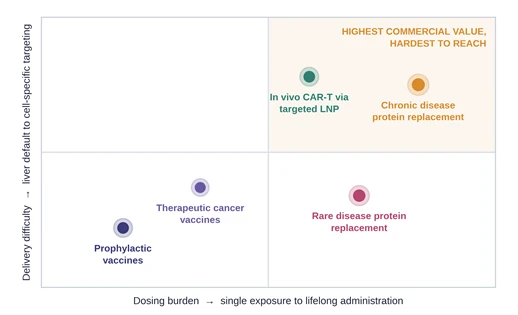
Figure 4: Where mRNA applications sit on dosing burden and delivery difficulty. Commercial value concentrates in the quadrant that is hardest to reach.
If in vivo CAR-T works, it removes the lymphodepletion, complex manufacturing and access constraints that have kept cell therapy confined to specialist centres and narrow indications. For the American market that is a structural change rather than an incremental one, because it converts a small number of high-cost hospital procedures into something closer to an administered biologic. Autoimmune disease in the United States is a large, chronically treated, commercially insured population, which is exactly the profile a platform needs to justify its manufacturing base.
mRNA Manufacturing and LNP Delivery: The American Supply Constraint Nobody Budgets For
The manufacturing footprint built for pandemic vaccines does not transfer cleanly to therapeutics. Vaccine facilities were optimised for enormous batch volumes of a single construct administered intramuscularly. Therapeutic programmes require smaller batches, more constructs, stricter impurity control for repeat systemic dosing, and lipid nanoparticle formulations engineered for tissue specificity rather than muscle deposition. Cold chain remains a persistent operating cost, and lyophilisation and microfluidic production are being pursued specifically to reduce it.
The commercial exposure sits in the lipids. Ionisable lipid supply, the intellectual property around delivery chemistry, and the specialist capacity to formulate targeted nanoparticles are all concentrated among a small number of suppliers, and much of that capacity sits outside the United States at a time when onshoring pressure is rising. US leadership teams should treat delivery chemistry as a strategic sourcing decision with the same seriousness they apply to the active substance, and should secure it earlier in development than conventional biologics practice would suggest.
Conclusion: What US Pharmaceutical Leadership Must Decide About mRNA Therapeutics Now
mRNA has completed the hardest part of its transition. It has demonstrated that a synthetic instruction can be delivered into human cells repeatedly, over years, to make a protein a patient cannot make for themselves. Everything that follows in rare disease, autoimmune disease and eventually broader chronic conditions rests on that single demonstration, and it has now been made.
What remains unresolved is American in nature rather than scientific. Federal enthusiasm for the platform has narrowed while its therapeutic scope has widened, delivery chemistry supply is concentrated and partly offshore, and payers have no established framework for pricing a chronically infused genetic medicine against a lifelong standard of care. None of these are reasons to step back. They are the reasons a deliberate position is now required, because the companies that build delivery capability and chronic-dosing safety databases in the next three years will define the category for the decade after.
The decision facing the US pharmaceutical C-suite is therefore not whether mRNA therapeutics will reach chronic conditions. It is whether their organisation will be holding the delivery technology, the manufacturing capacity and the safety evidence when that market arrives.
Frequently Asked Questions About mRNA Therapeutics
What is the difference between an mRNA vaccine and an mRNA therapeutic?
An mRNA vaccine delivers instructions for an antigen in order to provoke a protective immune response, usually in one or two doses. An mRNA therapeutic delivers instructions for a protein the patient needs, or for a receptor that reprogrammes a cell, and requires repeat dosing over long periods. In therapeutics, immune activation is an adverse effect to be minimised rather than the intended outcome.
Can mRNA therapy treat rare diseases?
Yes. The first clinical evidence came from a phase 1/2 trial in propionic acidaemia, where a dual mRNA therapy encoding both subunits of a missing enzyme was given by repeat intravenous infusion. Interim results showed a 70 per cent reduction in the risk of metabolic decompensation events among affected participants, with no dose-limiting toxicities across 346 doses. A registrational readout is expected at the end of 2026.
Did the US government stop funding mRNA research?
The federal action in August 2025 terminated 22 mRNA vaccine development contracts worth roughly $500 million within the biodefence procurement agency, and halted related equity investments. It applied to prophylactic vaccine development and did not restrict mRNA protein replacement therapy, mRNA oncology or in vivo cell engineering programmes, which are advancing primarily on private capital.
What is in vivo CAR-T using mRNA?
In vivo CAR-T uses targeted lipid nanoparticles to deliver mRNA directly to a patient's T cells, which then transiently express a chimeric antigen receptor inside the body. This avoids the lymphodepleting chemotherapy and the complex external manufacturing that conventional cell therapy requires, and the transient expression may reduce the risk of prolonged on-target toxicity.
What are the biggest challenges for mRNA therapeutics?
Four recur across programmes: achieving delivery to cells and tissues beyond the liver, controlling immune activation during repeat dosing, managing the cost and cold chain burden of lipid nanoparticle manufacturing, and establishing a reimbursement basis for a chronically infused genetic medicine. Supply concentration in ionisable lipids and delivery intellectual property is a further strategic exposure for US developers.

Lakshmi is a science writer with a foundation in the laboratory. She earned her master's in biotechnology and trained through research internships at ICGEB (JNU) and DIPAS, DRDO, with her work appearing in the Egyptian Journal of Veterinary Sciences. Now APCRM-certified and part of the editorial team at Pharma Focus America and Pharma Focus Europe, she reports on pharmaceutical technology, research, and innovation — giving complex science a clear and confident voice for industry leaders.