

The Future of Pharma Partnerships: Strategic Alliances Driving Innovation
Lakshmi, Editorial Team, Pharma Focus America
Partnerships have moved from the margins of pharmaceutical strategy to its center, yet most alliances still underdeliver against the case that justified them. This article examines how deal architecture, policy pressure and alliance management capability are reshaping collaboration across the U.S. industry, and argues that competitive advantage now depends less on which partnerships a company signs than on how deliberately it designs, governs and exits them.
Introduction
Beyond the Signing Ceremony: Why Alliances Became the Industry's Growth Engine
There is a familiar photograph in pharmaceutical strategy: two chief executives, a signed term sheet, a market capitalization moving on the news. What that photograph never captures is the eighteen months that follow, when joint steering committees discover that the two organizations meant different things by the word decision.
American pharmaceutical companies now source a substantial and rising share of their late-stage pipelines from outside their own laboratories. That shift has been building for two decades, but it has accelerated sharply as internal productivity has failed to keep pace with the revenue that must be replaced. The industry faces one of the heaviest concentrations of patent expirations in its history through the remainder of this decade, and no research organization, however well-funded, can internally generate replacement value on that timetable.
Partnership has therefore stopped being an opportunistic tactic and become structural. The consequence is less comfortable than the headline suggests. When alliances carry the growth burden, their failure rate becomes a strategic liability rather than a rounding error. Companies that treat collaboration as a series of transactions negotiated by deal teams and inherited by operating units are discovering that the value they modeled at signing rarely survives contact with two sets of priorities, incentives and calendars.
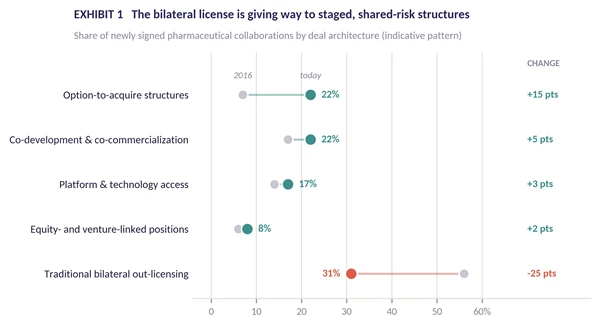
Exhibit 1: The bilateral license is losing share to structures that stage capital and distribute control.
The New Geometry: How the Shape of Pharmaceutical Deals Has Changed
The most visible change is not deal volume but deal structure. The classic bilateral license, in which one party hands over an asset and collects milestones, is giving way to arrangements that distribute both risk and control more deliberately.
Option-to-acquire structures let a larger company fund a defined development package while retaining the right, not the obligation, to buy the originator later. Co-development and co-commercialization agreements keep both parties economically exposed through launch, which changes behavior in ways that a royalty stream cannot. Equity-linked collaborations and corporate venture positions build relationships years before an asset is ready to partner. Platform deals give access to a technology across multiple targets rather than licensing a single molecule.
Two forces sit behind this diversification. The first is capital discipline. A long stretch of constrained biotech financing has left many originators unable to fund pivotal development alone, but also unwilling to sell outright at valuations set by a depressed market. Structures that provide capital now and preserve upside later resolve that standoff. The second is portfolio risk. Larger companies are less willing to concentrate replacement value in a small number of large acquisitions, and more willing to hold a wider spread of smaller, staged positions.
A quieter expansion is also underway at the edges of the traditional model. Partnerships with academic medical centers have moved beyond sponsored research into shared translational infrastructure. Collaborations with patient organizations increasingly shape trial design rather than merely support recruitment. And a small but growing number of outcomes-linked arrangements with payers effectively make the purchaser a partner in demonstrating value after approval, which changes what evidence a development program must generate.
The geographic pattern has shifted alongside the structural one. A meaningful proportion of newly in-licensed assets now originate outside traditional research hubs, particularly from Asian developers whose clinical execution economics differ substantially from those in the United States. That has widened the field of counterparties considerably, and introduced diligence questions that many alliance functions were not built to answer.
The Policy Overhang: Partnership Design Under American Regulatory Pressure
No discussion of U.S. pharmaceutical partnerships is complete without the policy environment that now shapes them. Federal drug pricing legislation has altered the calculus around which assets are worth developing and when, and the differing treatment of small molecules and biologics has consequences that flow directly into partnership decisions — including which modality a company chooses to in-license and how it sequences indications.
Antitrust scrutiny has become a second design constraint. Heightened federal review of larger transactions has made some companies more willing to structure collaboration as partnership rather than acquisition, accepting less control in exchange for a shorter and more predictable path to closing. Supply chain policy adds a third. Growing legislative and procurement attention to where medicines and their ingredients are manufactured has pushed manufacturing partnerships from a procurement conversation into a strategic one, with onshoring commitments increasingly negotiated as part of broader collaboration rather than as standalone contracts.
The practical effect is that partnership structures are now shaped as much by regulatory and political exposure as by scientific fit. Deal teams that model only the clinical and commercial case, without stress-testing how a structure performs under a range of policy outcomes, are producing incomplete analysis.
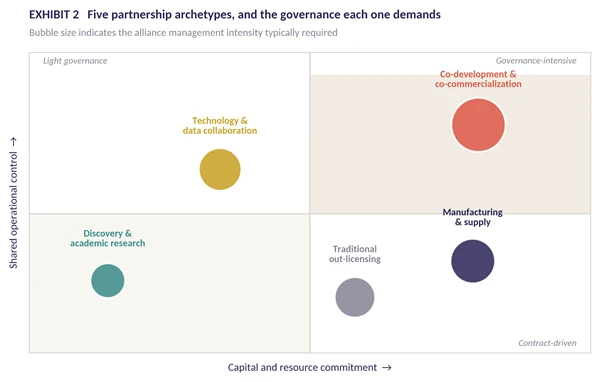
Exhibit 2: Governance cost should follow the archetype, not the size of the headline deal value.
Matching the Structure to the Objective: Choosing an Alliance Archetype
Not all partnerships are attempting the same thing, and a great deal of value is destroyed by applying the wrong structure to the right idea. It helps to think in archetypes, distinguished by how much capital each party commits and how much operational control each retains.
Discovery and academic collaborations sit at the low-capital, low-control end. They are cheap options on scientific insight, and they should be governed lightly; imposing full alliance infrastructure on an early research agreement burns goodwill and money. Technology and data partnerships, including the growing set of collaborations built around computational discovery and clinical development analytics, demand moderate capital but unusually close operational integration, because the value depends on data flowing continuously rather than on a milestone being achieved.
Co-development alliances are the most demanding archetype and the most frequently mismanaged. Both parties commit substantial capital, both retain meaningful control, and disagreements therefore have no natural resolution mechanism unless one was designed in advance. Manufacturing and supply partnerships invert the pattern: high capital, low shared control, and success determined largely by contractual precision and operational transparency rather than by joint decision-making.
The discipline is to name the archetype explicitly at the outset. A company that knows it is entering a high-capital, shared-control arrangement will invest in governance proportionate to that reality. One that assumes it has bought an asset with extra steps will not.
The value modeled at signing rarely survives contact with two sets of priorities, incentives and calendars.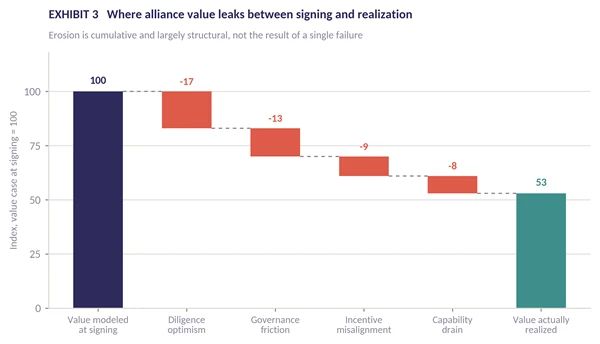 Exhibit 3: Roughly half the modeled value dissipates through ordinary decisions made in the first year.
Where Partnership Value Leaks Away
If alliances underperform, it is worth being specific about where the modeled value actually goes. In practice, erosion is rarely a single dramatic failure. It accumulates through a sequence of ordinary decisions.
Diligence optimism accounts for a meaningful share, particularly in valuations built on the partner's own trial assumptions rather than independently reconstructed ones. Governance friction takes another portion: committees meeting quarterly to resolve questions that arise weekly, escalation paths that terminate in relationships rather than authority, and joint teams with responsibility but no budget. Misaligned incentives contribute further, especially where one partner's commercial organization is compensated on a portfolio in which the alliance asset is a minor line item.
Slower still, and more corrosive, is capability drain. Alliances consume senior attention disproportionately. A partnership portfolio that grows faster than the alliance management function supporting it will quietly degrade every relationship in it, including the ones that were working.
There is also an underappreciated cost in speed. Every additional approval layer inserted between a joint team and a decision extends development timelines in ways that rarely appear in any variance report, because no one owns the delay. In a therapeutic area where competitors are running comparable programs, a governance structure that adds three months per significant decision is not an administrative inconvenience; it is a commercial outcome.
The encouraging finding is that most of these losses are structural rather than inevitable. They are decided in the first ninety days, when governance is designed, joint teams are staffed and decision rights are written down — or when they are not.
Alliance Management as a Competitive Capability, Not an Administrative Function
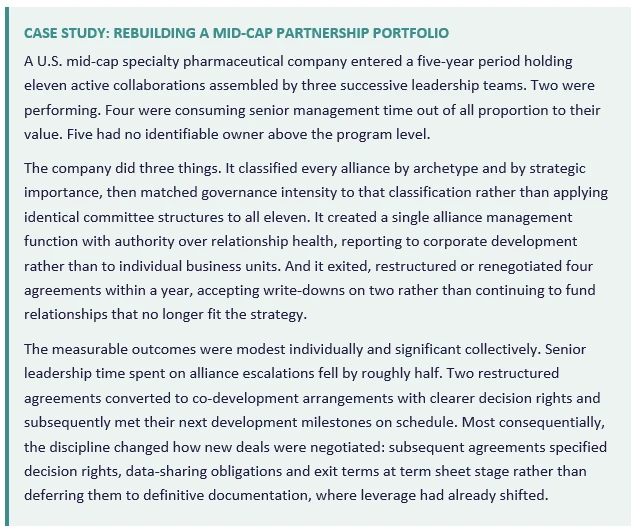
The companies that consistently extract value from partnerships treat alliance management as a discipline with its own expertise, career path and authority. That means senior practitioners rather than junior coordinators, a seat in deal negotiation rather than a handoff after closing, and a mandate that includes recommending exit.
It also means measuring the right things. Milestone attainment is a lagging indicator that tells leadership little until it is too late to act. Relationship health metrics — decision cycle time, escalation frequency, unresolved joint team issues, partner satisfaction assessed independently — provide earlier warning and are far more actionable.
Perhaps most importantly, it means designing for termination at the outset. Alliances that begin with clear, unemotional provisions for what happens when strategies diverge tend to run better while they last, because both parties understand the terms of the relationship rather than negotiating them under stress.
Conclusion: The Partnership Portfolio Becomes the Strategy
The next decade of American pharmaceutical innovation will be built substantially outside the walls of any single company. That is now an accepted premise rather than a prediction. What remains contested is which organizations will actually convert external innovation into approved medicines and durable revenue.
The evidence points away from deal-making prowess and toward operating discipline. Companies that name the archetype, size the governance to fit it, staff alliance management as a genuine capability and design exits before they are needed will compound advantage across a portfolio of relationships. Those that continue to celebrate signings and improvise the eighteen months that follow will keep generating photographs, and progressively fewer medicines.

Lakshmi is a science writer with a foundation in the laboratory. She earned her master's in biotechnology and trained through research internships at ICGEB (JNU) and DIPAS, DRDO, with her work appearing in the Egyptian Journal of Veterinary Sciences. Now APCRM-certified and part of the editorial team at Pharma Focus America and Pharma Focus Europe, she reports on pharmaceutical technology, research, and innovation — giving complex science a clear and confident voice for industry leaders.