

The Translational Gap Is Killing Your Best Molecules
Lakshmi, Editorial Team, Pharma Focus America
In an era of unprecedented scientific capability, the gap between promising preclinical data and clinical reality remains one of the industry's most persistent challenges.
Introduction
In today's rapidly evolving drug development landscape, the translational gap has emerged as a critical challenge that is fundamentally reshaping how organizations approach research and development. It's not just a scientific problem — it's a strategic imperative.
As biopharmaceutical organizations continue to navigate an increasingly complex environment characterized by rising development costs, compressed timelines, and heightened investor scrutiny, the question of translational validity has moved from the bench to the boardroom.
Let's dive into what this means for your organization.
Understanding the Translational Gap
The translational gap refers to the persistent disconnect between preclinical promise and clinical performance. Molecules that demonstrate compelling activity in laboratory and animal models frequently fail to replicate that performance in human subjects. This isn't merely an inconvenience — it's a foundational challenge.
At its core, the problem rests on three interconnected pillars: model system limitations, biomarker inadequacy, and patient population heterogeneity. Each pillar reinforces the others. Together, they create a challenge that is greater than the sum of its parts.
The implications are multifaceted and far-reaching. Organizations experiencing high late-stage attrition typically report escalating development costs, diminished portfolio confidence, and increased pressure on remaining assets. These effects, when compounded over time, can meaningfully erode competitive position.
It's worth noting that the challenge is not insurmountable. However, addressing it requires sustained commitment and may not deliver immediate returns.
Perhaps most significantly, the translational gap is not a single point of failure but rather a cumulative phenomenon. Small divergences between model and reality, individually unremarkable, accumulate across the development pathway until the aggregate distance becomes decisive. This cumulative quality is part of what makes the problem so persistent.
Industry observers have noted that the challenge has, if anything, intensified as therapeutic ambitions have expanded. As organizations pursue increasingly complex biology, the demands placed on preclinical models grow correspondingly. The tools have improved. So has the difficulty of the questions being asked of them.
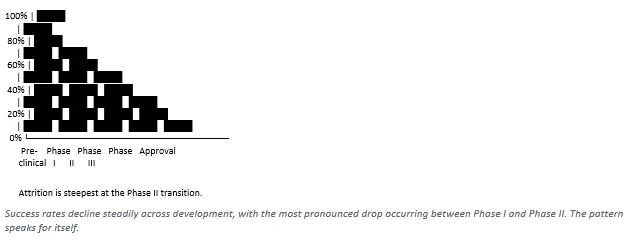
Figure 1. Attrition Across Development Phases
Key Drivers of Translational Failure
Several converging factors contribute to the persistence of the translational gap. Understanding these drivers is essential for any organization seeking to make an informed strategic decision.
- Model system limitations. Traditional preclinical models were never designed to recapitulate human disease biology in full. As therapeutic targets become more complex, the predictive limitations of conventional systems become increasingly consequential.
- Biomarker immaturity. Without validated translational biomarkers, organizations often lack the tools to distinguish genuine mechanistic engagement from apparent efficacy signals.
- Population heterogeneity. Preclinical models are typically homogeneous by design. Patient populations are not. This fundamental mismatch introduces variability that is difficult to anticipate.
- Data interpretation practices. The pressure to advance assets can subtly shape how ambiguous preclinical results are interpreted. Signals that support progression tend to receive more favorable readings than those that do not.
Each of these drivers, in its own way, compounds the strategic risk. Together, they create a challenge that forward-thinking organizations cannot afford to ignore.
It should be emphasized that these factors rarely operate in isolation. In practice, they interact in ways that can be difficult to disentangle retrospectively, which is itself part of why the problem resists straightforward solutions.
The Evolving Model Landscape
The methodological landscape has evolved considerably in recent years. What was once a field dominated by two-dimensional culture and standard animal models now encompasses a far broader toolkit.
Figure 2. Predictive Performance by Model Approach
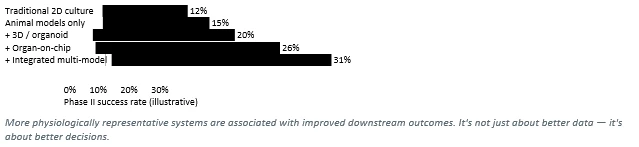
As the figure illustrates, the value proposition extends well beyond individual experiments. Improvements in translational confidence compound across a portfolio, and these compounding effects are often underappreciated in initial planning.
Organizations should be mindful, however, that results may vary considerably depending on therapeutic area, target class, and disease biology. Individual outcomes will depend on a range of factors.
Three-dimensional culture systems, organoids, microphysiological platforms, and computational approaches each contribute distinct capabilities. None represents a complete solution in isolation. The emerging consensus, to the extent one exists, favors integrated approaches that triangulate across multiple orthogonal systems rather than relying on any single methodology.
This integration presents its own challenges. Multi-model strategies generate more data, not necessarily clearer answers, and organizations must develop the interpretive frameworks to reconcile findings that do not always align. Investment in analytical capability is therefore as important as investment in the models themselves.
Where Confidence Breaks Down
Confidence in a molecule is not uniform across development. Understanding where it erodes is critical.
Figure 3. The Confidence Cascade
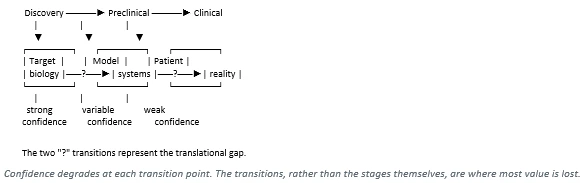
Three primary failure modes account for much of this erosion:
Target validation debt. Organizations that advance molecules on the strength of tractability rather than target confidence often discover the underlying biology was never adequately established. The cost of that discovery rises with every phase.
Endpoint misalignment. Preclinical endpoints and clinical endpoints frequently measure different things. A molecule can succeed decisively against the former while having no meaningful path to succeeding against the latter.
Organizational incentives. Program teams are rewarded for advancing assets. Killing a molecule early is scientifically correct and professionally unattractive. This distinction has profound implications for how portfolio decisions actually get made.
Reproducibility limitations. Preclinical findings that cannot be independently replicated provide a fragile foundation for substantial downstream investment. Organizations vary considerably in how rigorously they address this before committing to advancement.
Taken together, these failure modes suggest that the translational gap is as much an organizational phenomenon as a scientific one. Addressing the science without addressing the surrounding decision architecture is unlikely to produce durable improvement.
Navigating the Path Forward
Addressing the translational gap is not a one-size-fits-all proposition. Every organization's approach will be unique, shaped by its particular pipeline, capabilities, and strategic objectives.
That said, certain best practices have emerged from the collective experience of leading organizations. Teams should begin by conducting a thorough assessment of their current translational infrastructure, including an honest appraisal of both technical capability and decision-making culture.
From there, a phased approach is generally advisable, allowing organizations to build capability incrementally while managing resource exposure. Cross-functional alignment throughout the process is essential — arguably the single most important success factor.
It's important to recognize that technology alone is insufficient. People, processes, and incentives all play crucial roles in determining outcomes. Organizations that focus exclusively on the methodological dimension often find themselves disappointed by the results.
Several organizations have found value in establishing explicit, pre-specified criteria for advancement decisions before data are generated. This approach, sometimes described as pre-commitment, reduces the scope for retrospective reinterpretation of ambiguous findings. It is conceptually straightforward and, in practice, considerably harder to sustain than it appears.
Equally important is the cultivation of what might be termed constructive skepticism. Teams that treat disconfirming evidence as valuable information rather than an obstacle tend to make better portfolio decisions over time. Building that culture is a leadership responsibility rather than a scientific one.
Portfolio Implications
The translational gap does not affect all assets equally, and this uneven distribution has portfolio consequences that merit explicit consideration at the leadership level.
Assets in well-characterized target classes with established clinical precedent carry meaningfully lower translational risk than first-in-class molecules addressing novel biology. This is not an argument against innovation. It is an argument for pricing translational risk accurately when allocating resources across a portfolio.
Many organizations, in practice, apply relatively uniform advancement criteria across assets with substantially different risk profiles. A more differentiated approach — one that demands proportionally greater translational evidence from higher-risk programs — is conceptually appealing, though it introduces its own complexities around comparability and governance.
It is also worth considering the portfolio effects of timing. Resources committed to a molecule that ultimately fails in Phase II are resources unavailable to alternatives. The opportunity cost of late attrition is therefore substantially greater than the direct cost, though it is rarely accounted for with the same rigor.
The Regulatory Dimension
The regulatory landscape has evolved considerably in recent years. Regulatory authorities have demonstrated growing receptivity to alternative preclinical methodologies, though sponsors should engage early and maintain open dialogue throughout development.
Guidance now addresses many of the questions that historically created uncertainty, including the qualification of novel model systems, the role of translational biomarkers, and the evidentiary standards applied to non-animal approaches. These are methodological questions with methodological answers.
Organizations would be well advised to view regulatory engagement not as a hurdle to overcome, but as an opportunity to build alignment. Early dialogue is, in most cases, the most effective risk mitigation available.
Strategic Considerations for Leadership
For executive teams evaluating their translational posture, several questions merit careful consideration:
- How confident are we in the target biology underlying our lead assets?
- Do our preclinical endpoints map credibly onto our intended clinical endpoints?
- What would it take for us to kill a program earlier than we currently would?
- Do we possess the translational capability required, or must we build it?
There are no universally correct answers to these questions. Each organization must arrive at its own conclusions based on its own circumstances.
Looking Ahead
The trajectory is clear. As methodological options continue to expand, the gap between organizations that invest in translational rigor and those that do not will likely widen. Teams that act decisively today will be better positioned to capture value tomorrow.
Contract research organizations, in particular, represent an evolving dimension of this landscape. As sponsor demand for advanced model systems increases, capability dynamics may shift in ways that advantage those who have already invested.
Emerging computational approaches, including machine learning applied to preclinical datasets, represent a further dimension of this evolution. These tools hold considerable promise, though it remains to be seen how substantially they will alter outcomes in practice. Organizations would be prudent to approach the space with measured optimism.
The question, ultimately, is not whether the industry will close the translational gap. The question is whether your organization will lead that effort or follow it.
Conclusion
The translational gap represents both a significant challenge and a considerable opportunity for today's biopharmaceutical organizations. By understanding the drivers, anticipating the obstacles, and approaching the problem strategically, teams can position themselves for sustained success in an increasingly competitive landscape.
The organizations best positioned to address this challenge are likely to be those that treat translational rigor not as a compliance exercise or a methodological upgrade, but as a core component of how they allocate capital. That reframing is, in many respects, the most consequential change available.
The path forward will not be identical for every organization. But the direction of travel is unmistakable.
The time to act is now. Close the gap — or watch your best molecules die trying to cross it.

Lakshmi is a science writer with a foundation in the laboratory. She earned her master's in biotechnology and trained through research internships at ICGEB (JNU) and DIPAS, DRDO, with her work appearing in the Egyptian Journal of Veterinary Sciences. Now APCRM-certified and part of the editorial team at Pharma Focus America and Pharma Focus Europe, she reports on pharmaceutical technology, research, and innovation — giving complex science a clear and confident voice for industry leaders.