


U.S. Cell and Gene Therapy Market: How Pharma Is Scaling Up
Lakshmi, Editorial Team, Pharma Focus America
The U.S. cell and gene therapy market is moving from bespoke, center-by-center breakthroughs toward industrial-scale medicine. This article examines how pharma is scaling up: an advanced-therapy pipeline of more than 4,400 programs, regulatory changes that ease CAR-T delivery, a multibillion-dollar pivot to in vivo cell engineering, and outcomes-based payment models that make one-time therapies financeable. A 2026 case study shows how one U.S. major is buying its way past the cell therapy factory.

From Bespoke Cures to Industrial Medicine
Less than a decade after the first CAR-T therapy reached American patients in 2017, cell and gene therapy has earned its scientific credibility. Durable remissions in blood cancers once considered untreatable, one-time treatments for inherited disorders and meaningful responses in rare diseases have established these modalities as a permanent part of modern medicine. What the sector has not yet earned is industrial credibility.
For all their clinical promise, most cell and gene therapies are still made one patient at a time, delivered through a limited number of specialized centers and paid for through reimbursement systems designed for medicines taken over many years. In 2025, a leading industry advocacy group estimated that geographic, financial and logistical hurdles had kept approved CAR-T therapies out of reach for about 80% of eligible U.S. patients.
That gap between scientific success and commercial scale is now the central strategic problem for U.S. pharma leaders. This article examines how large pharmaceutical companies are closing it through manufacturing redesign, regulatory change, a decisive bet on in vivo engineering and new payment models, and what the next phase demands of the C-suite.
Inside the U.S. Cell and Gene Therapy Pipeline: Abundance Is No Longer the Constraint
The pipeline is not the bottleneck. By the second quarter of 2026, 4,487 gene, cell and RNA therapies were in development worldwide, from preclinical research through pre-registration. Gene therapies, including genetically modified cell therapies such as CAR-T, made up half of that pipeline with 2,132 programs in the first quarter of 2026, while non-genetically modified cell therapies contributed a further 881. By mid-2026, 46 gene therapies and 76 non-genetically modified cell therapies had been approved for clinical use around the world.
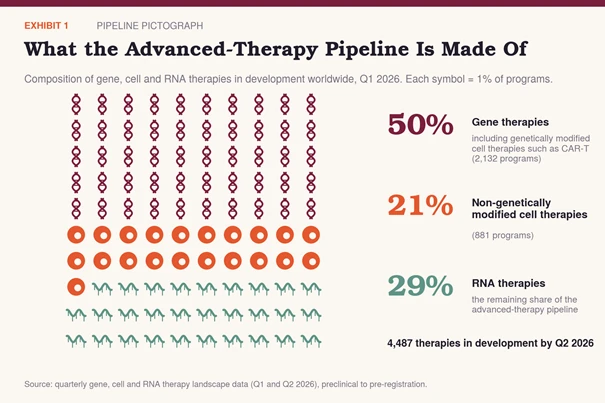
The United States sits at the center of this activity as the largest commercial market, the deepest clinical research environment and the primary arena for pharma dealmaking. Innovation is also broadening. In the second quarter of 2026 alone, 11 new mRNA-engineered CAR-T programs entered the pipeline, matching the total for all of 2025, a sign that developers are actively searching for ways to engineer immune cells without permanent genetic modification.
For pharma executives the implication is clear. Scientific supply is abundant; the scarce resources are manufacturing capacity, treatment-center reach and payer confidence. The companies pulling ahead are reallocating capital accordingly.
Breaking the Vein-to-Vein Bottleneck: How Pharma Is Industrializing Cell and Gene Therapy Manufacturing
Autologous cell therapy is manufacturing at its most personal. Each dose begins with the collection of a patient’s own cells, which are shipped under strict cold-chain control to a specialized facility, engineered and expanded, tested for release and returned for infusion. Every step adds cost, time and the risk of a failed batch, and none of it benefits from the economies of scale that define conventional biologics.
Pharma companies are attacking this chain from several directions. Automated, closed manufacturing systems reduce manual handling and the clean-room footprint each dose requires. Process redesign aims to shorten the time from collection to infusion, which matters most for patients with aggressive disease. Some companies are placing capacity closer to their treatment networks, while others are investing in allogeneic, or off-the-shelf, cell therapies derived from healthy donors that can be produced in larger batches and stored until needed.
Regulators have also reduced friction at the point of care. In June 2025, U.S. authorities removed risk evaluation and mitigation strategy (REMS) requirements for approved autologous CAR-T therapies directed at CD19 and BCMA. Updated labels shortened the period patients must stay near a treatment center from four weeks to two, and cut the recommended driving restriction from eight weeks to two. For community oncology practices and patients who live far from academic centers, those changes remove a real barrier to treatment, and they widen the commercial funnel for manufacturers.
The In Vivo Pivot: Pharma’s Boldest Bet to Scale Cell Therapy Beyond the Factory
The most ambitious answer to the manufacturing problem is to remove the factory altogether. In vivo CAR-T approaches use engineered viral vectors or lipid nanoparticles carrying genetic instructions to reprogram a patient’s T cells directly inside the body, potentially through a single intravenous infusion. If the approach proves safe and effective, it could turn a bespoke, weeks-long process into something much closer to an off-the-shelf biologic.
Large pharma has moved quickly (Exhibit 2). In March 2025, a U.K.-based major agreed to acquire a lentiviral in vivo CAR-T developer for up to $1 billion, including $425 million upfront. In June 2025, a U.S. biopharma major agreed a deal worth up to $2.1 billion for a company that delivers mRNA to T cells through targeted lipid nanoparticles, with an initial focus on autoimmune disease. Two further U.S. majors followed in August and October 2025, paying $350 million and $1.5 billion respectively. In 2026, an Indianapolis-based major made two acquisitions of its own, the second worth up to $7 billion.
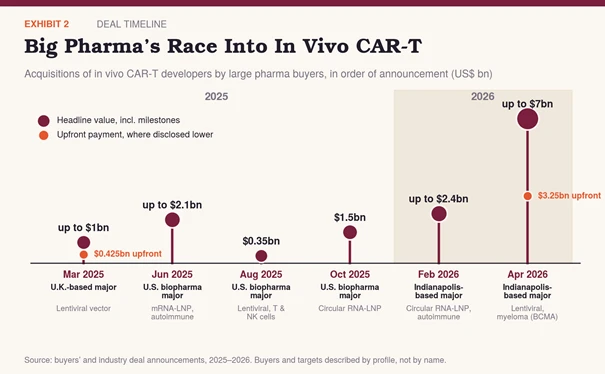
Two strategic signals stand out. First, buyers are paying substantial sums for platforms at Phase 1 or earlier, which shows how highly they value delivery technology that could scale. Second, many programs target autoimmune disease as well as cancer, which could expand cell therapy from a specialist oncology market into one of the largest therapeutic categories in U.S. medicine.
Case Study: How One U.S. Pharma Major Is Buying Its Way Past the Cell Therapy Factory
CASE STUDY | IN VIVO CELL THERAPY, 2026
The strategic problem. An Indianapolis-based pharmaceutical major with strengths in metabolic disease, oncology and immunology wanted a meaningful position in cell therapy without building the patient-specific manufacturing and logistics network that autologous CAR-T demands.
The first move. In February 2026, the company agreed to acquire a developer of circular RNA delivered by lipid nanoparticles, in a deal reported at up to about $2.4 billion. Its lead program is an in vivo anti-CD19 CAR therapy aimed at B-cell-driven autoimmune disease.
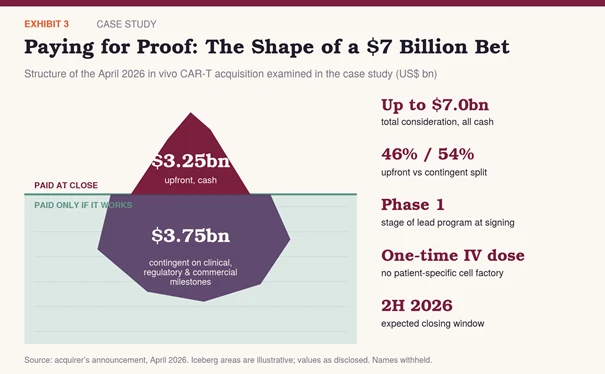
The second move. On April 20, 2026, the company agreed to acquire a clinical-stage developer of a lentiviral in vivo gene-placement system for up to $7.0 billion in cash: $3.25 billion upfront and up to $3.75 billion tied to clinical, regulatory and commercial milestones (Exhibit 3). The lead candidate is a one-time intravenous therapy that generates anti-BCMA CAR-T cells inside the body for relapsed or refractory multiple myeloma. Early Phase 1 results were presented in a plenary session at the leading U.S. hematology congress in December 2025, and the transaction is expected to close in the second half of 2026.
Why it matters. Within a single quarter, the company assembled two complementary delivery technologies, RNA and lentiviral, spanning both autoimmune disease and cancer. Structuring more than half of the larger deal’s value as milestone payments lets the buyer pay for proof rather than promise, a sensible discipline for a Phase 1 asset. If in vivo CAR-T delivers, the company will have leapfrogged the manufacturing infrastructure that competitors spent a decade building; if it does not, contingent payments limit the downside.
The lesson. Buying platforms rather than single assets, sequencing deals to hedge technology risk and tying consideration to evidence together form a repeatable playbook for executives seeking to enter cell and gene therapy at scale.
Paying for Cures: Outcomes-Based Models Reshaping U.S. Cell and Gene Therapy Access
Manufacturing breakthroughs mean little if payers cannot absorb the cost of a one-time therapy. Sickle cell disease shows both the challenge and a possible solution. About 100,000 Americans live with the condition, and a large share rely on Medicaid. When the first two gene therapies for sickle cell disease were approved in December 2023, their U.S. list prices were $2.2 million and $3.1 million.
In response, the Centers for Medicare & Medicaid Services launched the Cell and Gene Therapy Access Model, the first program in which the federal government negotiates outcomes-based agreements with manufacturers on behalf of state Medicaid agencies. More than 30 states, plus the District of Columbia and Puerto Rico, representing about 84% of Medicaid beneficiaries with sickle cell disease, are taking part. States receive guaranteed discounts and rebates if the therapies fail to deliver their promised clinical benefits, and participants can apply for up to $9.55 million each in federal support for implementation.
For pharma leaders, the model is a template as much as a program. It shows that one-time therapies can reach large public-payer populations when manufacturers share outcome risk, and it signals that future cell and gene therapy launches will be judged on real-world durability, not only on trial results.
The C-Suite Scale-Up Agenda for the U.S. Cell and Gene Therapy Market
The strategic agenda that follows is demanding but clear. Manufacturing must be treated as a source of competitive advantage rather than a support function, because cost of goods, turnaround time and batch success rates will increasingly separate commercial winners from scientific ones. Portfolios should span autologous, allogeneic and in vivo approaches, since it is not yet clear which modality will dominate in each disease area, and a diversified position protects against technology risk.
The treatment network deserves the same attention. With REMS requirements removed, community centers can deliver CAR-T, but they need training, referral pathways and support for managing side effects before volumes can grow. Finally, pricing must be designed around evidence. Companies that are willing to put revenue at risk against long-term outcomes will find public and commercial payers far more receptive to one-time therapies with seven-figure price tags.
Conclusion:
From Breakthrough to Business Model
The U.S. cell and gene therapy market has already proved that these medicines can transform patients’ lives. The next test is whether the industry can make them routine. Pharma is now scaling up on every front at once: industrializing autologous manufacturing, widening access through regulatory change, committing billions to in vivo engineering and accepting outcomes-based payment. None of these levers is sufficient on its own. The companies that lead the next decade will combine them into a single operating model in which science, supply and reimbursement are designed together from the first clinical trial. For the C-suite, the question is no longer whether cell and gene therapy will matter, but whether their organization is built to deliver it at scale.

Lakshmi is a science writer with a foundation in the laboratory. She earned her master's in biotechnology and trained through research internships at ICGEB (JNU) and DIPAS, DRDO, with her work appearing in the Egyptian Journal of Veterinary Sciences. Now APCRM-certified and part of the editorial team at Pharma Focus America and Pharma Focus Europe, she reports on pharmaceutical technology, research, and innovation — giving complex science a clear and confident voice for industry leaders.