


Risk Management in the U.S. Pharmaceutical Industry: Supply, Manufacturing and Regulatory Resilience
Sarah Richards, Editorial Team, Pharma Focus America
U.S. pharmaceutical companies face pressure to protect drug supply, quality and compliance at once. This article explains how pharma risk assessment connects supply chain, manufacturing and regulatory risk, outlines practical mitigation strategies such as dual sourcing and inspection readiness, and offers a framework for building resilience before disruptions reach patients.

Quick answer: U.S. pharma risk management is the practice of identifying, scoring and reducing threats to drug quality, supply and compliance before they reach patients. The strongest programs focus on three areas: supply chain risk (sourcing, logistics, shortages), manufacturing risk (quality, contamination, capacity) and regulatory risk (FDA inspections, data integrity, policy shifts). They connect all three through one shared risk assessment process.
Key Takeaways
- Most pharma disruptions come from a handful of weak points: single-source suppliers, aging plants, and slow quality signals.
- A good pharmaceutical risk assessment scores both likelihood and impact on patients, not just financial loss.
- Resilience is built before the crisis: dual sourcing, buffer stock, real-time monitoring and regulatory readiness.
- Regulatory risk and quality risk are two sides of the same coin. Fix the quality culture and inspection outcomes usually follow.
Why Risk Management Matters So Much in U.S. Pharma
Most industries treat a disruption as a revenue problem. Pharma does not get that luxury. When a sterile injectable runs short, a hospital pharmacist is rationing chemotherapy doses. When a plant fails inspection, thousands of patients may need a substitute overnight.
- That is why U.S. pharmaceutical risk management sits at the intersection of patient safety, business continuity and legal compliance. The U.S. has also lived through repeated drug shortages in recent years, especially in generic sterile injectables, where thin margins leave little room for redundancy. Those shortages taught the industry an uncomfortable lesson: efficiency and resilience are not the same thing.
- If you work in quality, supply chain, regulatory affairs or operations, this guide breaks the problem into three parts and then shows how to tie them together.
What Is Pharma Risk Assessment?
Pharmaceutical risk assessment is a structured way to find what could go wrong, estimate how likely it is, and decide what to do about it.
Most U.S. companies base their approach on the quality risk management principles in ICH Q9 (R1), which FDA recognizes. The basic loop is simple:
1. Identify the hazard (a supplier delay, a failed sterilization cycle, a data gap).
2. Analyze how likely it is and how severe the effect would be.
3. Evaluate whether the risk is acceptable.
4. Control it with prevention, detection or contingency plans.
5. Review regularly, because risk changes.
A simple scoring grid helps teams stay consistent:
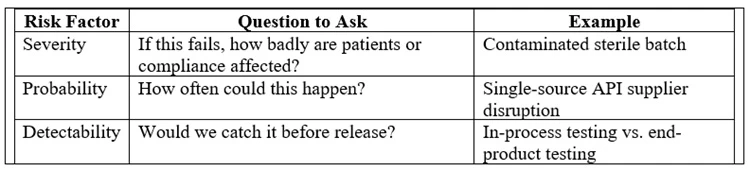
Multiply or combine the scores and you get a priority list. The point is not the math. The point is that everyone in the room argues about the same list.
Pharma Supply Risk and Supply Chain Risk: Where It Usually Breaks
Pharma supply chain risk is the chance that materials, ingredients or finished products fail to arrive where and when they are needed.
American pharma runs on a global network. Active pharmaceutical ingredients (APIs) and key starting materials often come from overseas, with India and China playing major roles for many generics. That setup lowers cost, but it also concentrates risk.
The most common supply risks
- Single-source dependency. One supplier, one site, one point of failure.
- Geographic concentration. A weather event, export restriction or port delay can hit many products at once.
- Thin inventory. Lean models save money until demand spikes.
- Limited visibility. Many companies know their tier-one suppliers well but have little sight into tier two and tier three.
- Cold chain failures. Biologics, vaccines and cell therapies can be ruined by a few hours outside temperature range.
- Trade and policy shifts. Tariffs, sourcing rules and security-related restrictions can change cost and availability quickly. Check current policy, because it keeps evolving.
Supply chain risk management in American pharma: what works
1. Map your supply chain deeply. Go beyond tier one. Know where your APIs, excipients and packaging components really originate.
2. Qualify second sources. Dual sourcing is slow and costly, so start with your most critical, highest-risk products.
3. Hold strategic buffer stock. Not for everything. Target products with no alternatives and long lead times.
4. Use early-warning signals. Supplier financial health, regulatory actions, weather and logistics data can flag trouble weeks ahead.
5. Build shortage playbooks. Remember that FDA expects certain manufacturers to notify it of permanent discontinuances or interruptions likely to disrupt supply. Knowing your reporting duties in advance saves precious days.
6. Meet traceability rules. The Drug Supply Chain Security Act (DSCSA) requires electronic, interoperable tracing of prescription drugs, which also doubles as a visibility tool.
Pharma Manufacturing Risk: Quality Is the Foundation
Pharma manufacturing risk covers anything in production that can compromise product quality, safety or output.
Manufacturing is where the physical and the regulatory meet. A drifting process or a tired piece of equipment does not just reduce yield. It can trigger a recall or a warning letter.
Typical manufacturing risks
- Contamination and cross-contamination, especially in sterile fill-finish operations
- Equipment aging and unplanned downtime
- Process variability that goes unnoticed until a batch fails
- Data integrity lapses such as incomplete records, shared logins or unreviewed audit trails
- Workforce gaps, including turnover and training shortfalls
- Capacity constraints that leave no room when something breaks
- Contract manufacturer (CDMO) oversight when quality is outsourced but accountability is not
How strong manufacturers reduce the risk
Shift from reactive to preventive. Instead of testing quality in at the end, build it in through process understanding and continuous monitoring. FDA has encouraged this thinking for years through its quality-by-design and quality management maturity efforts.
Invest in modern manufacturing. Advanced and continuous manufacturing, automation and real-time analytics reduce human error and variability. They also help domestic capacity scale when needed.
Treat your quality culture as a risk control. Plants that encourage staff to raise problems early tend to have fewer surprises. Plants that punish bad news tend to hear about it from an inspector.
Audit partners like they are your own site. Because FDA holds the product owner responsible, supplier and CDMO audits belong in your risk program, not on a back shelf.
Regulatory Risk: Staying Ahead of FDA Expectations
Regulatory risk is the threat of enforcement, delays or restrictions caused by non-compliance or changing rules.
For U.S. pharma, the main reference point is current good manufacturing practice (cGMP) under FDA oversight. Inspections, application reviews and post-market surveillance all create exposure.
What drives regulatory risk
- Inspection findings (Form 483 observations, warning letters, import alerts)
- Data integrity and documentation problems
- Delays or deficiencies in applications and supplements
- Post-market safety signals and recalls
- Shifting policy, including supply chain, pricing and sourcing rules
- Gaps in change control when processes or suppliers are modified
Practical ways to build regulatory resilience
1. Be inspection-ready every day. Mock inspections and self-audits beat last-minute scrambling.
2. Close CAPAs for real. Corrective and preventive actions should fix root causes, not just paper over symptoms.
3. Run strong change control. Many compliance issues begin with an unreviewed change to a supplier, method or material.
4. Track regulatory intelligence. Assign someone to watch FDA guidance, enforcement trends and legislation, then feed it into your risk register.
5. Align quality and supply teams. A supplier change that saves money can create a regulatory problem if no one loops in quality.
Risk Management Strategies for U.S. Pharmaceutical Companies: A Simple Framework
Here is a practical way to connect supply, manufacturing and regulatory risk instead of managing them in silos.
Step 1: Build one integrated risk register. One list, shared by quality, supply chain, manufacturing and regulatory. Silos hide dependencies.
Step 2: Prioritize by patient impact. Rank products by medical criticality and availability of alternatives, not only by revenue.
Step 3: Assign clear owners. Every high risk needs a named person, a mitigation plan and a review date.
Step 4: Use leading indicators. Watch supplier performance, deviation trends, audit results and lead times, not just recall counts after the fact.
Step 5: Stress-test regularly. Run scenario exercises such as a key supplier going offline or a critical line shutting down for eight weeks. Gaps appear fast.
Step 6: Learn and update. After every event or near miss, feed the lessons back into the assessment.
Common Mistakes to Avoid
- Treating risk assessment as a one-time document instead of a living process
- Scoring only financial impact and ignoring patient impact
- Relying on tier-one supplier data and ignoring deeper tiers
- Letting the risk register become a spreadsheet nobody reads
- Cutting redundancy for cost savings without modeling the downside
Frequently Asked Questions
What is pharma risk management?
Pharma risk management is the process of identifying, assessing and controlling risks to drug quality, supply continuity and regulatory compliance across the product lifecycle.
What are the biggest risks in the U.S. pharmaceutical supply chain?
The most common are single-source suppliers, geographic concentration of APIs, low inventory buffers, limited multi-tier visibility, cold chain failures and policy or trade changes.
What framework do U.S. pharma companies use for risk assessment?
Many follow ICH Q9 (R1) quality risk management principles, often supported by tools such as FMEA, risk matrices and HACCP-style analyses.
How can pharma companies reduce manufacturing risk?
Through preventive quality systems, modern process controls, strong data integrity practices, equipment maintenance, trained staff and close oversight of contract manufacturers.
How does regulatory risk affect pharma supply?
An inspection failure, warning letter or import alert can halt production or shipments, which can quickly turn a compliance problem into a drug shortage.
How often should a pharmaceutical risk assessment be updated?
At least on a scheduled cycle (many teams do it annually) and whenever something material changes, such as a new supplier, process change, regulatory shift or major deviation.
Final Thoughts
Risk will never reach zero in pharma, and that is not the goal. The goal is resilience: seeing trouble early, absorbing the hit, and recovering without letting patients pay the price.
The companies that do this well are rarely the ones with the thickest binders. They are the ones where supply chain, manufacturing and regulatory teams talk to each other, share one risk picture and act on weak signals while they are still small.
If you are starting from scratch, pick your five most critical products this week. Map their suppliers, score their risks and name an owner for each. That small exercise often reveals more than a year of generic planning.
Disclaimer: This article is for general informational purposes and does not constitute legal, regulatory or compliance advice. Always verify current FDA requirements and consult qualified professionals.

Sarah Richards, Editorial Team at Pharma Focus America, leverages her extensive background in pharmaceutical communication to craft insightful and accessible content. With a passion for translating complex pharmaceutical concepts, Sarah contributes to the team's mission of delivering up-to-date and impactful information to the global Pharmaceutical community.