

Pharmaceutical Manufacturing in the United States: Production Processes, Technologies, Quality and Supply Chain Operations
Kate Williamson, Editorial Team, Pharma Focus America
US pharmaceutical manufacturing turns active ingredients into safe, consistent medicines under strict FDA oversight. This article explains core production processes from API synthesis to dosage forms, emerging technologies such as continuous manufacturing and automation, cGMP quality systems, and the supply chain steps of packaging, serialization, cold chain storage and distribution that carry drugs to patients.
Introduction:
Every pill, injection, inhaler and patch starts as a set of raw materials and a carefully written plan. Between those two points sits one of the most heavily regulated industries in the world. US pharmaceutical manufacturing is not just about making medicine. It is about making the same medicine, with the same strength and purity, millions of times over, and proving it every step of the way.
This article walks through how American drug production works: the processes, the technologies, the quality systems that keep patients safe, and the supply chain that carries a finished product to a pharmacy shelf.
What is pharmaceutical manufacturing in the United States?
Pharmaceutical manufacturing in the US is the regulated, multi-stage process of turning active ingredients and inert materials into finished drug products that meet strict standards for identity, strength, quality and purity. The US Food and Drug Administration (FDA) oversees it, and every facility must follow current Good Manufacturing Practice (cGMP) rules.
Facilities range from large multinational campuses producing billions of tablets a year to small contract manufacturers making sterile injectables in limited batches. They all share one obligation: documented, repeatable control over everything that touches the product.
How are drugs made? The core production processes
Though each medicine has its own recipe, most US drug manufacturing processes follow the same broad path.
1. Active ingredient production. The active pharmaceutical ingredient (API) is the part of the drug that does the work. Small-molecule APIs are usually made through chemical synthesis in reactors, followed by crystallization, filtration and drying. Biologic APIs, such as monoclonal antibodies and vaccines, are grown in living cell cultures inside bioreactors, then purified through several filtration and chromatography steps.
2. Formulation. The API is rarely used alone. It is blended with excipients such as binders, fillers, stabilizers and coatings that give the drug its shape, stability and release profile. Getting this mixture uniform is harder than it sounds. A tablet that holds slightly too much or too little active ingredient is a failure, even if it looks perfect.
3. Dosage form manufacturing. This is where the product takes its final shape. Solid dosage forms like tablets and capsules are made through granulation, compression and coating. Liquids, creams and ointments are made through controlled mixing and homogenization. Sterile injectables go through aseptic filling in tightly controlled cleanrooms, often followed by lyophilization (freeze-drying) to keep sensitive drugs stable.
4. Testing and release. Samples are tested at several points, not just at the end. Raw materials are tested before use, in-process checks happen during production, and finished batches are tested before a quality unit formally releases them. If the paperwork or the results do not line up, the batch does not ship.
Which technologies are changing American drug production?
For decades, pharmaceutical production relied on batch manufacturing: make a lot, stop, test it, make the next. That model is slowly giving way to smarter, more connected methods. Several pharmaceutical production technologies are leading the shift.
Continuous manufacturing lets materials flow through a connected line without stopping between steps. It shortens production time, shrinks the physical footprint and makes quality easier to monitor in real time. The FDA has openly encouraged adoption, and several approved products are already made this way.
Process analytical technology (PAT) uses in-line sensors and spectroscopy to measure quality while the product is being made, rather than waiting for lab results. This supports the idea of building quality into the process instead of inspecting it afterward.
Automation and robotics are most valuable in sterile work, where the biggest contamination risk is people. Isolators and robotic filling systems keep operators physically separated from the product.
Digital tools now run through modern plants. Electronic batch records, manufacturing execution systems and data analytics reduce transcription errors and make it faster to spot trends. Some manufacturers are also using predictive maintenance and machine learning to catch equipment drift before it causes a deviation.
Advanced therapies such as cell and gene therapies bring their own manufacturing challenges. Many are made for individual patients in small batches, with tight time windows and complicated logistics, which pushes the whole industry to rethink what "scale" means.
None of these technologies replaces the fundamentals. They make good manufacturing easier to achieve and easier to prove.
What does GMP actually mean in practice?
You will see the term "GMP" everywhere in this industry, and it is often misunderstood. GMP production systems are a set of legally enforceable requirements, found mainly in 21 CFR Parts 210 and 211, that define how drugs must be made, tested, documented and stored.
The "c" in cGMP stands for "current," which means manufacturers are expected to keep up with modern practice, not just meet a standard written decades ago.
In everyday terms, GMP quality systems across American pharmaceutical production facilities come down to a handful of habits:
- Dr. Thorsten Knoechel, Head of R&D Governance Operations, Merck, Germany
- Ullas Hiremath, Director- Early Portfolio & Pipeline, Sandoz, Germany
- Vincenzo Garzya, Data Science and Artificial Intelligence Head of Business Planning, Strategy & Operations, AstraZeneca, UK
- Bence Tuske, Head of Program Management, Sanofi, Hungary
- George Mouzakis, Global Pipeline Planning Director - Cardio/Renal/Metabolic, Neuroscience & Gene Therapies Dev. Units, Novartis, Switzerland
- Carolina Bernhardt, Global Marketing and Value Lead Inflammation Indication Strategies, Boehringer Ingelheim, Germany
Modern quality thinking also leans on risk-based approaches from ICH guidelines such as Q9 on risk management and Q10 on pharmaceutical quality systems. The idea is to put the most attention on the steps that matter most for patient safety.
The FDA checks all of this through inspections, which can be scheduled or unannounced. Findings range from minor observations to warning letters, import alerts and, in serious cases, production halts. That oversight is a big reason American-made medicines carry the level of trust they do.
How does the pharmaceutical supply chain work from plant to pharmacy?
A drug is not finished when it leaves the production line. The US pharmaceutical manufacturing supply chain is a long, carefully managed chain with many hands in it.
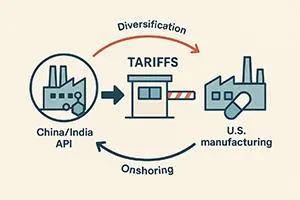
Sourcing. Manufacturers buy APIs, excipients and packaging components from suppliers around the world. Each supplier must be qualified and audited. Because many ingredients come from overseas, supply chain resilience has become a major business and policy conversation in the US, with growing interest in domestic and diversified sourcing.
Packaging and labeling. Packaging protects the product and carries critical information. Blister packs, bottles, vials, syringes and cartons are filled and labeled under strict controls to prevent mix-ups, since a wrong label can be as dangerous as a wrong ingredient. Tamper-evident features, child-resistant closures and clear lot coding are standard.
Serialization and traceability. Under the Drug Supply Chain Security Act (DSCSA), prescription drug packages are assigned unique identifiers so they can be traced as they move through the system. This helps detect counterfeit, stolen or contaminated products and makes recalls faster and more precise.
Storage and distribution. Many medicines have to stay within specific temperature ranges. Vaccines, biologics and some injectables need cold chain handling from the warehouse to the truck to the pharmacy. Temperature monitors, qualified shipping containers and validated transport lanes help make sure the product arrives in the same condition it left.
Wholesalers and last-mile delivery. Most products move from manufacturers to wholesale distributors and then to hospitals, retail pharmacies and mail-order pharmacies. Each handoff is documented, and each party has regulatory responsibilities.
The industry also keeps a close eye on shortages. A single disruption, such as a plant shutdown, a raw material delay or a quality failure, can ripple through the system quickly, which is why inventory planning and supplier diversity matter so much.
What challenges does the industry face today?
American manufacturers are working through several pressures at once:
- Supply chain security. Dependence on a small number of global suppliers for key ingredients is a recognized vulnerability.
- Cost and complexity. Compliance, validation and quality systems are expensive, and the cost rises with every new technology and product type.
- Talent. Skilled engineers, quality professionals and technicians are in demand, and training takes time.
- Cybersecurity. As plants become more connected, protecting data integrity and production systems becomes part of quality.
- Sustainability. Energy use, solvent waste and packaging waste are getting more attention from regulators and investors.
These are not small problems, but they are also pushing innovation, from greener chemistry to smarter inventory planning.
Frequently asked questions
Who regulates pharmaceutical manufacturing in the US?
The FDA is the primary regulator. It sets and enforces cGMP requirements and inspects facilities, both in the US and abroad, that supply the American market.
What is the difference between GMP and cGMP?
They refer to the same system. The added "c" emphasizes that manufacturers must follow current, up-to-date practices.
How long does it take to manufacture a drug?
It varies widely. A simple tablet batch may take days from start to release, while a complex biologic can take weeks or months once cell culture, purification and testing are included.
Why is documentation so important in drug production?
Documentation proves that each batch was made and tested the way it was supposed to be. It also makes investigations and recalls possible when something goes wrong.
What is continuous manufacturing?
It is a production approach where materials move through connected steps without stopping, instead of being made in separate, stop-and-start batches.
How are counterfeit drugs kept out of the US supply chain?
Serialization and electronic tracing under the DSCSA, along with licensed distributors and regulatory oversight, help verify that products are genuine as they move through the supply chain.
Final thoughts
American drug production is built on a simple promise: the medicine in your hand is the medicine it claims to be. Delivering that promise takes careful chemistry and biology, well-designed processes, modern technology, disciplined quality systems and a supply chain that can be traced from start to finish.
The tools will keep evolving, with more automation, more data and more personalized therapies. But the foundation stays the same. Strong systems, honest documentation and a culture that puts patients first are what make pharmaceutical manufacturing operations in the United States work

Kate, Editorial Team at Pharma Focus America, leverages her extensive background in pharmaceutical communication to craft insightful and accessible content. With a passion for translating complex pharmaceutical concepts, Kate contributes to the team's mission of delivering up-to-date and impactful information to the global Pharmaceutical community.