

Using AI to Improve Drug Repurposing and Molecule Discovery
Lakshmi, Editorial Team, Pharma Focus America
American pharmaceutical leaders face mounting pressure to extract more value from existing assets while replenishing their pipelines. Artificial intelligence is reshaping both tasks, uncovering new uses for approved drugs and exploring chemical space at a scale no laboratory can match. Drawing on peer-reviewed evidence, including an AI-generated hypothesis that became an FDA-approved COVID-19 treatment, this article examines where AI creates measurable value, where its limits lie, and what executives must decide next.
The AI Opportunity Hiding in Pharma's Existing Portfolio
Every pharmaceutical company owns more knowledge than it can use. Approved medicines carry years of safety, dosing and manufacturing data. Shelved compounds sit in archives with toxicology packages already complete. Decades of assay results, clinical observations and published literature describe how molecules interact with human biology. Historically, much of this value has been unlocked by chance: a side effect noticed in a trial, a physician's off-label observation, or a researcher who happened to connect two unrelated findings.
Artificial intelligence is changing that. Machine learning models can now read across biological networks, clinical records and chemical libraries to generate testable hypotheses systematically rather than by serendipity. The payoff runs along two tracks. The first is drug repurposing, finding new indications for molecules that are already approved or well characterized. The second is molecule discovery, identifying entirely new chemical matter faster and more broadly than conventional screening allows. For U.S. executives weighing capital allocation, partnerships and pipeline strategy, understanding what AI genuinely delivers on each track, and what it does not, has become a leadership competency rather than a technical curiosity.
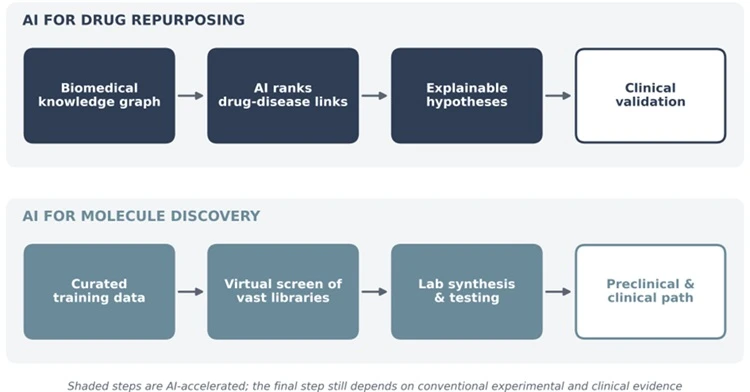
Figure 1. The two engines of AI-enabled R&D: how AI accelerates drug repurposing and new molecule discovery
Why AI Is Rewriting the Economics of Drug Repurposing
Repurposing has always been attractive on paper. A drug with an established human safety profile, a known pharmacokinetic behavior and an existing manufacturing process can, in principle, move into new-indication trials without repeating much of the early work that consumes time and capital in de novo development. In the United States, the 505(b)(2) pathway allows an applicant to rely in part on data it did not generate itself, and the Orphan Drug Act of 1983 offers seven years of market exclusivity for qualifying rare-disease indications. The regulatory architecture for repurposing has existed for decades.
What was missing was a scalable way to find the right drug-disease pairs. AI fills that gap in three ways. Biomedical knowledge graphs connect drugs, protein targets, genes, pathways, phenotypes and diseases into a single network that algorithms can traverse to find non-obvious links. Language models mine millions of publications and trial records to surface mechanistic evidence a human team could never read in full. And models trained on real-world data, such as electronic health records and claims, can detect signals where patients taking a drug for one condition show unexpected improvement in another.
The strategic shift is from opportunism to portfolio discipline. Instead of waiting for a lucky observation, companies can now screen their entire asset base, including discontinued programs, against thousands of diseases and prioritize the most credible hypotheses for investment.
The question is no longer whether an old drug might have a new use, but which of thousands of AI-ranked hypotheses deserves capital first.
Mapping the Untreated: How AI Knowledge Graphs Target Diseases Without Therapies
The scale of unmet need explains why this matters. In a foundation model for drug repurposing published by an academic research team in September 2024, the underlying medical knowledge graph covered 17,080 diseases, and 92% of them lacked any FDA-approved drug. The model, trained on that graph, ranked 7,957 candidate drugs, spanning approved medicines and experimental compounds, as potential indications or contraindications across those diseases.
Two design choices made the work notable for industry. First, it was built for zero-shot prediction, meaning it could propose candidates for diseases with no existing treatments at all, which is precisely where conventional similarity-based methods struggle. Benchmarked against eight other methods under this stringent setting, it improved prediction accuracy by 49.2% for indications and 35.1% for contraindications. Second, it included an explanation module that shows the chain of biological relationships behind each prediction, so clinicians and scientists can judge whether the reasoning is plausible. The researchers also reported that many of its predictions aligned with off-label prescribing decisions made by clinicians in a large healthcare system.
For executives, the relevance is direct. Rare and neglected diseases represent both a significant unmet need and, under U.S. orphan incentives, a viable commercial pathway. Explainability is not a nice-to-have in this context: it is what allows a research committee, and eventually a regulator, to trust an algorithmic suggestion enough to fund a trial.
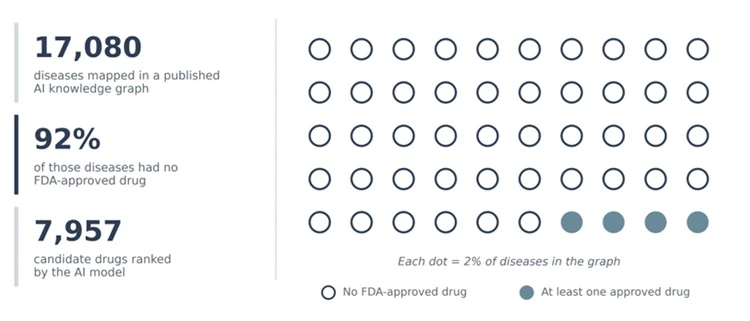
Figure 2. The treatment gap at a glance: key figures from a published AI repurposing model, with each dot representing 2% of the diseases it mapped
Case Study: The AI-Generated Hypothesis That Became an FDA-Approved COVID-19 Therapy
The clearest demonstration of AI-driven repurposing reaching patients came during the COVID-19 pandemic. In early 2020, researchers used an AI-driven biomedical knowledge graph to search for approved drugs that might both limit viral entry into cells and dampen the damaging inflammatory response seen in severe disease. The search pointed to baricitinib, an oral JAK1/JAK2 inhibitor already approved for rheumatoid arthritis. The hypothesis was published in a peer-reviewed medical journal in February 2020.
The hypothesis then had to survive rigorous testing. In a National Institutes of Health-sponsored trial of more than 1,000 hospitalized patients, baricitinib combined with remdesivir shortened time to recovery compared with remdesivir alone. On November 19, 2020, the FDA issued an Emergency Use Authorization for that combination. A subsequent placebo-controlled phase 3 trial enrolled 1,525 hospitalized patients across 101 sites in 12 countries. It did not meet its primary endpoint of disease progression or death by day 28, with rates of 27.8% versus 30.5%. However, 28-day all-cause mortality was 8.1% with baricitinib versus 13.1% with placebo, a 38% relative reduction. In July 2021 the authorization was revised to allow use without remdesivir, and on May 10, 2022, the FDA granted full approval for hospitalized adults requiring supplemental oxygen, non-invasive or invasive mechanical ventilation, or extracorporeal membrane oxygenation.
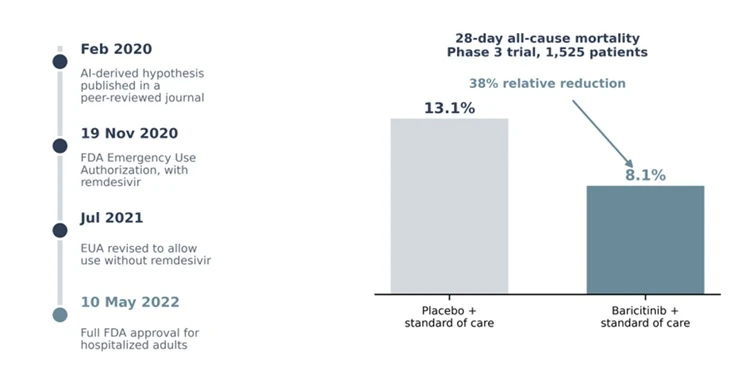
Figure 3. From AI hypothesis to full FDA approval, with the mortality outcome from the phase 3 placebo-controlled trial
Three lessons stand out for leadership teams. AI contributed the hypothesis, not the proof: the value was realized only through large, well-designed randomized trials. The results were mixed as well as positive, a reminder that AI-derived candidates face the same statistical realities as any other. And repurposing inherits a drug's full label, including its risks; the medicine carries a boxed warning covering serious infections, mortality, malignancy, major adverse cardiovascular events and thrombosis. Known safety data accelerates development, but it also defines the benefit-risk debate from the start.
Beyond Repurposing: AI Molecule Discovery Explores Chemical Space at Unprecedented Scale
Where repurposing works with known molecules, AI-enabled discovery searches for new ones. Conventional high-throughput screening is physically limited to the compounds a company can store, dispense and assay. Computational screening has no such ceiling. An academic study published in February 2020 illustrates the point. Researchers trained a deep neural network on just 2,335 molecules labeled for their ability to inhibit bacterial growth, then applied it to chemical libraries totaling more than 107 million molecules.
The model flagged a compound previously investigated as a c-Jun N-terminal kinase inhibitor, renamed halicin, which proved structurally distinct from conventional antibiotics and was active against a broad range of pathogens, including in mouse infection models of Clostridioides difficile and pan-resistant Acinetobacter baumannii. From the larger virtual screen, 23 predictions were tested in the laboratory and eight showed antibacterial activity while being structurally distant from known antibiotics.
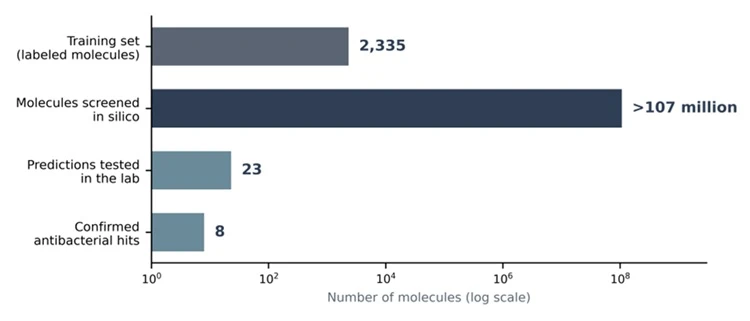
Figure 4. How an AI model narrowed more than 107 million molecules to eight confirmed antibacterial hits
The example shows both the promise and the boundary. AI compressed the search dramatically and found chemistry that human intuition had overlooked, in a therapeutic area where commercial investment has been scarce. Yet a promising preclinical molecule is still years from patients. AI changes the front end of the funnel; it does not remove the clinical, manufacturing and regulatory work that follows.
AI can shrink the search from millions of molecules to a handful, but every candidate must still earn its approval the conventional way.
FDA and AI: The Regulatory Signals Every Pharma Executive Should Read
The FDA has made clear that AI in drug development is a present-day reality rather than a future prospect. In January 2025 the agency issued draft guidance on the use of artificial intelligence to support regulatory decision-making for drug and biological products, proposing a risk-based credibility assessment framework tied to a model's specific context of use. The agency noted that its drug center had seen more than 500 submissions with AI components between 2016 and 2023.
The practical message is that regulators will judge an AI model by how much weight a decision places on it. A model used only to prioritize internal research hypotheses faces little scrutiny; one whose output directly supports safety or efficacy claims in a submission must be documented, validated and monitored. Intellectual property adds another layer. In February 2024, the U.S. Patent and Trademark Office issued guidance confirming that AI-assisted inventions can be patented where a natural person makes a significant contribution. For repurposing strategies that depend on method-of-use patents, demonstrating and recording that human contribution is now a strategic necessity.
Leading the AI-Enabled Pharma Enterprise: Data, Talent and Governance
The companies extracting the most value from AI share a few characteristics. They treat proprietary data, including negative results and discontinued programs, as a strategic asset and invest in making it clean, connected and machine-readable. Models trained only on public literature inherit its publication bias toward positive findings; internal failure data is often what differentiates a model's judgment.
They also build hybrid teams in which computational scientists, medicinal chemists, clinicians and regulatory specialists share accountability for outcomes, rather than handing hypotheses across organizational walls. And they establish governance early: documented model validation, controls for bias in training data, clear rules for when AI output can inform a go or no-go decision, and a coherent view of which capabilities to own and which to access through academic and commercial collaborations. Boards should expect AI investment cases to report not only the number of hypotheses generated, but how many progressed through experimental validation and at what cost.
Conclusion:
Turning AI Insight Into Pharma Pipeline Value
AI has already shown that it can find overlooked value in medicines that are sitting on the shelf and chemistry no one thought to test. A knowledge-graph hypothesis helped deliver an FDA-approved COVID-19 therapy, repurposing models now reason across thousands of untreated diseases, and deep learning has surfaced new antibiotic candidates from more than 100 million molecules. None of these achievements bypassed clinical evidence, and none would have mattered without it.
For American pharmaceutical leaders, the opportunity is to make AI a disciplined engine for deciding where to invest, not a substitute for proving that an investment works. Organizations that pair high-quality data and explainable models with rigorous experimentation, regulatory foresight and clear governance will convert AI's speed into what ultimately counts: more medicines, for more patients, reaching the market with greater confidence.

Lakshmi is a science writer with a foundation in the laboratory. She earned her master's in biotechnology and trained through research internships at ICGEB (JNU) and DIPAS, DRDO, with her work appearing in the Egyptian Journal of Veterinary Sciences. Now APCRM-certified and part of the editorial team at Pharma Focus America and Pharma Focus Europe, she reports on pharmaceutical technology, research, and innovation — giving complex science a clear and confident voice for industry leaders.