


What Is Driving Investment in Cell and Gene Therapy Manufacturing in the US
Lakshmi, Editorial Team, Pharma Focus America
Cell and gene therapy has moved from scientific promise to industrial reality in the United States, and manufacturing has become the decisive battleground. Regulatory reforms easing manufacturing expectations, a federal outcomes-based payment model, new supply-chain security legislation and sustained investor appetite are reshaping where capital is deployed. This article examines the forces behind that investment, explores a landmark access case study and sets out priorities for pharmaceutical leaders building the next generation of capacity.
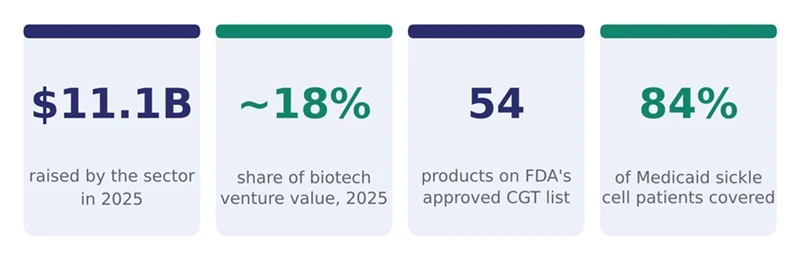
At a glance: the US cell and gene therapy manufacturing landscape. Sources: sector funding data (2025, upfront payments only); FDA list of approved cellular and gene therapy products (September 2026); Centers for Medicare & Medicaid Services (July 2025).
Why Cell and Gene Therapy Manufacturing Is Now a Pharmaceutical Boardroom Priority
In January 2019, the leadership of the US Food and Drug Administration predicted that the agency would be approving 10 to 20 cell and gene therapy products a year by 2025, citing more than 800 investigational new drug applications already received in the field. The science has largely delivered. The FDA's list of approved cellular and gene therapy products now runs to 54 entries, including cord blood products, and spans blood cancers, inherited blindness, haemophilia, sickle cell disease and rare neuromuscular disorders.
Yet the pace of approvals has not matched that forecast. The United States recorded six new cell and gene therapy approvals in 2025, fewer than in 2024. Much of the gap between promise and delivery is a manufacturing story. Discovering a therapy that edits a patient's genes or reprograms their immune cells is one challenge; producing it consistently, affordably and at commercial scale is another. That is why manufacturing, once a back-office function, has become the area where American pharmaceutical leaders are now concentrating capital, talent and strategic attention.
Capital Follows Conviction: The Investment Momentum Behind Cell and Gene Therapy
Investor appetite has proved resilient through a difficult period for biotechnology funding. The cell and gene therapy sector raised US$11.1 billion across 216 financings in 2025, counting upfront payments only. Its share of private capital also grew: cell and gene therapy accounted for roughly 18% of the value of all biotechnology venture financing in 2025, up from about 15% in 2024, and represented 50 of 222 therapeutics venture deals. Strategic buyers were active too, with three acquisitions carrying upfront values of US$1 billion or more.
Commercial results are reinforcing that conviction. Industry data count two blockbuster cell and gene therapies launched between 2021 and 2024, with two more added to that group in 2025. Each commercial success sends the same signal to boards and investors: demand exists, and the constraint on growth is increasingly the ability to manufacture reliably. Capital is therefore flowing towards platforms, facilities and technologies that lower cost per dose, shorten production timelines and reduce batch failure.
Regulatory Reset: How the FDA Is De-Risking Cell and Gene Therapy Manufacturing
For years, sponsors argued that manufacturing rules designed for conventional biologics fitted poorly with therapies made in small batches, sometimes for a single patient. On 11 January 2026, the FDA responded with a more flexible approach to chemistry, manufacturing and controls requirements for cell and gene therapies, which it said would guide its evaluation of development strategies before a biologics license application is filed.
The changes go to the heart of manufacturing economics. The agency confirmed there is no requirement to supply three process performance qualification lots for process validation, and that such lots may in some cases be released concurrently, batch by batch. Final release specifications are not expected until late in development, minor manufacturing changes between early and late-stage trials can be supported by comparability data without onerous requirements, and post-approval revisions to release criteria will be considered once consistent quality is demonstrated. For a therapy serving a few hundred patients a year, avoiding unnecessary validation batches can save months and significant cost.
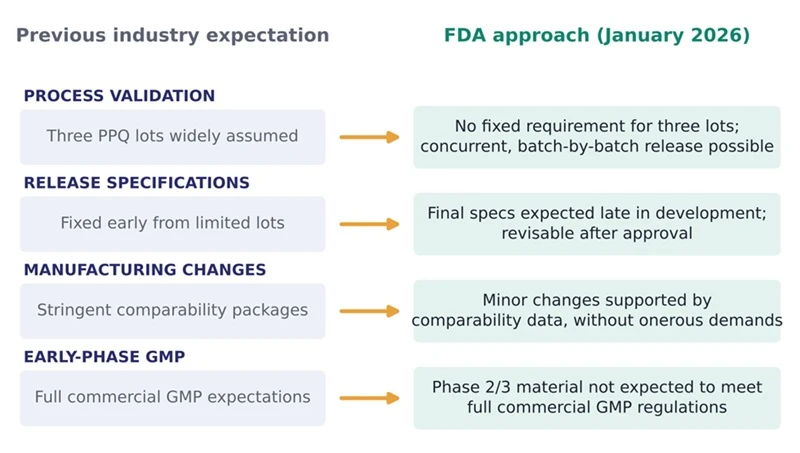
Figure 1: Key elements of the FDA's January 2026 flexible approach to chemistry, manufacturing and controls for cell and gene therapies.
A second reform targets the production technology itself. Under the Advanced Manufacturing Technologies Designation Program, created by the Food and Drug Omnibus Reform Act of 2022 and supported by final guidance issued in December 2024, the FDA must decide on a designation request within 180 days. Designated technologies can benefit from expedited review and allow their data to be relied on in later applications within the same context of use. The first designation from the agency's biologics centre went to an automated cell therapy manufacturing platform in 2025, a clear signal that regulators see automation as part of the solution.
The Cost Equation: Automation and Process Innovation in Cell Therapy Manufacturing
Autologous cell therapies, in which a patient's own cells are collected, engineered and returned, remain among the most complex products the pharmaceutical industry has ever commercialised. A peer-reviewed cost analysis published in 2020 estimated the vein-to-vein cost of an autologous CAR-T therapy at US$78,000 to US$93,000 per patient, including supply chain, with the viral vector and quality control testing identified as key cost drivers.
That analysis also carried a useful warning for investors. A partially automated process proved the most economical on a cost-of-goods basis, but once scale-out and the time value of capital were considered, a manual process was the most cost-effective option at 5,000 patients a year. Automation, in other words, is not automatically cheaper; its value depends on volume, facility design and how quickly capacity is filled. This is why sophisticated investors are scrutinising utilisation assumptions as closely as technology claims, and why flexible, modular facilities that can serve several products are attracting particular interest.
Process innovation is also widening the menu of manufacturing models. Off-the-shelf allogeneic therapies, made from donor cells in larger batches, promise economies of scale that patient-specific products cannot reach. In vivo approaches, which aim to modify cells inside the body rather than in a facility, could shift spending from cleanroom capacity towards vector and delivery technology. Each model implies a different facility footprint, workforce and supply chain, so manufacturing strategy is now inseparable from pipeline strategy. Boards that commit capital to one model are, in effect, placing a bet on which modality will dominate their portfolio a decade from now.
Securing the Supply Chain: Pharmaceutical Resilience Meets National Policy
Supply-chain security has also entered the investment calculus. On 18 December 2025, the BIOSECURE Act became law through the Fiscal Year 2026 National Defense Authorization Act. It generally bars federal agencies from procuring biotechnology equipment or services from designated biotechnology companies of concern, and from contracting with entities that use such equipment or services to perform government contracts. The Office of Management and Budget must publish a full list of designated companies by 18 December 2026, and existing contracts with companies designated later benefit from a five-year safe harbour.
For cell and gene therapy developers, which often depend on specialised vector production, testing and analytical services, the law adds weight to long-term supplier qualification and dual sourcing. The practical effect is not a sudden disruption, but a gradual premium on manufacturing and testing partners whose ownership and operations will remain beyond doubt for the life of a product.
Case Study: How an Outcomes-Based Federal Model Is Turning Gene Therapy Demand into Predictable Volume
Manufacturing investment ultimately depends on predictable demand, and for one-time therapies with high upfront prices, payment has been a persistent barrier. Sickle cell disease illustrates the challenge. The inherited blood disorder affects an estimated 100,000 Americans, many of whom rely on Medicaid. Two gene therapies for the condition were approved by the FDA in December 2023, but state Medicaid programmes faced the difficulty of funding a one-time treatment whose benefits accrue over many years.
The Centers for Medicare & Medicaid Services responded with the Cell and Gene Therapy Access Model. Rather than each state negotiating alone, the federal agency negotiates outcomes-based agreements with manufacturers on behalf of participating state Medicaid programmes, with input from states, patients and providers. If a therapy does not deliver its expected clinical benefit, participating states receive guaranteed discounts and rebates. States can also draw on up to US$9.55 million each in optional federal support for implementation, outreach and data collection.
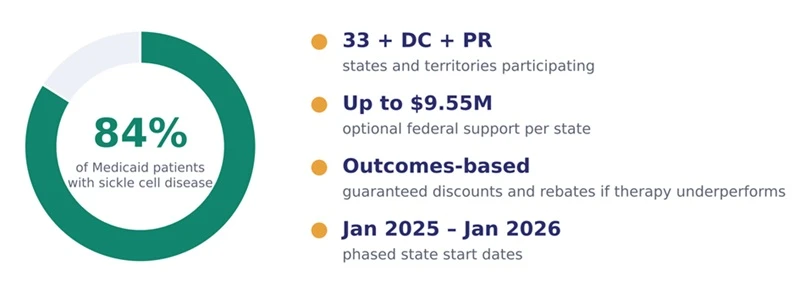
Figure 2: Reach of the federal Cell and Gene Therapy Access Model for sickle cell disease. Source: US Department of Health and Human Services, July 2025.
In July 2025, the agency announced that 33 states, the District of Columbia and Puerto Rico had joined, together covering approximately 84% of Medicaid beneficiaries living with sickle cell disease, with start dates phased between January 2025 and January 2026. For manufacturers, the model's significance extends beyond a single disease. Pooled, outcomes-linked purchasing turns fragmented, uncertain demand into a more visible patient pipeline, which in turn supports confident capacity planning. It also raises the bar operationally: when payment depends on outcomes, manufacturing consistency, on-time delivery and robust real-world data systems become directly tied to revenue.
Strategic Imperatives for Pharmaceutical Leaders in Cell and Gene Therapy Manufacturing
Taken together, these drivers point to a clear agenda for the American C-suite. The first priority is to treat manufacturing strategy as a core part of development, not a downstream task. The FDA's new flexibilities reward sponsors who build deep process understanding early, because that knowledge now justifies fewer validation batches and more adaptable specifications.
The second is disciplined capacity planning. With automation economics highly sensitive to volume, leaders should match facility investments to realistic demand curves, favouring modular, multi-product designs and partnerships that share fixed costs. The third is supply-chain assurance, qualifying vector, testing and raw-material partners with a view to the full commercial life of each product. Finally, companies should build the outcomes-tracking and patient-support infrastructure that value-based payment models increasingly demand, linking manufacturing performance to the commercial promise made to payers.
Conclusion:
Building the Industrial Backbone of American Cell and Gene Therapy
The forces driving investment in US cell and gene therapy manufacturing are mutually reinforcing. Regulators have signalled that manufacturing rules will fit the realities of small-batch, personalised products. Investors continue to commit billions of dollars to the field. Federal payment innovation is beginning to convert clinical promise into predictable demand, while new legislation is reshaping supplier choices.
The FDA's 2019 forecast of 10 to 20 approvals a year has not yet been met, and manufacturing remains the main reason. The pharmaceutical organisations that close that gap, by producing living medicines reliably, affordably and at scale, will define the next decade of American biomedicine. For today's leaders, the decisions made on manufacturing capability in the next few years will shape who leads the field, and how many patients ultimately benefit.

Lakshmi is a science writer with a foundation in the laboratory. She earned her master's in biotechnology and trained through research internships at ICGEB (JNU) and DIPAS, DRDO, with her work appearing in the Egyptian Journal of Veterinary Sciences. Now APCRM-certified and part of the editorial team at Pharma Focus America and Pharma Focus Europe, she reports on pharmaceutical technology, research, and innovation — giving complex science a clear and confident voice for industry leaders.