
Why Data Integrity Continues to Matter in FDA Inspections
Lakshmi, Editorial Team, Pharma Focus America
Data integrity has been an FDA enforcement priority for more than a decade, yet it still drives some of the most serious inspection outcomes in pharma. As unannounced foreign inspections expand, software assurance expectations evolve and AI enters quality operations, the question is no longer whether records are complete, but whether leadership can prove they are true. This article explains why data integrity remains a C-suite issue for American pharma leaders.
WHY DATA INTEGRITY IS A TRUST PROBLEM, NOT A PAPERWORK PROBLEM
Every FDA inspection rests on a simple bargain. Investigators cannot watch every batch being made or every sample being tested, so they rely on records to tell them what happened. When those records are trustworthy, an inspection becomes a focused review of how well a company manages risk. When they are not, everything the company reports, from stability results to release decisions, becomes suspect at once.
That is why data integrity has stayed near the top of FDA findings long after the agency published its question-and-answer guidance on the topic in 2018. The underlying rules have not changed much. The requirements of 21 CFR Parts 210 and 211 and the electronic records provisions of 21 CFR Part 11 have been in place for decades. What has changed is the operating environment: more data, more systems, more outsourced partners, more inspections without advance notice and, increasingly, algorithms making or supporting decisions that used to be made by people.
For American pharma leaders, data integrity is therefore best understood not as a laboratory housekeeping matter but as a measure of whether the organization can be believed. Regulators, investors, partners and patients all draw conclusions from it.
THE PERSISTENT PATTERN BEHIND DATA INTEGRITY FINDINGS
Read across several years of FDA Form 483 observations and warning letters, and a consistent pattern emerges. The most serious data integrity findings are rarely about exotic technology. They are about basic controls that were assumed to be working but were not.
Shared logins on chromatography systems make it impossible to know who performed an analysis. Audit trails are switched off, or switched on but never reviewed. Analysts run trial injections before the official test and discard results that look unfavorable. Out-of-specification results are invalidated without a scientifically sound investigation. Paper worksheets are completed after the fact, or exist in more than one version. Raw electronic data is deleted to free up storage, leaving only a printed summary behind.
Each of these failures touches a specific regulatory requirement, but their real significance lies elsewhere. They suggest that the quality system can be overridden when schedules are tight or results are inconvenient. Investigators treat them seriously for exactly that reason.
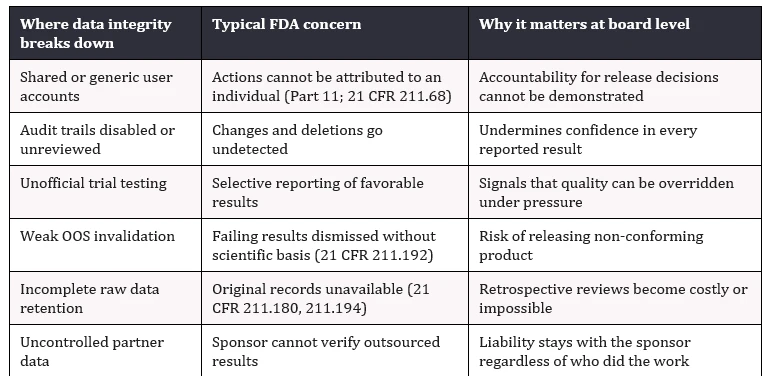
Table 1: Common data integrity failure points, the FDA concerns they raise, and their strategic significance.
FOUR SHIFTS RAISING THE STAKES FOR DATA INTEGRITY IN FDA INSPECTIONS
Inspections Without Warning
In 2025, the FDA announced that it would expand unannounced inspections at foreign manufacturing sites, bringing overseas facilities closer to the conditions domestic sites have long experienced. For companies relying on global supply networks, this removes the window in which a site could prepare its records before investigators arrive. Data integrity that depends on advance notice is not data integrity at all.
Software Assurance Replacing Paper-Heavy Validation
The FDA's final guidance on computer software assurance for production and quality system software, issued in 2025, encourages a risk-based approach that concentrates testing effort where software failure could affect product quality or patient safety. This is good news for efficiency, but it places more weight on management's judgment. Companies must be able to explain why a system was considered high or low risk, and that explanation itself becomes part of the record investigators will review.
Data Volumes Outpacing Human Review
Modern manufacturing and laboratory environments produce vast quantities of electronic data, from process sensors to instrument audit trails. Manual review of every entry is unrealistic, yet periodic, risk-based review is expected. Organizations that have not invested in tools to surface anomalies automatically face a growing gap between what they are expected to know and what they actually know about their own data.
Algorithms Entering Quality Decisions
Machine learning is beginning to support visual inspection, deviation trending and predictive maintenance. When an algorithm influences a GMP decision, its training data, version history and performance monitoring become part of the data integrity picture. Leaders should expect investigators to ask how a model's outputs can be traced, reproduced and challenged, in the same way they would question any analytical method.
WHAT DATA INTEGRITY FAILURES REALLY COST AMERICAN PHARMA
The direct consequences of serious data integrity findings are well known: warning letters, import alerts for foreign sites, delayed or withheld approvals for applications that reference the affected facility, and in severe cases consent decrees that place operations under external oversight for years.
The indirect costs are often larger and less visible. Once the FDA questions a site's data, previously submitted results may need to be re-examined, sometimes requiring retrospective reviews of years of laboratory records. Commercial partners may pause technology transfers. Supply agreements can be disrupted while alternative sources are qualified. Inside the organization, scientists and quality staff are diverted from development and improvement work into remediation, often for an extended period.
Reputation compounds the damage. Warning letters are public documents, and the language used in data integrity citations tends to be stark. Analysts, acquirers and prospective partners read them, and the narrative they create can outlast the remediation itself.
“Remediation is measured in months. Rebuilding regulatory trust is measured in inspection cycles.”
LEADERSHIP BEHAVIORS THAT MAKE DATA INTEGRITY DURABLE
Technical controls are necessary, but they are not what distinguishes companies with strong data integrity records. The difference usually lies in how leaders behave when quality data delivers unwelcome news.
Rewarding the messenger: Where an out-of-specification result is treated as a problem to be explained away, analysts learn to avoid generating one. Where it is treated as valuable information, they report it promptly. Executives set this tone through how they respond to bad news in operational reviews, not through policy statements.
Removing pressure that invites shortcuts: Release targets, headcount reductions and aggressive launch timelines all create incentives to cut corners. Responsible leaders test whether their plans are achievable without compromising records, and they adjust targets when the honest answer is no.
Funding the unglamorous infrastructure: Unique user accounts, network-connected instruments, secure data storage and automated audit trail review rarely appear on a strategic roadmap. They are nonetheless the foundation on which every other quality investment depends, and they deserve protected budgets.
Extending expectations to partners: A product is only as reliable as the least controlled lab that tested it. Quality agreements with contract manufacturers and testing laboratories should give the sponsor clear rights to access raw data and audit trails, and oversight visits should examine data practices, not just facilities.
Asking better questions in the boardroom: Rather than asking whether the company had any data integrity findings, boards can ask how many potential issues were detected internally before an investigator found them. Self-detection is one of the clearest signs that data governance is working.
CASE STUDY: REBUILDING DATA INTEGRITY AFTER AN FDA WAKE-UP CALL
This case study is an anonymised composite based on recurring patterns in US pharma remediation programs. Details have been generalised and figures are indicative.
Background: A US-based manufacturer of generic oral solid dose products, operating one domestic site and relying on an overseas contract laboratory for part of its release testing, underwent a routine FDA surveillance inspection. Investigators identified shared administrator accounts on chromatography software, audit trails that had not been reviewed for over a year, and several invalidated out-of-specification results with weak justification. The resulting Form 483 led to a warning letter, and two pending generic applications referencing the site were placed on hold.
Leadership response: The chief executive made the remediation a standing item at every executive meeting and appointed a dedicated program lead reporting jointly to the chief operating officer and the head of quality. An independent consultancy carried out a retrospective review of three years of laboratory data to establish whether any released batches had been affected. None were found to be out of specification, but the review was documented thoroughly and shared transparently with the agency.
Structural changes: The company replaced standalone instrument workstations with a networked chromatography data system, eliminated shared accounts and introduced automated flags for deleted, modified or aborted runs. Out-of-specification investigation procedures were rewritten with clear scientific criteria for invalidation. The contract laboratory's quality agreement was renegotiated to provide direct read-only access to raw data, and the company began quarterly data-focused audits of that partner.
Cultural changes: Analysts were retrained not only on procedures but on why data integrity matters to patients. Supervisors were assessed partly on the timeliness of deviation reporting, and an anonymous channel for raising data concerns was introduced and actively promoted by senior leaders.
Results: After roughly two years, a reinspection found no data integrity observations and the warning letter was closed out. Internally detected data anomalies rose sharply in the first year, which leadership treated as a positive sign of transparency, before declining steadily as root causes were addressed. Both held applications were eventually approved.
Key insight: The turning point came when leadership stopped treating the warning letter as a laboratory problem and began treating it as a governance problem that touched incentives, partnerships and culture.
BUILDING A DATA INTEGRITY STRATEGY THAT SURVIVES ANY FDA INSPECTION
The most resilient organizations approach data integrity as an enterprise capability with a defined owner, measurable indicators and a multi-year investment plan. They map critical data flows from instrument to release decision and identify every point where data could be altered, lost or misinterpreted. They classify systems by risk, in line with modern software assurance thinking, and match the depth of their controls to that classification.
They also prepare for scrutiny that arrives without notice. That means being able to retrieve original electronic records quickly, demonstrate who accessed and changed them, and explain the scientific rationale behind every invalidated result. Mock inspections that test these abilities under realistic time pressure reveal gaps far more effectively than document reviews.
Finally, they recognize that data integrity is never finished. New systems, acquisitions, partners and technologies continually introduce new risks. A program that is reviewed and refreshed regularly will hold up far better than one designed to close out a single set of findings.
CONCLUSION: DATA INTEGRITY AS THE CURRENCY OF REGULATORY TRUST
Data integrity continues to matter in FDA inspections because it underpins every other judgment an investigator makes. A company with sound processes but unreliable records cannot demonstrate that its processes are sound. A company with reliable records, even one that has encountered problems, can show that it detected and addressed them.
For American pharma C-suite leaders, the implication is clear. Data integrity should be governed with the same seriousness as financial reporting, because in the eyes of regulators it serves a similar purpose. Organizations that invest in trustworthy data, and in a culture that protects it, gain faster approvals, smoother inspections, stronger partnerships and a reputation that becomes a lasting competitive advantage.

Lakshmi is a science writer with a foundation in the laboratory. She earned her master's in biotechnology and trained through research internships at ICGEB (JNU) and DIPAS, DRDO, with her work appearing in the Egyptian Journal of Veterinary Sciences. Now APCRM-certified and part of the editorial team at Pharma Focus America and Pharma Focus Europe, she reports on pharmaceutical technology, research, and innovation — giving complex science a clear and confident voice for industry leaders.