
Why Data Integrity Is Becoming Critical for Pharmaceutical Quality Management
Lakshmi, Editorial Team, Pharma Focus America
Data integrity has moved from a laboratory compliance topic to a board-level business risk. FDA drug quality assurance inspections climbed from 522 in fiscal 2022 to 1,248 in fiscal 2025, and enforcement now reaches beyond factories to contract laboratories, remote records requests and digital systems. This article examines why trustworthy data now underpins approvals, supply continuity and reputation, and how American pharmaceutical leaders can build integrity into quality culture, technology and partnerships.
Why Data Integrity Now Sits on the Pharmaceutical Boardroom Agenda
Every pharmaceutical product reaches a patient on the strength of a promise: that the records describing how it was developed, tested, manufactured and released are complete, accurate and true. For decades, that promise was treated as the domain of laboratory analysts and quality auditors. Today it has become a strategic concern for chief executives, boards and investors.
Three forces explain the shift. First, regulatory scrutiny of manufacturing sites in the United States and abroad has intensified sharply. Second, the volume of data generated by modern operations, from chromatography systems to manufacturing execution platforms and cloud-based laboratory software, has expanded beyond what paper-era controls were designed to manage. Third, the pharmaceutical value chain is now heavily outsourced, which means a company's regulatory standing can depend on records created by partners it does not directly control.
The consequence is simple but profound. Data integrity is no longer just a compliance requirement. It is the foundation on which approvals, supply continuity, payer confidence and corporate reputation rest. When it fails, the damage rarely stays inside the quality department.
The Inspection Surge Putting Pharmaceutical Data Integrity Under the Microscope
The Food and Drug Administration's annual reports on the state of pharmaceutical quality show how quickly oversight has accelerated. The agency conducted 522 drug quality assurance inspections in fiscal year 2022, 766 in fiscal 2023 and 972 in fiscal 2024. In fiscal 2025, the total reached 1,248, more than double the 2022 level.
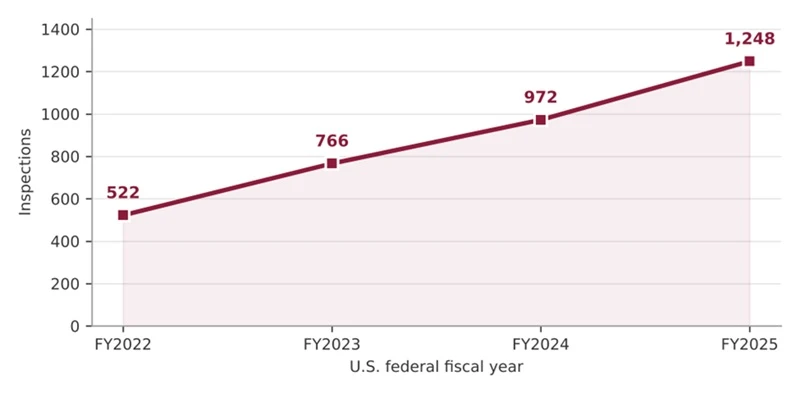
Figure 1: FDA drug quality assurance inspections by fiscal year, FY2022–FY2025. Source: FDA Reports on the State of Pharmaceutical Quality (FY2024 and FY2025).
The composition of that growth matters for American leaders. Domestic inspections rose from 432 in fiscal 2024 to 702 in fiscal 2025, an increase of about 62%, while foreign inspections held broadly steady at 546. As the country pushes to expand domestic manufacturing capacity, U.S. sites should expect inspection intensity to stay high, not fade.
Enforcement has followed the same direction. In fiscal 2024, the FDA issued 105 warning letters to human drug manufacturing sites for drug quality, the highest such total in five years. The agency also makes increasing use of its authority under Section 704(a)(4) of the Federal Food, Drug, and Cosmetic Act to request records in advance of or in lieu of an inspection. A request for records is, in effect, a data integrity test conducted remotely: organizations that cannot produce complete, reliable documentation quickly are exposed before an investigator ever arrives.
Beyond ALCOA: What Data Integrity Means in Modern Pharma Quality Management
The core expectation has not changed. Since its final guidance on data integrity and drug current good manufacturing practice in December 2018, the FDA has made clear that cGMP data must be attributable, legible, contemporaneous, original and accurate, the familiar ALCOA principles. Industry has since extended that framework to ALCOA+, adding requirements that data be complete, consistent, enduring and available throughout its lifecycle. Electronic records and signatures remain governed by 21 CFR Part 11, a regulation first issued in 1997.
What has changed is the environment in which these principles must operate. A single batch may now generate thousands of electronic data points across interconnected systems. Audit trails, user access privileges, system configuration, backup and archiving, and data transfers between platforms all represent points of potential failure. Many data integrity lapses are not acts of fraud but symptoms of weak system design: shared logins, disabled audit trails, unreviewed metadata, or spreadsheets operating outside validated environments.
For senior leaders, the key insight is that data integrity is a property of the whole quality system rather than of individual records. It depends on governance, technology, procedures and behavior working together. That makes it a management responsibility, not a technical one.
Case Study: How One Laboratory's Data Integrity Failure Rippled Across the Generic Pharmaceutical Market
In March 2025, the FDA notified pharmaceutical companies that certain studies performed by a contract research organization in India could no longer be relied upon. Following inspections between 2019 and 2023, and correspondence with the firm in 2024, the agency concluded that the organization had created falsified in vitro data that had been submitted to the FDA in support of drug applications.
The consequences extended far beyond the laboratory itself. The FDA declared the affected in vitro studies unacceptable, requiring them to be repeated at sites without data integrity concerns where they were essential to approval. For approved products that relied on the questioned bioequivalence data, the agency changed the therapeutic equivalence rating to BX, meaning those products were no longer recommended for automatic substitution at the pharmacy, even though they remained approved. Holders of affected applications were given 30 days to submit a plan either to repeat the studies or to request voluntary withdrawal of approval.
For generic manufacturers, automatic substitution is the commercial engine of the business model. Losing it can erode market share almost immediately, while repeat studies add cost and delay. Crucially, the sponsors bearing these consequences were not the organization that generated the questionable data. They had outsourced the work, and with it, a significant portion of their regulatory risk. The episode was not isolated: the FDA had issued comparable notifications about other contract testing sites earlier in the decade.
The lesson for executives is direct. Outsourcing an activity does not outsource accountability. Sponsor oversight of partners, including independent data audits, review of raw data and audit trails, and contractual rights to inspect, is now a strategic safeguard for revenue, not an administrative formality.
Digital Quality Systems and AI: The Next Frontier of Pharmaceutical Data Integrity
Digital transformation offers the best long-term remedy for data integrity risk, but only if it is implemented with integrity built in. Integrated laboratory information management systems, electronic batch records and automated data capture can eliminate many manual transcription steps where errors and manipulation occur. Centralized audit trail review and automated exception reporting allow quality teams to focus on anomalies rather than sampling documents by hand.
Artificial intelligence adds both promise and complexity. Machine learning tools are increasingly used to detect deviations, predict equipment failures and support release decisions. Yet any AI system is only as trustworthy as the data used to train and operate it. In January 2025, the FDA published draft guidance outlining a risk-based credibility framework for AI used to support regulatory decision-making for drugs and biological products. Executives should expect regulators to ask not only what an algorithm concluded, but how its inputs were controlled, how the model was validated and how its outputs were documented.
The practical implication is that data governance must precede digital ambition. Companies that automate poorly governed processes simply generate unreliable data faster.
The Hidden Business Cost of Weak Data Integrity in Pharma
Data integrity failures carry costs that are often underestimated because they surface in different parts of the business. A warning letter can delay pending approvals tied to the affected site. An import alert can block products from entering the U.S. market. Remediation programs frequently require outside consultants, retrospective data reviews and system replacements that consume years of management attention. Supply interruptions can trigger shortages, damaging relationships with health systems, distributors and payers.
There are less visible costs, too. Investors and acquirers increasingly examine quality history during due diligence, and a record of data integrity findings can reduce valuations or derail transactions. Contract manufacturers with weak records struggle to win new business. And because regulators share inspection intelligence with international counterparts, a problem uncovered in one jurisdiction can quickly affect standing in others.
Seen this way, investment in data integrity is closer to insurance than overhead. Its return is measured in approvals that arrive on time, supply that does not break, and reputations that remain intact.
Building a Data Integrity Culture: A Leadership Mandate for Pharmaceutical Executives
Technology and procedures matter, but regulators consistently identify culture as the decisive factor. Data integrity breaks down when employees feel pressure to meet production targets at the expense of accurate reporting, or when raising concerns is perceived as career-limiting. Only leadership can change those incentives.
The most effective organizations make data integrity visible at the top. Boards receive regular reporting on quality metrics, including audit trail review findings, repeat deviations and partner audit outcomes, alongside financial performance. Executives set the expectation that a missed timeline is acceptable but an inaccurate record is not. Quality units are resourced and empowered to stop work without fear of reprisal.
Leading companies also connect data integrity to broader quality maturity. The FDA has signaled growing interest in quality management maturity, encouraging manufacturers to move beyond minimum compliance toward continual improvement. Organizations that treat integrity as a capability to be built, rather than a finding to be closed, are better positioned for that future and for the more data-driven inspections it implies.
Conclusion: Data Integrity Is the New Currency of Pharmaceutical Trust
The evidence points in one direction. Inspections are increasing, enforcement reaches deeper into supply chains, and digital systems are multiplying both the volume of data and the ways it can fail. In this environment, data integrity has become a core determinant of whether a pharmaceutical company can secure approvals, maintain market access and protect its reputation.
For American C-suite leaders, the task is to elevate data integrity from a compliance checkbox to a strategic capability, one built into governance, technology, partnerships and culture. Companies that make this shift will not merely avoid regulatory trouble. They will earn the trust of regulators, partners, payers and patients, which remains the most valuable asset any pharmaceutical business can hold.

Lakshmi is a science writer with a foundation in the laboratory. She earned her master's in biotechnology and trained through research internships at ICGEB (JNU) and DIPAS, DRDO, with her work appearing in the Egyptian Journal of Veterinary Sciences. Now APCRM-certified and part of the editorial team at Pharma Focus America and Pharma Focus Europe, she reports on pharmaceutical technology, research, and innovation — giving complex science a clear and confident voice for industry leaders.