

Why Peptide Manufacturing Is Becoming a Major Opportunity for US CDMOs
Lakshmi, Editorial Team, Pharma Focus America
Peptide medicines have moved from a specialist corner of the pharmaceutical market to the center of US demand, driven by GLP-1 therapies, a first wave of generic peptides and new rules on where critical ingredients are made. Yet peptide synthesis remains capacity-limited, waste-intensive and technically unforgiving. This article explains why that combination is creating a rare, durable opportunity for US contract development and manufacturing organizations, and what it will take to capture it.
The Peptide Moment for American Contract Manufacturing
For most of the past two decades, peptides were the pharmaceutical industry's awkward middle child. Too large and fragile to behave like small molecules, yet too small to justify the infrastructure of biologics, they were made in modest volumes by a limited number of specialist suppliers. That world has ended. Peptide-based medicines now sit at the heart of the largest therapeutic growth story in modern US healthcare, and the manufacturing base has not kept pace.
The demand signal is unmistakable. According to the National Center for Health Statistics, 40.3% of US adults lived with obesity during August 2021 to August 2023, and 9.4% lived with severe obesity. GLP-1 receptor agonists, most of them peptides, have become a primary pharmacological response to that burden, alongside their established role in type 2 diabetes and emerging cardiovascular and kidney indications.
For US contract development and manufacturing organizations (CDMOs), this is more than a volume story. Peptide manufacturing combines scarce technical know-how, heavy capital requirements and growing policy pressure to source critical ingredients domestically. Few opportunities in the outsourcing market offer that mix of high barriers to entry and sustained demand. The leaders who move decisively now are positioning their companies for a decade-long advantage.
The Peptide Demand Curve: Three Forces Converging
The first force is innovation. Branded GLP-1 medicines created a demand shock that the industry spent years trying to absorb; injectable semaglutide did not leave the US Food and Drug Administration's shortage list until February 21, 2025. Behind them sits a crowded pipeline of next-generation incretin and multi-agonist peptides, many of them developed by small and mid-sized biotechs that own no manufacturing assets and must outsource from the first clinical batch onward.
The second force is format. Oral peptide tablets dramatically increase the quantity of active pharmaceutical ingredient (API) a single patient consumes, because only a small fraction of a swallowed peptide is absorbed. At approved maintenance doses, a daily 25 mg oral semaglutide tablet uses 700 mg of API every 28 days, against 9.6 mg for the weekly 2.4 mg injection. Every patient who moves to an oral peptide multiplies upstream synthesis demand many times over.
The third force is genericization. In November 2024, the FDA approved the first generic GLP-1 medicine, referencing exenatide, and on December 23, 2024 it approved the first generic of the daily liraglutide injection, noting that generic applications in this class were a priority because of ongoing shortages. Generic peptide developers face demanding expectations on impurity profiles and sameness, and they need partners able to deliver high-purity API at competitive cost. As further peptide exclusivities expire, this segment will add a second, price-driven layer of demand on top of branded volume.
Why Peptide Synthesis Is So Hard to Scale
Peptides are typically produced by solid-phase peptide synthesis, in which amino acids are added one at a time to a growing chain anchored on resin beads. Each coupling and deprotection step must run at very high efficiency, because small losses compound across dozens of cycles into significant yield and purity penalties. The crude peptide is then cleaved from the resin, purified through repeated rounds of preparative chromatography and isolated, often by lyophilization, before it is ready for formulation.
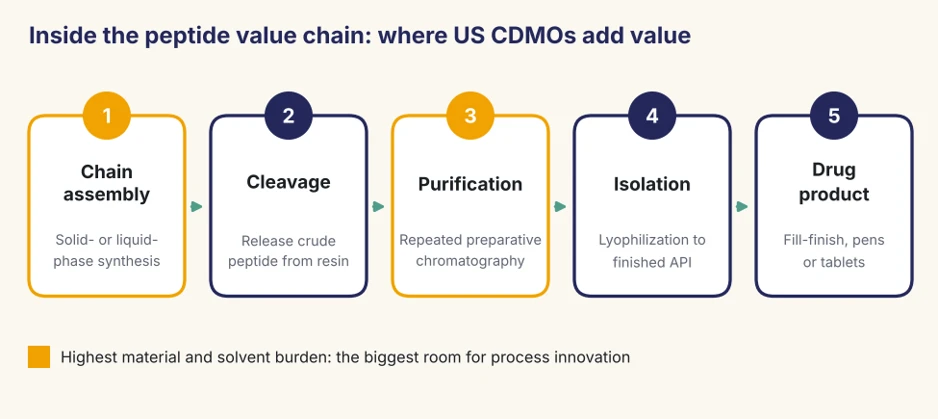
Figure 1: The main stages of peptide manufacturing and where CDMOs add value.
That sequence carries an environmental and economic burden that sets peptides apart. An assessment of 40 synthetic peptide processes coordinated by the ACS Green Chemistry Institute Pharmaceutical Roundtable found that solid-phase peptide synthesis has a process mass intensity of roughly 13,000, meaning around 13,000 kilograms of materials consumed per kilogram of finished API. The comparable figures were roughly 168 to 308 for small molecules and about 8,300 for biopharmaceuticals.
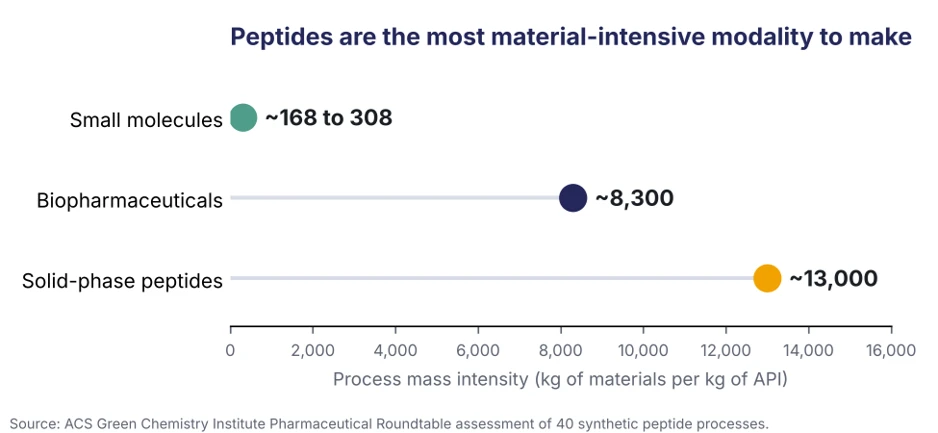
Figure 2: Process mass intensity of peptides compared with other modalities.
For a CDMO, these numbers translate into specific capital needs: large-scale synthesizers, solvent handling and recovery systems, high-capacity chromatography, and environmental permits that take time to secure. They also define where competitive advantage lies. Every percentage point of yield improvement and every liter of solvent recovered flows directly into cost per gram, which is exactly what both branded and generic sponsors will negotiate on.
The Policy Tailwind Behind US Peptide Capacity
Commercial demand alone would justify investment, but US policy is now amplifying it. The BIOSECURE Act became law on December 18, 2025 as part of the National Defense Authorization Act for Fiscal Year 2026. It bars federal agencies from contracting with companies that use biotechnology equipment or services from designated companies of concern to fulfill those contracts, with an initial list due within a year of enactment and a phased implementation through federal acquisition rules. For sponsors whose peptide supply chains run through such providers, the law creates a strong incentive to qualify alternative partners well before the rules bite.
Trade measures are adding further weight. A presidential proclamation issued on April 2, 2026 imposed tariffs of up to 100% on imported patented pharmaceuticals, and its coverage explicitly extends to their active ingredients and key starting materials. The final phase took effect on September 29, 2026, while products of US origin and generic medicines are currently exempt. For innovators bringing patented peptides to the American market, domestic API production has become a strategic hedge rather than a nice-to-have.
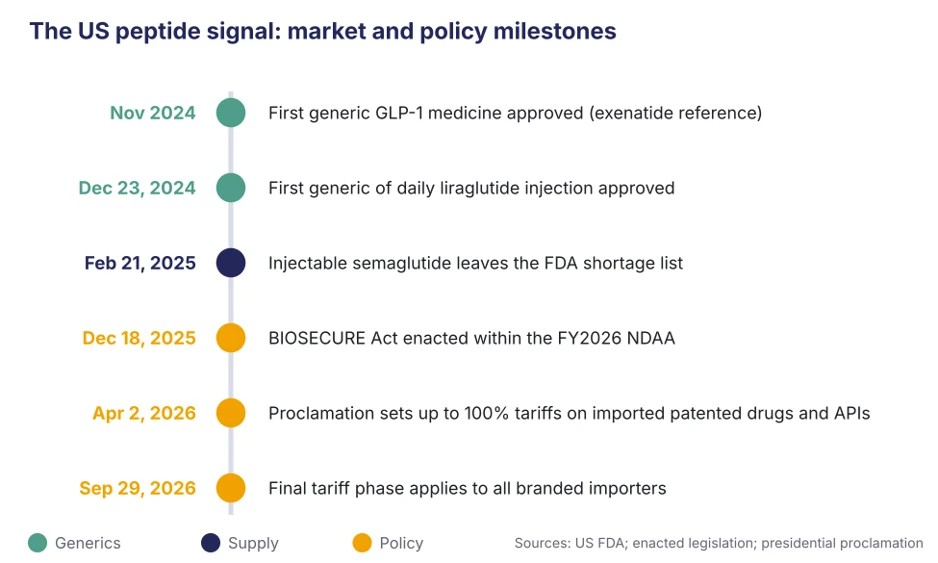
Figure 3: Market and policy milestones shaping US peptide manufacturing demand.
Taken together, these measures change the calculus of sourcing decisions. Price per kilogram remains important, but supply assurance, regulatory continuity and the geographic origin of each manufacturing step are now board-level considerations. US CDMOs with qualified peptide capacity are among the few partners that can answer all three questions at once.
Case Study: A Billion-Dollar Bet on American Peptide Scale
One recent strategic move illustrates the scale of ambition now visible in this market. In 2024, a European-headquartered peptide CDMO announced plans to invest €900 million, then about $984 million, over three years to expand its GLP-1 and peptide platform. In the United States, the program covers additional manufacturing trains at its existing plant in Colorado alongside the construction of a new large-scale peptide facility at the same location, while a new greenfield site is planned in Europe.
The investment was underpinned by customer commitments rather than speculation. A clinical-stage obesity drug developer agreed to pay the CDMO $150 million through 2028 for the production of its investigational dual GIP/GLP-1 receptor agonist, securing capacity years before any potential approval. The company subsequently agreed to acquire a US-based peptide contract manufacturer with operations in South Carolina and Shanghai and about 400 employees, a move that would give it a second American peptide production site and fully US-based API supply options for large commercial projects.
Three lessons stand out for American executives. First, sponsors are willing to pre-commit significant sums to lock in peptide capacity, which reduces the risk of building ahead of demand. Second, acquisition is proving a faster route to scale than greenfield construction, because experienced peptide teams and validated processes are as scarce as steel and equipment. Third, a credible US footprint has become a selling point in its own right, as sponsors seek supply chains that will stand up to both trade and national-security scrutiny.
Where US Peptide CDMOs Can Win
The opportunity is broad, but it is not uniform. The most attractive positions combine technical depth with commercial scale. Early-stage biotechs need partners that can support process development, impurity characterization and regulatory filings from the clinic onward, and they tend to remain with a CDMO that has carried them through approval. Large innovators, meanwhile, want multi-ton capacity, dual sourcing and the confidence that a partner can scale without compromising quality.
Process innovation is a second battleground. Hybrid approaches that combine solid-phase and liquid-phase chemistry, continuous or semi-continuous synthesis, greener solvent systems and more efficient chromatography all target the waste and cost burden that defines the modality. CDMOs that can demonstrate a measurably lower process mass intensity will win on cost, ease environmental permitting and support the sustainability commitments their customers now report to investors.
Integration is the third. Sponsors increasingly value partners that can link peptide API with downstream steps such as formulation, sterile fill-finish and, for oral products, specialized tablet manufacturing. Each hand-off between suppliers adds time, technology-transfer risk and regulatory complexity. A US CDMO able to offer a coherent path from amino acid to finished dose gives sponsors fewer points of failure and a simpler story for regulators.
Talent may be the hardest constraint of all. Peptide chemists, purification specialists and operators experienced in large-scale synthesis are in short supply nationwide. Companies that invest early in training pipelines, partnerships with universities and community colleges, and retention programs will be able to bring new capacity online faster than rivals that rely solely on recruitment.
Conclusion: Turning Peptide Momentum into a Lasting US CDMO Advantage
Peptide manufacturing has become one of the clearest growth opportunities in American contract manufacturing because several forces now point in the same direction. Patient demand for GLP-1 therapies is vast, oral formats are multiplying API requirements, generic peptides are entering the market, and federal policy is rewarding domestic, trusted supply. At the same time, the modality's technical complexity and heavy resource intensity keep the number of capable providers small.
For C-suite leaders at US CDMOs, the window is real but finite. Capacity announced today will take years to qualify, and the sponsors choosing partners now are making decisions that will last a decade. Those who pair disciplined capital allocation with genuine process innovation, integrated services and a deliberate investment in people will not simply ride the peptide wave. They will help define how America makes its most important medicines for the next generation.

Lakshmi is a science writer with a foundation in the laboratory. She earned her master's in biotechnology and trained through research internships at ICGEB (JNU) and DIPAS, DRDO, with her work appearing in the Egyptian Journal of Veterinary Sciences. Now APCRM-certified and part of the editorial team at Pharma Focus America and Pharma Focus Europe, she reports on pharmaceutical technology, research, and innovation — giving complex science a clear and confident voice for industry leaders.