

Why Rare-Disease Medicines Are Reshaping U.S. Pharma Commercialization
Lakshmi, Editorial Team, Pharma Focus America
Rare-disease medicines now account for half of new U.S. drug approvals, yet each typically serves fewer than 200,000 patients. That arithmetic is rewriting pharma commercialization, from diagnosis-led demand generation and specialty distribution to value-based contracting. This article examines the numbers behind the shift, the 2025 to 2026 policy changes reshaping orphan economics, and a personalized gene-editing case that points toward platform-based rare-disease business models.
Rare-Disease Medicines Move to the Center of Pharma Strategy
For most of the modern era, U.S. pharmaceutical commercialization followed a familiar formula. Companies built large sales forces, targeted high-prescribing physicians, negotiated formulary access with major payers and relied on volume to recover development costs. That formula was designed for medicines that millions of patients would take for years.
Rare-disease medicines invert nearly every element of it. Under the Orphan Drug Act of 1983, a rare disease in the United States is one affecting fewer than 200,000 people. Some conditions now targeted by new therapies affect a few hundred patients nationwide, or, in the case of bespoke genetic treatments, a single child. Yet these medicines are no longer a specialty sideline. They have become the largest single category of new U.S. drug approvals, and they are forcing pharma leaders to rethink how products find patients, how prices are justified and how commercial teams are organized.
This shift matters well beyond companies that define themselves as rare-disease specialists. The capabilities that orphan medicines demand, from precise patient identification to outcomes-based payer engagement, are increasingly the capabilities that determine commercial success across the industry. The sections that follow explain why.
Half the Pipeline, a Fraction of the Patients: The Rare-Disease Arithmetic
The scale of unmet need is substantial. According to the National Institutes of Health, about 10,000 rare diseases are known, collectively affecting nearly one in ten Americans, or roughly 30 million people. Half of the people diagnosed with a rare disease are children. Yet approximately 95% of rare diseases still have no FDA-approved treatment.
Regulators and developers are responding. In 2024, the FDA's Center for Drug Evaluation and Research approved 50 novel drugs, of which 26, or 52%, carried orphan designation. In 2025, the center approved 46 novel drugs, and 23, exactly half, were orphan-designated. Expedited programs are now the norm rather than the exception: 72% of the 2025 novel approvals used at least one, whether fast track, breakthrough therapy, priority review or accelerated approval.
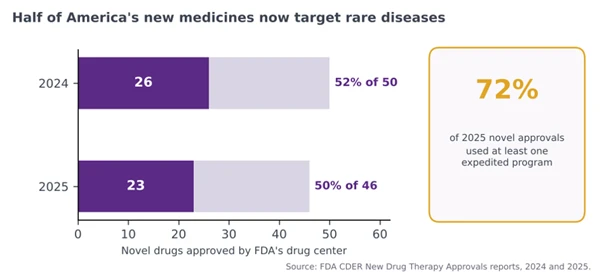
Figure 1: Orphan-designated medicines made up half or more of novel FDA drug approvals in both 2024 and 2025.
For C-suite leaders, the implication is straightforward. If half of new approvals target populations measured in thousands or hundreds, then half of future launches will need a commercial model built for scarcity rather than scale. Portfolio decisions, launch budgets and organizational design must reflect that reality. Forecasting methods built for primary care, which assume steady uptake across broad prescriber bases, rarely hold when a launch depends on a few hundred identified patients and a small number of treating centers.
From Mass Reach to Precision Reach: How Rare-Disease Medicines Rewire the Commercial Model
The first and hardest commercial problem in rare disease is not persuading physicians to prescribe. It is finding the patients at all. Many rare conditions are misdiagnosed or diagnosed late, and a single community physician may never see a second case. Demand generation therefore begins upstream, with disease education, support for genetic testing and partnerships with the specialist centers where diagnosed patients concentrate. In many rare-disease launches, the size of the diagnosed population, not market share, is the true ceiling on revenue.
The second shift is in the field force itself. Rare-disease commercial teams are typically small, highly specialized and organized around accounts rather than territories. A handful of centers of excellence may treat a large share of eligible patients, which changes how companies measure productivity and allocate investment. Medical science liaisons and patient-facing case managers often matter as much as traditional sales representatives.
Third, the patient journey after prescription is commercially decisive. Rare-disease therapies are frequently dispensed through limited specialty pharmacy networks, require prior authorization and may involve infusion logistics, home administration or long-term monitoring. Patient support programs that handle benefit verification, financial assistance and adherence are no longer an add-on service. They are core infrastructure, and the quality of that infrastructure directly affects time to therapy and persistence.
Finally, pricing conversations look different. With small populations, prices per patient are high, and payers increasingly ask for evidence of durable benefit. Outcomes-based agreements, installment arrangements and warranty-style contracts, once rare, are becoming part of standard launch planning for one-time and high-cost therapies. Companies that build robust registries and real-world evidence programs from launch are better positioned to defend value over time.
Washington Rewrites the Orphan Rulebook: New Policy Signals for Rare-Disease Commercialization
Federal policy moved decisively in 2025 and early 2026, and almost every change alters rare-disease economics. In July 2025, Congress expanded the orphan exemption from Medicare drug price negotiation. The original provision covered only drugs designated and approved for a single rare disease; the revised version allows drugs with multiple orphan indications to remain exempt. For developers, that reduces the commercial penalty for pursuing follow-on rare-disease indications, a point that now belongs in lifecycle planning from the earliest stages.
On September 3, 2025, the FDA announced its Rare Disease Evidence Principles, a process for therapies addressing very small genetic populations, generally fewer than 1,000 patients in the United States. Eligible programs may rely on one adequate and well-controlled study, which can be single-arm, supported by robust confirmatory evidence such as natural history data, pharmacodynamic results or case reports. In November 2025, agency leaders went further, proposing a plausible mechanism pathway for individualized therapies where each patient may receive a different product.
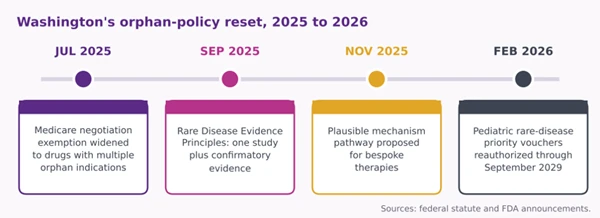
Figure 2: Four policy milestones between July 2025 and February 2026 that reshape the economics of rare-disease development and launch.
Then, on February 3, 2026, the Consolidated Appropriations Act reauthorized the rare pediatric disease priority review voucher program through September 30, 2029, after it had lapsed at the end of 2024. The vouchers, which entitle the holder to a faster review for a different application, changed hands for between $150 million and $200 million in sales disclosed from 2024 to early 2026. For smaller rare-pediatric developers, a voucher can be a meaningful source of non-dilutive capital that partly offsets the challenge of commercializing to very small populations.
Taken together, these changes widen the regulatory door while leaving the commercial burden firmly with companies. Faster and more flexible approvals mean earlier launches built on smaller datasets, which in turn raises the importance of post-approval evidence, payer engagement and disciplined pricing strategy.
Case Study: A Bespoke Gene Edit Previews the Next Rare-Disease Business Model
In 2025, a team at Children's Hospital of Philadelphia and the University of Pennsylvania treated an infant, known publicly as KJ, who had been diagnosed within days of birth with severe carbamoyl phosphate synthetase 1 (CPS1) deficiency, a urea cycle disorder in which toxic ammonia accumulates in the blood. No approved therapy could correct the underlying mutation.
Within about six months of the child's birth, the team designed and manufactured a base-editing therapy tailored to his specific genetic variant, delivered to the liver using lipid nanoparticles. The first dose was given in late February 2025, under a single-patient expanded access investigational new drug application, with follow-up doses in March and April. As of April 2025, the infant had experienced no serious side effects, tolerated more dietary protein and needed less medication to control ammonia. The results were published in a leading peer-reviewed medical journal on May 15, 2025, with researchers noting that longer follow-up is needed.
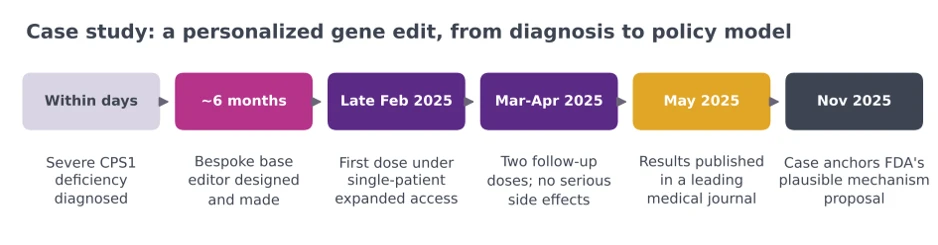
Figure 3: The personalized gene-editing case moved from diagnosis to treatment in months and later became the illustrative model for a proposed FDA pathway.
The case did not stay in the clinic. When FDA leaders proposed the plausible mechanism pathway in November 2025, they used it as their illustration. The proposal envisions single-patient experience building toward marketing applications, with success demonstrated across successive patients receiving different bespoke therapies built on a shared platform, and with real-world evidence collection required after approval.
For commercial leaders, three lessons stand out. First, value may increasingly sit in the platform, meaning the delivery system, editing chemistry and manufacturing process, rather than in any single product. Second, speed to patient becomes a competitive advantage in its own right when disease progression is measured in weeks. Third, revenue models built on unit sales of one molecule will struggle to capture the economics of therapies made for one person at a time. Service-based, platform-licensing or health-system partnership models may prove more durable.
Winning the Rare-Disease Decade: Where Commercial Advantage Will Be Built
The companies best positioned for the next decade will treat diagnosis as a commercial capability. Investment in newborn and genetic screening partnerships, physician education and data-driven identification of undiagnosed patients determines how large a market can become, and it often has to start years before launch.
They will also integrate evidence planning across functions. When an approval rests on a single study and confirmatory data, the same evidence package must persuade regulators, payers and treating physicians. Health economics, medical affairs and commercial teams need a shared plan for registries and long-term follow-up from the outset.
Lifecycle strategy is the next frontier. With the expanded Medicare negotiation exemption, sequencing additional rare-disease indications has become a more attractive route to building franchise value, provided each indication is supported by credible evidence and a clear unmet need.
Supply chain design deserves board-level attention as well. Rare-disease products are often made in small batches, sometimes for individual patients, and a single manufacturing delay can interrupt therapy for a meaningful share of the entire treated population. Building redundancy, close coordination with specialty distributors and transparent communication with treatment centers is a commercial safeguard, not merely an operational one.
Finally, rare-disease success depends on trust. Patient advocacy organizations often fund natural history studies, maintain registries and connect companies with families. Engaging them as partners in trial design and access planning, rather than as late-stage marketing channels, improves both recruitment and real-world uptake.
Conclusion: Rare-Disease Medicines Are Writing the New U.S. Pharma Commercialization Playbook
Rare-disease medicines have moved from the margins to the center of American drug development. They now account for half of novel FDA approvals, address a population of roughly 30 million Americans, and benefit from a policy environment that, in 2025 and 2026, has expanded both regulatory flexibility and economic incentives.
But approval is only the beginning. Small populations, complex patient journeys and intense pricing scrutiny mean that commercial excellence in rare disease depends on precision rather than reach. Personalized therapies, such as the gene edit delivered to a single infant in 2025, suggest the model will keep evolving toward platforms and services.
For U.S. pharma leaders, the message is clear. The capabilities required to commercialize rare-disease medicines, including patient finding, integrated evidence, flexible contracting and authentic patient partnership, are fast becoming the capabilities required to commercialize medicines of every kind.

Lakshmi is a science writer with a foundation in the laboratory. She earned her master's in biotechnology and trained through research internships at ICGEB (JNU) and DIPAS, DRDO, with her work appearing in the Egyptian Journal of Veterinary Sciences. Now APCRM-certified and part of the editorial team at Pharma Focus America and Pharma Focus Europe, she reports on pharmaceutical technology, research, and innovation — giving complex science a clear and confident voice for industry leaders.