Pipeline discussions often focus on which molecules to advance. Far less attention is paid to how those molecules are developed. Yet development strategy has become one of the biggest influences on whether promising science reaches the clinic and, ultimately, patients.
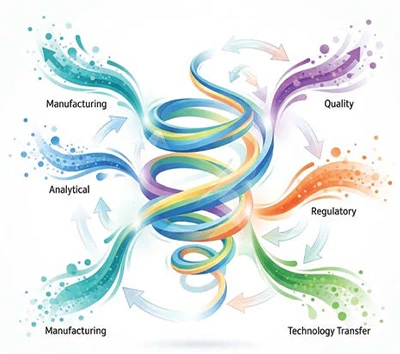
Every development program is shaped by a series of scientific, technical, operational, and regulatory decisions. Each serves a specific purpose, whether advancing CMC strategy, refining analytical methods, developing manufacturing processes, preparing for technology transfer, or supporting regulatory submissions. Together, those decisions establish the foundation for every stage that follows, influencing how efficiently a program progresses and how prepared it is for commercialization.
Today's pipelines are more diverse than ever. Organizations are developing small molecules as oral solid dose products alongside biologics in injectable formats, RNA therapeutics, cell and gene therapies, antibody-drug conjugates, and other increasingly sophisticated medicines. Each product brings distinct CMC, analytical, manufacturing, and regulatory considerations. Development teams are expected to navigate this diversity while maintaining speed, scientific rigor, and commercial readiness. As a result, development strategy has become less about advancing programs through predefined stages and more about making informed decisions that reflect the unique needs of each product throughout its lifecycle.
What drives pipeline performance?
Pipeline management has traditionally focused on portfolio decisions: which assets to prioritize, when to invest, and when to discontinue development. Those decisions determine which assets move forward and how finite R&D resources are allocated. They are informed by scientific, commercial, technical, and strategic considerations, including intellectual property, market opportunity, and technical feasibility. Assets that are deprioritized may still create value through licensing or other business development opportunities, generating resources that can be reinvested in higher-priority programs.
Once a development candidate is selected, however, another set of decisions begins to influence whether that asset progresses efficiently toward commercialization. Development strategy shapes how risks are identified, how knowledge is generated and applied, and how prepared a program is for each successive stage of development.
The challenge is that these decisions are rarely independent. A formulation selected to support an early clinical study must ultimately be manufacturable at scale. Analytical methods developed to characterize a product early in development should generate knowledge that remains useful through process validation and regulatory submission. Process development influences technology transfer, while manufacturing considerations often inform process optimization long before commercial production begins. Similarly, decisions about control strategies or critical quality attributes may appear to address immediate development needs while also shaping process validation and long-term manufacturing consistency. Each decision creates opportunities or constraints for the next.
This is why development benefits from a lifecycle perspective. Rather than optimizing individual activities in isolation, development teams can ask a different set of questions: How will this decision affect manufacturing six months from now? Will the analytical strategy support future regulatory expectations? Does the process generate the knowledge needed for a successful technology transfer? Addressing these questions early helps reduce rework, strengthen development continuity, and improve readiness for subsequent stages.
Looking beyond the next milestone
Development programs are often measured by their ability to achieve the next milestone, whether that's producing material for a clinical study, completing process development activities, or preparing for a regulatory submission. Milestones provide structure and help maintain momentum. The challenge is ensuring that work completed to meet today's objective also supports what comes next.
This requires development teams to think beyond the immediate deliverable. An analytical method developed to characterize a product early in development should provide a foundation that can evolve as product understanding increases. Process development should generate knowledge that supports future scale-up and technology transfer. Manufacturing activities should strengthen confidence in process performance rather than simply produce material for the next study.
Looking beyond the next milestone also changes the questions development teams ask. Rather than focusing exclusively on what is needed to complete the current phase, they also consider what future stages will require. Will today's analytical strategy support later regulatory expectations? Does the process generate sufficient understanding to support technology transfer? Have manufacturing considerations been incorporated early enough to avoid redesign later?

This perspective also changes how development teams think about speed. Pressure to accelerate development is a reality across the industry, but speed should not be measured solely by how quickly a program reaches its next milestone. It should also reflect how well that work prepares the program for what comes next. Development readiness and development speed are closely linked. Programs that advance rapidly but require significant redevelopment before scale-up, technology transfer, or commercial manufacturing rarely achieve meaningful time savings.
Where development programs lose momentum
Many development delays occur long after the decision that contributed to them was made. Analytical methods may need to be expanded to support regulatory expectations. A manufacturing process that performed well at laboratory scale may require additional optimization before technology transfer. Information needed to support process validation or commercial manufacturing may not have been generated during earlier development activities.
None of these situations necessarily reflects poor science. More often, they reflect the cumulative effect of decisions made to address immediate objectives without fully considering downstream requirements. The result is additional studies, revised timelines, and development resources directed toward resolving issues that could have been anticipated earlier.
These situations rarely appear as a single, dramatic setback. More often, they emerge through a series of incremental adjustments. An analytical method requires additional qualification. A process parameter proves difficult to scale. A manufacturing site requests information that was not generated during earlier development. Individually, each issue may seem manageable. Collectively, they consume time, resources, and organizational attention. Across a portfolio, these incremental delays can have a meaningful impact on overall pipeline performance.
Preventing these situations does not require predicting every future challenge. It requires asking broader questions throughout development. What process knowledge will a receiving manufacturing site need during technology transfer? Does the current development plan generate the information needed for commercial scale-up? Will today's analytical strategy continue to support tomorrow's regulatory requirements? These questions help teams evaluate today's decisions in the context of tomorrow's needs.
Designing development for continuity
Organizations can reduce rework by treating development as a continuous process rather than a sequence of handoffs. Scientific knowledge generated during formulation, analytical development, process development, manufacturing, and technology transfer should inform the decisions that follow. That continuity helps preserve program momentum while strengthening readiness for future stages.
Successful development programs recognize that every activity should contribute to the next stage of the product lifecycle. Formulation, analytical development, process development, manufacturing, and technology transfer are often managed by different teams, but they contribute to the same objective. Development is most effective when knowledge generated in one stage becomes the starting point for the next rather than something that must be recreated or reinterpreted.
That continuity also supports more effective problem-solving when unexpected results occur. Teams can build on an established understanding of the product and process rather than spending valuable time reconstructing decisions or regenerating information that should already exist.
This requires continuity in both information and decision-making. Scientific understanding should evolve as a program matures. Manufacturing considerations should inform development decisions before scale-up begins. Technology transfer planning should draw on knowledge accumulated throughout development rather than relying solely on documentation prepared at the end of the process.
Viewed this way, continuity becomes more than operational efficiency. It improves decision quality, reduces unnecessary iteration, and creates a more predictable path toward commercialization.
Improving the quality of development decisions
Every development decision is made with incomplete information. The objective is not to eliminate uncertainty but to ensure decisions are informed by the right expertise at the right time.
That requires looking beyond the immediate technical objective. Manufacturing implications should be considered as processes are developed. Regulatory expectations should inform analytical strategies as product understanding evolves. Technology transfer requirements should be evaluated while process knowledge is still being generated rather than after development activities are complete.
Development decisions should also evolve as new knowledge becomes available. Product understanding increases over time. Manufacturing experience grows. Regulatory expectations become clearer. Revisiting earlier assumptions in light of new evidence is a natural part of development and reflects scientific learning. That is fundamentally different from repeating work because critical information was never generated or downstream requirements were not considered. Recognizing that distinction helps teams focus their time and resources where they create the greatest value. It also helps identify when additional expertise can strengthen a decision before it becomes difficult or costly to change.
Not every decision requires every function, but key decisions often benefit from input beyond the immediate technical discipline. Manufacturing, analytical, quality, regulatory, and technology transfer teams each see different aspects of program risk. Bringing those perspectives together before decisions are finalized helps identify downstream implications while there is still flexibility to respond.
Development teams that consistently approach decision-making this way spend less time revisiting earlier work because decisions are made with a broader understanding of their impact across the development pathway.
Asking better questions throughout development
Effective development strategy is reflected in the questions teams ask before key decisions are made. While every program is different, several questions can help strengthen decision-making throughout the development pathway.
Will this decision remain effective at the next stage of development? A formulation, analytical method, or manufacturing process may meet today's objectives while creating limitations later. Evaluating downstream implications early can reduce the need for redesign as programs mature.
What knowledge will future teams need? Process development, manufacturing, quality, regulatory, and technology transfer teams all rely on knowledge generated earlier in development. Identifying those future information needs helps ensure critical data are generated before they become difficult or costly to obtain.
Which perspectives are missing from this decision? Development decisions often benefit from input beyond the immediate technical discipline. Manufacturing, analytical, regulatory, and quality experts may identify considerations that influence long-term program success.
Are we solving today's problem or strengthening the overall development pathway? Programs inevitably face technical challenges. The most durable solutions are those that resolve the immediate issue while improving the foundation for future development.
A new definition of pipeline performance
Pipeline performance is often measured by the number of candidates entering the clinic or advancing through development. Those metrics remain important, but they don't fully reflect the strength of the development system supporting those programs.
A high-performing pipeline is one in which decisions build on one another, technical knowledge carries forward throughout development, and each stage strengthens the next. Manufacturing readiness, technology transfer, and regulatory preparedness are not activities reserved for the end of development. They are shaped by decisions made throughout the program.
Managing today's pipelines requires a broader perspective than selecting promising candidates and advancing them through milestones. It requires development strategies that connect scientific, technical, manufacturing, and regulatory decision-making across the product lifecycle. When development is approached this way, organizations are better positioned to reduce rework, preserve momentum, and translate scientific advances into medicines that reach patients.
Read the full article — it's free
Register with Pharma Focus America to unlock expert insights, research articles and in-depth industry analysis.