


The pharmaceutical industry is undergoing a fundamental transformation driven by the integration of real-world evidence (RWE), patient registries, and decentralized clinical trials (DCTs). These innovations are bridging the gap between traditional randomized controlled trials (RCTs) and the complexities of real-world medical practice. Regulatory agencies such as the U.S. Food and Drug Administration (FDA) and the European Medicines Agency (EMA) are actively encouraging the use of RWE to complement and, in some cases, replace conventional trial evidence. This shift is ushering in a new era of patient-centric research and accelerating the pathway from drug development to market access.
The Expanding Role of RWE in Clinical Trials
Real-world evidence (RWE) is derived from real-world data (RWD) sources such as electronic health records (EHRs), claims databases, patient registries, and wearable devices. Historically, RWE was limited to observational studies or post-marketing surveillance. However, over the past decade, its integration into clinical trial design has accelerated, driven by the need for evidence that reflects real-world patient populations, treatment patterns, and long-term outcomes.
Regulatory bodies have been instrumental in this shift. The FDA’s Real-World Evidence Framework (2018) outlines how RWE can be used to support regulatory decisions, particularly for new indications or label expansions (FDA, 2018). Similarly, the EMA’s DARWIN EU network, launched in 2022, leverages RWE to enhance safety and efficacy evaluations by combining health system data, registries, and biobank information (EMA, 2022).
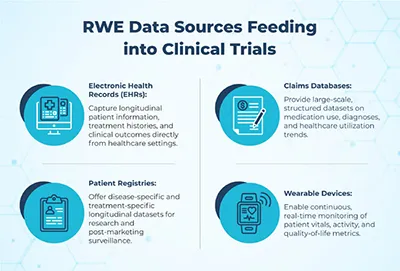
A growing body of research supports this trend. A PubMed review of RWE in clinical research highlights a marked increase in peer-reviewed studies over the past decade, particularly in chronic and rare diseases where traditional RCTs face enrollment and feasibility challenges (PubMed ID: 36011793). This surge reflects how real-world data (RWD) is increasingly being leveraged to design pragmatic and hybrid clinical trials, enabling broader patient inclusion, improved feasibility assessments, and more generalizable outcomes compared to conventional trial models. Furthermore, since 2017, the FDA has approved over 100 labeling expansions and new indications that included RWE in their evidence package (PubMed ID: 37393555).
RWE in Hybrid and Pragmatic Trials
Traditional RCTs, while the gold standard for demonstrating efficacy, often have limited generalizability due to strict inclusion criteria and controlled environments. Hybrid trial designs, which combine elements of RCTs with real-world data, are addressing this limitation. Pragmatic clinical trials, for instance, incorporate RWD, such as EHR data or claims information, into the trial protocol, allowing researchers to evaluate outcomes in settings that mirror real clinical practice.
Hybrid trials are particularly effective in:
• Optimizing patient recruitment, by pre-screening participants using RWD from registries or EHRs.
• Reducing trial costs and timelines, by using real world endpoints that require fewer site visits.
• Capturing long term outcomes, especially when linked to registries and patient-reported outcomes.
According to a systematic review in Clinical Trials, hybrid designs have been successfully applied in cardiovascular, oncology, and neurology studies, producing data that is both rigorous and reflective of real-world patient journeys (PubMed ID: 36011793).
Patient Registries as a Source for RWE
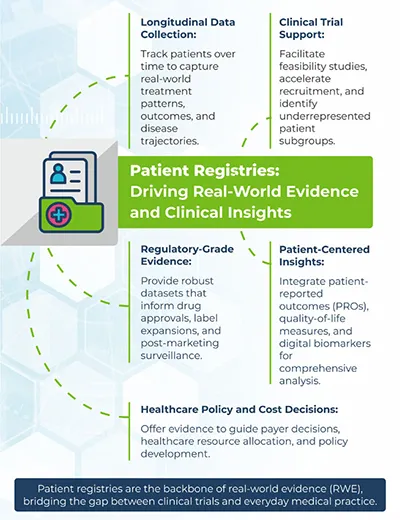
Patient registries are essential tools for generating RWE. By systematically collecting longitudinal data on patient demographics, disease progression, treatments, and outcomes, registries provide rich datasets for both clinical trials and post-market surveillance. A registry, as a source for RWE, can be very valuable to inform future clinical trial design, possible targeted participants for recruitment, care cost and policy decision. Patient registries are driven by patient-centered mission statements, heavily informed by renowned experts in clinical care and disease communities, and accountable to stakeholders seeking to make a significant impact.
Close collaboration with government agencies, biotech companies, and non-profit foundations is essential to understanding the essential aspects of clinical research. Active participation in stakeholder meetings, including Steering Committee discussions, helps ensure that these groups receive high-quality registry data to support evidence-based decision-making. By adopting a partnership-focused approach, registry programs can leverage mission-centered strategies to guide site and data management activities effectively. A deep understanding of clinical research practices is key to maintaining compliance with industry standards while adapting to evolving goals set by sponsors, partners, and stakeholders. Through integrated registry operation coordination and data coordination services, such programs benefit from consistent site engagement, improved communication on high-impact operational topics, and streamlined processes that enhance scalability and increase enrolment without placing undue burden on sites.
Decentralized Clinical Trials: Building on RWE and Registries
Decentralized clinical trials (DCTs) are another key innovation shaping modern research. By incorporating remote technologies, such as telemedicine, eConsent, home nursing visits, and wearable sensors, DCTs reduce the need for physical site visits and expand access to diverse patient populations. The COVID-19 pandemic significantly accelerated the adoption of decentralized models, which have since become a mainstay in many therapeutic areas.
DCTs offer several advantages:
• Improved patient engagement and retention, due to reduced travel and flexible participation.
• Access to geographically dispersed or underserved populations, enhancing diversity.
• Continuous data collection, facilitated by digital devices and remote monitoring.
However, DCTs also present challenges, including endpoint validation, data standardization, and regulatory alignment. Guidance from the FDA on decentralized elements in clinical trials underscores the need for rigorous quality standards, risk-based monitoring, and secure digital platforms (FDA, 2021).
For conditions like Parkinson’s disease, where continuous monitoring of motor function and cognitive changes is critical, combining DCT methods with registry data creates a powerful synergy. Remote patient assessments, integrated with real-world registry datasets, enable a more comprehensive and real-time understanding of disease progression.
Integrating RWE, Registries, and DCT: A Unified Framework
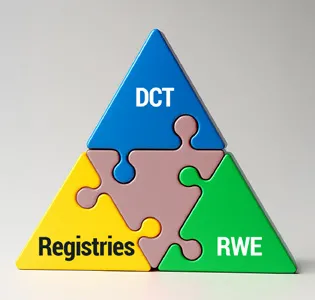
The integration of RWE, registries, and decentralized trial approaches represents the future of clinical research. They offer a holistic, patient-centric framework that addresses the limitations of traditional trials. Registries provide a pre-identified and pre-consented patient pool, RWE enriches trial data with real world context, and DCTs enhance flexibility and convenience.
For example, well-structured patient registries, when combined with wearable device data and patient-reported outcomes, can create a strong foundation for real world data (RWD) generation. Such registries can be effectively leveraged in hybrid or decentralized trial models to accelerate recruitment, improve feasibility assessments, and produce regulatory grade data that truly reflects patients’ daily lives.
The Strategic Imperative for RWE and Registries
The future of clinical research lies in a seamless fusion of real-world evidence (RWE), patient registries, and decentralized trial models, where data-driven insights power faster, more patient-centric innovation. For pharmaceutical and biotech sponsors, the ability to generate high-quality RWE will increasingly determine the success of regulatory submissions, market access, and post-approval safety strategies. The foundation of this transformation is a robust data ecosystem, integrating electronic health records, disease registries, and digital health platforms, that not only captures real-world patient outcomes but also provides the contextual intelligence needed to optimize trial design and therapeutic strategies.
Registries are pivotal in this evolution. They offer longitudinal datasets that reveal trends in disease progression, treatment patterns, and quality-of-life. By aligning registries with advanced analytics, sponsors can identify patient subgroups, refine endpoint selection, and accelerate trial recruitment while ensuring regulatory-grade data quality. Moreover, the inclusion of digital biomarkers, wearable device data, and patient-reported outcomes within registry frameworks is enabling continuous, real-time evidence generation.
However, achieving this vision requires more than technology; it demands a strategic partner with deep expertise in RWE and registry management. Sponsors need partners who understand both the operational and regulatory complexities, can harmonize disparate data sources, and can build scalable registry systems. Organizations that excel in delivering integrated solutions, combining advanced data harmonization, risk-based quality management and AI-driven analytics with operational excellence will lead the way.
The road ahead will favor those who can connect the dots between RWE, registries, and decentralized models to create actionable intelligence and accelerate time-to-market. A forward-looking, integrated approach that blends expertise in RWE, registry management, and decentralized trials will be critical to delivering smarter and more inclusive clinical research.
References
1. FDA. Framework for FDA’s Real-World Evidence Program. 2018. https://www.fda.gov/media/120060/download
2. EMA. DARWIN EU: Data Analysis and Real World Interrogation Network. 2022. https://www.ema.europa.eu/en/darwin-eu
3. Clinical Trials Review on RWE. PubMed ID: 36011793. https://pubmed.ncbi.nlm.nih.gov/36011793/
4. FDA approvals involving RWE. PubMed ID: 37393555. https://pubmed.ncbi.nlm.nih.gov/37393555/
5. FDA Guidance on Decentralized Elements in Clinical Trials. 2021. https://www.fda.gov/regulatory-information/search-fda-guidance-documents/conducting-clinical-trials-decentralized-elements
6. Parkinsons Disease Registry. Successful Registry and Data Coordinating Center Support for Parkinson’s Foundation’s Parkinson’s Disease GENEration Registry