

For a decade the industry has chased patient-centricity as three separate projects: better recruitment, decentralized delivery, connected data. What changes when these initiatives are merged into a single operating model?
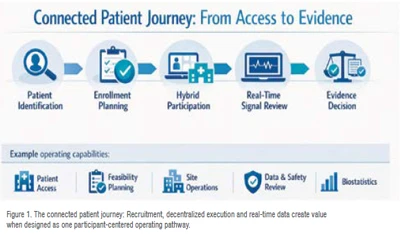
The first change is accountability. Recruitment cannot promise access that the protocol later makes difficult to deliver. Decentralized visits cannot add convenience while creating fragmented evidence. Data teams cannot repair signals after participants have disengaged. A single operating model begins with the participant pathway, then aligns protocol design, site strategy, data capture, monitoring and escalation. A hospital-network-anchored CRO model illustrates this well: screening and safety visits stay site-based, while home nursing, app-based patient-reported outcomes and teleconsultations feed into one eClinical dashboard managed by the same study team. Equally important is a disciplined approach to feasibility planning that combines physician insight, real-world data and site execution input to confirm that patient access will translate into enrollment, not just look promising on paper.
Is the connected patient journey a genuine structural shift in how U.S. trials are run, or the same fragmented process wrapped in a more sophisticated layer of technology?
The connected journey becomes structurally and operationally consistent only when operating rights actually change. Simply adding wearables, eConsent, telehealth and dashboards to a site-first protocol risks digitizing fragmentation rather than fixing it. Sponsors must decide which activities require an investigator, which can move closer to the participant and which data need real-time review. FDA guidance on decentralized elements preserves oversight, safety and data integrity while allowing selected trial activities to shift location. The broader principle holds across functions: clinical operations, data management, biostatistics, safety and medical writing need to operate under one execution framework. Documentation and evidence should flow through a single pathway with clear delegation, rather than as separate workstreams.
Patient recruitment remains one of the biggest challenges in clinical development. What recruitment strategies are proving most effective today in improving enrollment speed while ensuring diverse and representative patient populations?
Effective recruitment now combines precision, proximity and trust. Precision uses epidemiology, electronic health record signals and referral patterns before sites open. Proximity reduces travel, visit frequency and time away from work. Trust comes through clinicians, community groups and caregivers who influence patient decisions. FDA's draft Diversity Action Plan guidance asks sponsors to set enrollment goals for clinically relevant populations and explain how those goals will be met. Industry reporting continues to identify recruitment as a leading driver of trial delay. This reinforces why feasibility planning must precede protocol finalization rather than follow a stalled enrollment curve. A care-network-linked research environment, drawing on physician insight, real-world data and site feasibility, can help recruitment teams improve speed without weakening representativeness.
Recruitment, decentralized trial execution, and real-time data collection are often discussed separately. How can sponsors successfully integrate these three elements to create a seamless and connected clinical trial ecosystem?
Integration starts before protocol finalization. Sponsors should map each participant segment against enrollment source, visit model, data source, risk profile and escalation pathway. A rural participant using a connected device needs different support from an oncology participant who requires complex site-based procedures. The operating plan should define what is centralized, what remains at the site, what moves home and what triggers intervention. An effective operating model brings trial design, feasibility, site start-up, data management, biostatistics, safety oversight and laboratory services into closer alignment. The trial then functions as one evidence system rather than as separate operational layers.
This operating model also changes how sponsors judge CRO value. The question is not whether a partner can provide a recruitment campaign, a decentralized tool or a data dashboard in isolation. It is whether the partner can connect patient access, site readiness, protocol practicality, safety oversight and analysis into one accountable delivery system. The broader lesson, particularly for U.S.-focused sponsors, is that connected trials require operational coherence, not a larger collection of disconnected vendors.
Real-time data compresses the distance between signal and decision, but does industry governance move at the same speed?
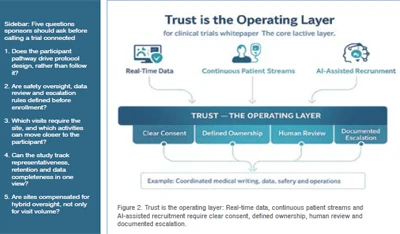
Technology today surfaces signals faster than many organizations can act. A dashboard showing adherence risk, a safety signal or missing device data has limited value if no one owns the decision tree. Connected trials need thresholds, roles and response times agreed before enrollment. Some signals require investigator judgment, some require medical monitoring, and others require operational outreach. My experience across AI-first clinical data platforms and CRO operations supports a pragmatic view: real-time data improves trials only when governance converts signals into safe, documented action.
As trials collect continuous patient data from devices, apps and remote interactions, who should own and govern that data?
Legal ownership, ethical stewardship and operational accountability are not the same. Sponsors may control trial data for regulatory purposes, but participants should understand what is collected, how often, why it is collected, who can see it and what happens after the study. Investigators remain responsible for participant safety within the protocol. Vendors may process data but should not become invisible decision-makers. Contracts should define custody, access, retention, audit rights, security and breach response. This matters most when data comes from devices, apps and home-based assessments rather than from a conventional clinic visit. The practical requirement is to route continuous patient data through governed workstreams so that the consent-to-data pathway remains understandable and enforceable.
AI now drives much of patient matching and recruitment. Where is the line between efficiency and encoded bias?
The line appears where prediction starts narrowing opportunity. AI can identify patients faster, reduce screen failure and prioritize sites with realistic enrollment potential. It can also reproduce under-representation if trained on incomplete records, biased referral patterns or claims data that miss underserved groups. The connected model makes bias easier to detect when sponsors track who was found, contacted, screened, randomized and retained. Sponsors should audit algorithms, test subgroup performance, use human review and compare AI-generated pools with epidemiology. Physician insight, real-world data, site knowledge and operational review should remain part of human-in-the-loop oversight. Fairness and efficiency should be measured together, not traded against each other.
What practical approaches can sponsors and CROs adopt to improve participant retention and reduce dropout rates in decentralized and hybrid trials?
Retention improves when the study respects daily life. Sponsors should simplify visit schedules, use remote options when they reduce patient and caregiver burden, provide rapid technical support, reimburse costs promptly and keep communication human. Participants need to know what each task means and how the study protects safety. Site teams need visibility into remote activity, or participants may feel managed by devices rather than clinicians. Risk-based retention analytics can flag missed entries or declining engagement early. Hospital-linked teams and home-based elements can support participants while protecting connected study data.
The common thread across governance, data ownership, AI and retention is trust. Participants trust a study when consent is clear, technology reduces burden, clinical teams remain visible and data use feels proportionate to the scientific purpose. Sponsors trust the study when signals have owners, thresholds and documentation. Regulators trust it when decentralized procedures preserve oversight, safety and data integrity.
Is the connected journey solving a data problem, or institutionalizing a costly integration problem?
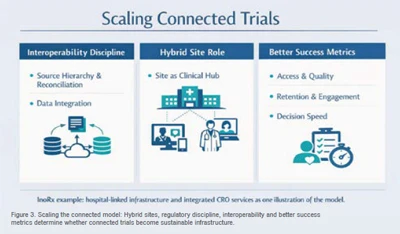
Connected trials solve a data problem when sponsors define standards, metadata, source traceability and review workflows early. They institutionalize cost when each study creates a bespoke web of devices, apps, outcome assessments, EDC, safety systems, laboratories and dashboards. Interoperability means that systems can exchange, interpret and preserve trial data without repeated manual reconciliation. It is not a procurement slogan, but an operating discipline. Sponsors should design data flows as carefully as visit schedules, including source hierarchy, reconciliation rules and audit trails. Industry research has linked rising protocol complexity with more endpoints, data points, amendments and patient burden, making disciplined data architecture increasingly important.
Interoperability is also where connected trials either scale or become expensive. A sponsor may collect high-quality information from sites, laboratories, wearables, ePRO tools and safety systems, yet still lose time if each source follows different logic. The broader principle is that sponsors should plan how data will move, how discrepancies will be resolved and how outputs will support decisions that regulators, investigators and participants can trust.
How are sponsors adapting to changing U.S. regulatory expectations while continuing to innovate in trial design?
Leading sponsors treat regulatory engagement as a design input, not a late-stage defense. FDA guidance confirms that telehealth, local healthcare providers, home visits and digital health technologies can fit within regulated trials when oversight, safety and data integrity are maintained. FDA's Diversity Action Plan draft guidance also pushes sponsors to justify representative enrollment goals and explain how they will reach under-represented populations. In practice, adaptation requires early agency dialogue, technology validation, risk-based monitoring, clearer delegation and stronger documentation of decentralized procedures.
Responsible experimentation now depends on evidence discipline as much as technology choice. Sponsors should document why a decentralized element belongs in a study, how participants will be supported, how data will be verified and how safety oversight will remain active when activities occur outside the traditional site. [1] That discipline also changes success metrics. A connected trial should not celebrate remote visits or digital touchpoints alone. It should show that the design improved access, preserved data integrity, reduced avoidable amendments and accelerated a credible development decision.
As home-based trial activities expand, how should sponsors rethink the role of the traditional clinical trial site?
The site does not disappear. Its role changes. Complex consent, eligibility confirmation, investigational product oversight, safety evaluation and relationship-building still require qualified clinical infrastructure. What changes is the assumption that every data point must be collected at the site. The site economy may shift from visit-volume economics toward orchestration, specialty procedures, community reach and remote oversight. CROs can help by giving sites better data visibility, training and remote workflows rather than bypassing them. A hospital-anchored site network can operate as a clinical hub connected to home-based data and central oversight.
Site evolution also requires a commercial and operational reset. Sites can rely on the hub-and-spoke model that has long coordinated large academic medical centers with community clinics. While the role of the PI does not change, the roles of care-extenders and clinical research coordinators, supported by appropriate technology, do change. In this evolving model, sponsors should invest in site training, shared data visibility, remote workflow support and fair compensation for hybrid oversight, not only for visit volume.
What is the industry celebrating about connected trials that may turn out to be the wrong thing to measure?
The industry often celebrates the number of digital tools deployed, the percentage of remote visits or the speed of first patient in. Those measures matter, but they can mislead. A trial can start quickly and still recruit the wrong population, burden participants, overwhelm sites and generate noisy data. Better measures ask whether the connected model improved representativeness, reduced avoidable amendments and shortened time to decision. They also ask whether it protected safety, improved retention and produced evidence regulators trust. The number worth watching is time to decision-grade evidence: enrollment quality, retention, data completeness and safety responsiveness together, rather than enrollment speed alone. Connected trial value should be judged by evidence quality and participant continuity rather than by tool deployment alone.
The final measure is learning velocity. Connected trials should shorten the time between a patient signal and a sponsor's decision without weakening clinical judgment. That requires fewer bespoke integrations, clearer source data rules, stronger site enablement and metrics that reward representative enrollment, retention, safety responsiveness and decision quality. The wider argument is that access, evidence and oversight need to be connected within a disciplined clinical research operating model.
Refernces: Editorial Fact-Checking Only: Not Intended for Print Publication
1. U.S. Food and Drug Administration. Conducting Clinical Trials With Decentralized Elements: Guidance for Industry, Investigators, and Other Interested Parties. September 2024.
2. U.S. Food and Drug Administration. Diversity Action Plans to Improve Enrollment of Participants from Underrepresented Populations in Clinical Studies: Draft Guidance for Industry. June 2024.
3. Tufts Center for the Study of Drug Development. Publications and industry reporting on protocol complexity, data volume, site workload, patient burden and decentralized trial normalization. Accessed July 2026.
Read the full article — it's free
Register with Pharma Focus America to unlock expert insights, research articles and in-depth industry analysis.