



1. Can you elaborate on the concept of virtual clinical trials and how they differ from traditional trials in terms of design and execution?
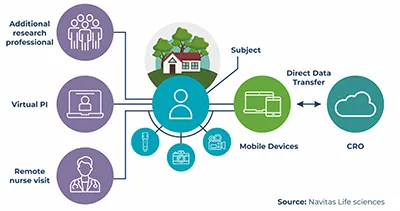
Virtual clinical trials leverage digital tools to conduct the trial remotely, including patient recruitment, data collection, and monitoring. Unlike traditional trials where patients often visit sites for assessments, virtual trials let patients participate from their homes or other locations using digital methods. This allows for greater flexibility, convenience, and potentially broader participant demographics. Virtual trials also often employ decentralized or hybrid designs, where data collection may occur at various locations, including patients' homes, local clinics, or through mobile devices, rather than solely at centralized trial sites.
We made a significant move towards virtual clinical trials during the initial stages of the COVID-19 pandemic. We have always consistently worked towards enhancing our systems and technological solutions, including electronic Data Capture (eDC), imaging, Laboratory Information Management Systems (LIMS), and statistical analyses, together with their backup and Data Recovery methods. This helped in the transition to remote working.
While we had the necessary technological advancements prior to the pandemic, it served as the impetus for widespread adoption. As one of the few CROs to transition seamlessly, we played a pivotal role in supporting clinical research and medical advancement during this critical phase.
2. What are the key benefits that virtual trials offer compared to traditional models, particularly in terms of patient recruitment, retention, and overall trial efficiency?
One of the biggest benefits is that virtual trials can reach a wider pool of patients by reducing geographical barriers and offering more flexible participation options, driving patient centricity as a core value. This results in greater patient retention as well, as it reduces the burden of frequent site visits. Remote data collection and monitoring enables real time data review, reducing overall trial timelines and costs. Also, virtual trials can enhance data quality. Digital data collection tools used in virtual trials often lead to higher data quality and accuracy compared to traditional paper-based methods. Real-time data monitoring and automated validation checks help identify and address data discrepancies promptly.
3. One of the challenges often discussed with virtual trials is ensuring data quality and integrity. How do you address this challenge, and what technologies or methodologies are crucial in maintaining high data quality standards?
To maintain high data quality standards in virtual trials, rigorous protocols, and technologies are essential. These include ensuring robust systems for secure data collection, and utilizing the right tool and AI platform, like One Clinical Analytics, to get near real time data insights. We also need to ensure data validation checks and quality control measures throughout the trial. CROs should develop standardized procedures and protocols for data collection, entry, and validation. Also, digital signatures and timestamps to authenticate data entries and ensure their integrity.
4. Patient engagement is a critical aspect of successful virtual trials. Could you share some strategies or best practices for enhancing patient engagement in decentralized research settings?
Strategies for enhancing patient engagement in virtual trials include providing clear communication and educational materials about the trial. Offering remote support services, such as telehealth consultations and virtual support groups also helps improve patient interest. Another important strategy is to incorporate patient feedback into the trial design and processes to improve the participant experience. Our personal investigators work closely with patients to ensure their interests are met and that they are comfortable throughout the study period.
5. Regulatory considerations play a significant role in the adoption of virtual trial methodologies. How do you navigate regulatory complexities to ensure compliance while leveraging the benefits of virtual trials?
To ensure compliance with regulatory requirements while leveraging the benefits of virtual trials, Navitas Life Sciences employs a proactive approach by engaging with regulatory agencies early in the trial planning process to address concerns and ensure alignment. We adhere to Good Clinical Practice (GCP) guidelines and relevant regulatory frameworks while ensuring robust data security and privacy measures to protect patient information.
6. Could you discuss the role of digital health technologies, such as wearables, remote monitoring devices, and telehealth platforms, in facilitating virtual trials and improving patient outcomes?
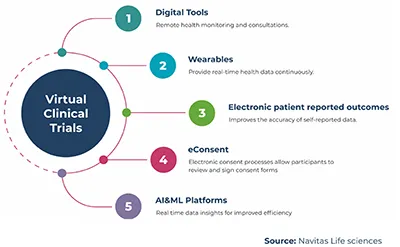
Digital health technologies play a crucial role in facilitating virtual trials and improving patient outcomes by enabling remote monitoring of patients’ vital signs, medication adherence, and symptoms using wearable devices and remote monitoring platforms.
Facilitating telehealth consultations allows patients to communicate with healthcare providers remotely.
Moreover, providing real-time data insights to researchers allows proactive intervention and personalized care for participants. These approaches collectively contribute to the successful implementation of virtual trials while maximizing patient engagement, data quality, and regulatory compliance.
7. Collaboration and partnerships are often essential to the success of virtual trials. Can you share insights into how collaborations between pharmaceutical companies, technology providers, and healthcare organizations contribute to the advancement of virtual trial capabilities?
Collaboration between pharmaceutical companies and technology providers is crucial for accessing cutting-edge digital tools and platforms specifically designed for virtual trial implementation. By partnering with technology providers, pharmaceutical companies gain access to expertise in developing and integrating digital solutions tailored to the unique needs of clinical research.
Partnerships with healthcare organizations play a key role in enhancing participant engagement and adherence in virtual trials. This integration not only facilitates participant recruitment and retention efforts but also ensures that virtual trial protocols align with clinical practice standards, ultimately improving the overall quality of trial data.
Collaborative efforts among pharmaceutical companies, technology providers, and healthcare organizations are essential for ensuring regulatory compliance and data security in virtual trials. By working together, stakeholders can navigate complex regulatory requirements and standards for virtual trial conduct. Technology providers contribute expertise in implementing robust data security and privacy measures throughout the trial process.
Partnerships streamline trial operations by leveraging the strengths of each stakeholder involved. Pharmaceutical companies provide clinical expertise and trial oversight, while technology providers offer solutions for remote data collection, monitoring, and analysis. Healthcare organizations facilitate access to patient data and medical expertise, supporting efficient trial execution.
Partnerships enable the scalability and generalizability of virtual trial models across diverse therapeutic areas and patient populations. By collaborating across sectors, pharmaceutical companies, technology providers, and healthcare organizations can adapt virtual trial strategies to varying clinical contexts and geographical locations. This collaborative approach ensures that virtual trials are accessible and applicable across a wide range of healthcare settings, ultimately maximizing their impact on improving patient outcomes.
8. How do you see the future of virtual clinical trials evolving, particularly in terms of scalability, adoption across different therapeutic areas, and integration with real-world evidence generation?
The future of virtual clinical trials holds significant promise, with several key trends shaping their evolution is scalability. Virtual trials will become more scalable as technology advances and becomes more accessible. Cloud-based platforms, wearable devices, and remote monitoring tools will enable larger and more diverse patient populations to participate in trials, leading to faster recruitment and more comprehensive data collection.
Virtual trials will increasingly span across different therapeutic areas beyond traditional fields like oncology and rare diseases. Advancements in digital health technologies will enable remote monitoring of various health parameters, making virtual trials feasible for a broader range of conditions, including chronic diseases and mental health disorders.
Virtual trials will be integrated more seamlessly with Real-World Evidence (RWE) generation efforts. By combining data from virtual trials with real-world data sources such as electronic health records and wearable devices, researchers can gain deeper insights into treatment effectiveness, safety profiles, and patient outcomes in real-world settings.
9. Are there specific case studies or success stories from Navitas Life Sciences' experience in implementing virtual trials that you can share to highlight the impact and outcomes achieved?
Certainly, it's an exciting time as we continue to push the boundaries of traditional clinical trial methodologies through the implementation of virtual trials. While it's important to acknowledge that this approach is still evolving and we're refining our strategies along the way, there have been notable successes in various aspects of several trials. Here are a few examples:
o Remote Patient Monitoring in Allergic Broncho Pulmonary Trial: In this recent trial, we successfully integrated remote patient monitoring device, Peak expiratory flow meter to track participants' respiratory function through peak expiratory flow rate (PEFR). The Investigators got real time alerts for significant decline in PEFR in real time. While this was a significant advancement, other aspects of the trial still required in-person visits, indicating a partial implementation of virtual trial elements.
o Smartphone App for a Type 2 Diabetes Mellitus trial (T2DM): Participants were provided with a smartphone app specifically designed for diabetes self-management. The app was developed in collaboration with a technology provider specializing in digital health solutions. Key features of the smartphone app included Remote Symptom Monitoring and Medication Adherence Tracking.:
Participants used the app to regularly log their symptoms related to hypoglycemia like dizziness, sweating, palpitations etc. This allowed study coordinators to remotely monitor participants' well-being and disease progression over time.
The app also included a medication adherence feature that reminded participants to take their diabetes medication according to the prescribed schedule. Participants could also log when they took their medication, providing researchers with insights into medication adherence patterns.
As we continue to refine our processes and technologies, we aim to expand the scope of virtual trials to maximize their benefits for participants, sponsors, and research stakeholders alike.
10. In conclusion, what do you believe are the key factors that will drive the continued growth and innovation in virtual clinical trials, and what advice would you give to organizations considering adopting virtual trial methodologies?
Several key factors will continue to drive the growth and innovation in virtual clinical trials like
a. Advancements in Technology: Continuous advancements in digital health technologies, such as wearables, remote monitoring devices, and telehealth platforms, will enable more efficient and patient-centric trial processes.
b. Effective Collaborations: Collaborations between pharmaceutical companies, technology providers, and healthcare organizations will lead to greater innovation and facilitate the development of scalable and effective virtual trial solutions.
c. Patient-Centric Approach: Emphasizing patient engagement and participation will be crucial for the success of virtual trials. Strategies that prioritize patient convenience, communication, and feedback will enhance recruitment, retention, and overall trial outcomes.
d. Real-World Evidence Integration: Integrating virtual trial data with real-world evidence sources will enrich the understanding of treatment effectiveness and safety profiles, driving evidence-based decision-making in drug development.
For organizations considering adopting virtual trial methodologies, they should consider beginning with hybrid approach to assess the feasibility and effectiveness of virtual trial approaches within their organization. This allows for iterative learning and optimization before scaling up.
They should invest in technology and infrastructure to support virtual trial operations securely and efficiently. They must stay informed about regulatory requirements and seek guidance from regulatory experts to ensure compliance with relevant guidelines and standards throughout the trial process.
They should develop strategies to engage patients effectively throughout the trial, including clear communication, remote support services, and incorporating patient feedback into trial design and processes.
The ideal step would be to collaborate between stakeholders. Strategic partnerships with virtual clinical trial specialists will help leverage collective expertise and resources in implementing virtual trial methodologies successfully.