By enabling faster turnaround times and eliminating cleaning validation, Single-use technologies allow us to accelerate clinical-to-commercial timelines, bringing lifesaving therapies to patients faster.
1. How have single-use technologies (SUT) reshaped pharma manufacturing?
SUT has shifted manufacturing toward speed, flexibility, and modular capacity. By replacing fixed stainless steel equipment with pre-sterilised disposable assemblies, companies have accelerated facility deployment, reduced cleaning validation burdens, and enabled efficient multiproduct operations. The result is faster clinical to commercial timelines and improved agility across development and manufacturing.
2. Where do you see the highest adoption of SUT today, and why?
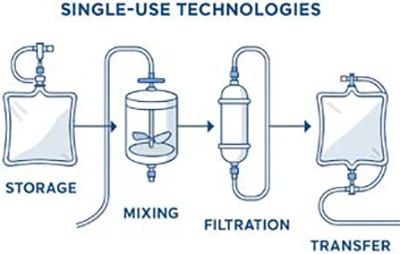
In my experience, SUT adoption is highest where flexibility matters, such as clinical manufacturing, multiproduct facilities, CDMOs, as well as unit operations like mixing, storage, transfer, filtration, and parts of upstream. These environments benefit most from rapid changeovers and closed, preconfigured systems. Large volume or long campaign commercial manufacturing still relies heavily on stainless steel due to its robustness and scale requirements.
3. How has SUT changed facility design and capital investment strategies?
SUT enables smaller utility footprints (less clean steam/WFI for CIP/SIP), more modular suite layouts, and scalable “build as you grow” capacity. Capex shifts from large vessels and permanent piping toward skids and consumables, plus a larger emphasis on supplier quality systems and supply assurance.
4. What operational efficiencies does SUT deliver?
The biggest gains come from faster changeovers and improved scheduling agility. Eliminating cleaning and sterilisation frees up capacity and reduces cross-contamination risks. Standardised assemblies, closed transfers, and well-defined verification steps help maintain consistency and reduce deviation risk.
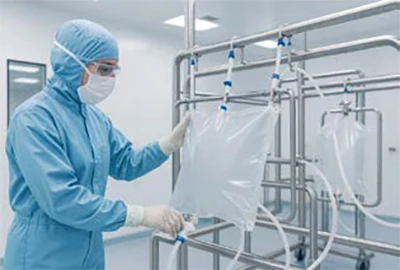
"Single-use technology has revolutionised pharmaceuticals by transforming how we think about capacity and speed, allowing us to move from rigid, stainless-steel infrastructure to agile, modular platforms that deliver faster and more safely."
5. What misconceptions remain about SUT cost and complexity?
The misconception I see most is “single-use is always cheaper.” The honest answer is that it depends on throughput, campaign length, labor model, and cleaning expense. The second misconception is “single use is simpler.” It can be operationally simpler, but it creates new complexity in materials, documentation, supply chain, and change control, all of which must be managed within a lifecycle validation mindset.
6. How well do SUTs perform on a larger commercial scale?
SUT performs reliably at many commercial scales, particularly for fluid management (e.g., mixing, storage, transfer), filtration, and portions of upstream. Limitations emerge at very large volumes, high pressures/temperatures, or with aggressive solvents. As a result, at larger commercial scales, hybrid facilities, combining stainless and disposables, remain the dominant model.
7. What are the best practices for SUT scale-up and tech transfer?
Effective scale-up requires defining component platforms early, characterising mixing and hold times, and establishing strong URS and BOM governance. During tech transfer and scale-up, controlling assembly variability and ensuring clear documentation are essential to avoid requalification delays or inconsistencies.
8. How do you see SUT supporting continuous or hybrid manufacturing models?
Continuous and intensified operations benefit from modular skids, closed transfers, and fast reconfiguration. Advances in sensors and automation are closing the instrumentation gap between stainless and disposable systems, enabling more integrated, data-driven operations.
9. How should manufacturers approach qualification and regulatory expectations?
Qualification must follow a structured, risk-based approach - URS, supplier qualification, integrity strategies, and E&L evaluation. Regulators remain equipment agnostic; they expect sound process control, traceability, and lifecycle validation, whether using stainless steel or single-use assemblies.
10. How has SUT influenced supply chain risk management?
SUT shifts critical risks toward material availability, sterilisation capacity, and supplier dependence. Organisations are increasingly adopting safety stocks, dual sourcing, and standardised assemblies to improve supply resilience and reduce change control exposure.
11. What progress is being made toward sustainability in SUT?
Sustainability is now a core design consideration. While SUT increases plastic waste, it reduces water, chemical, and energy consumption associated with CIP/SIP. Companies are improving waste segregation, exploring energy recovery options, reducing packaging, and engaging suppliers on lifecycle impacts - all while balancing regulatory and E&L constraints.
12. How do you envision SUT evolving over the next 5–10 years?
I expect more standardisation, better sensing, and tighter digital integration. The recent focus on structured interchangeability is a strong signal that maturity is moving from “adoption” to “industrialisation.” Hybrid models are expected to dominate because stainless remains advantageous for certain extremes of scale and operating conditions, while SUT is unmatched for flexible multiproduct operation and rapid changeover.
13. What advice would you give organisations starting their SUT journey today?
Treat SUT as an operating model transformation, not an equipment purchase. Standardise connectors and components early, build strong supplier quality agreements, and implement structured risk-based qualification. Invest in workforce training for assembly configuration, aseptic handling, and integrity verification. Above all, embed SUT within a lifecycle validation mindset.