


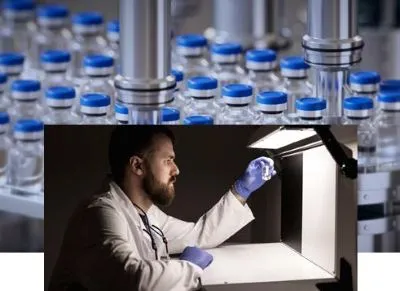
Q1: What is Visual Inspection of parenteral products?
Satish
Visual inspection (VI) is a critical manufacturing process step in ensuring the quality and safety of injectable drug products. The VI step involves a careful examination of each container for the presence of particulate matter, which are “extraneous, mobile, undissolved particles other than gas bubbles unintentionally present in the solutions”, as well as for other defects such as container blemishes etc.
Atanas
Parenteral products are expected to be essentially / practically free of visible particles. The “essentially free” requirement is based on a statistical assessment of the whole batch (USP<790>). Each batch undergoes 100% VI (either manual, semi-automated or automated) as part of the manufacturing process and containers with particles and other defects are culled.
Q2: Why is visual inspection important?
Satish
A review of the FDA website shows that over the last decade, particulate contamination has consistently been the cause for about 40 percent (on average) of the recall notices of injectable drug products in the US Recalls, Market Withdrawals, & Safety Alerts | FDA. [Note that the terms particles or particulate matter is used interchangeably].
Particles in parenteral products are controlled to protect against risk to sterility of product, capillary occlusion, or in the case of biotherapeutics, the risk for generation of immunogenicity. Apart from controlling for the direct safety impact in the product, particles in products should also be considered as a tool to monitor process and facility integrity. Zero particles in all containers produced is the ideal state - however, a rigorous program of training, qualification, inspection, identification and trending is needed to drive the continuous improvement to achieve this state.
Atanas
Particles can be classified into extrinsic (from the environment external to the process), intrinsic (from within the process), and inherent (of the product) (USP<1790>). Different levels of risk are posed by these particles and therefore the ability to detect, eliminate as well as identify / classify particles found in products is critical for any manufacturing facility.
While control of particulate matter requires a holistic approach, we will focus on visual inspection in this discussion. Particulate matter control is a perennial hot topic in the industry with ongoing efforts to make VI more effective and efficient including technological and procedural aspects, some of which are discussed here.
Q3: What are the best practices and critical factors for designing a robust VI qualification (Manual VI and Automated VI) program?
Satish
The basis of a consistent VI operation is a robust qualification program - the process of demonstrating that a visual inspection system (encompassing personnel, equipment, and procedures) is capable of consistently detecting defects in parenteral drug products. This is critical to ensure quality of products manufactured in a facility.
Current guidance documents provide implicit definitions of "visible particles" as those readily detectable by the naked human eye under standardized conditions, acknowledging the probabilistic nature of visible particle detection. There is no fixed size threshold for particle detectability and the use of statistical methods, such as threshold studies or Knapp tests, is recommended to establish the probability of detection. The qualification process should cover aspects such as light intensity, duration of inspection, background conditions, and the training and certification of visual inspectors. All these elements must be standardized to ensure consistent results.
Atanas
Designing an effective VI qualification program starts with a clear scope definition, including the types of products and defects to be evaluated. It is useful to define what defects are "typical" or expected in the manufacturing process or the product versus what is "atypical". An essential part of the qualification program is comprehensive training of all VI operators, both theoretical and practical. It is helpful to implement a certification process to verify the competence of each inspector. Training should enable inspectors to distinguish typical, process-related particles from atypical particles that might indicate a problem with the production process or even the facility. An important part of a detailed training program is establishing a good reference library of typical and atypical defects to support inspector training and qualification.
To evaluate the ability of the inspection program (human inspectors or automatic, machine-based) to correctly and consistently identify defects, a properly designed qualification test set that reflects the operations and processes in the facility is essential. Qualification defect test sets are used to conduct qualification runs that mimic the actual inspection process to evaluate the ability of VI operators or automatic machine vision systems to consistently detect defects against pre-established acceptance criteria. Naturally, it is important to maintain and continuously improve the program by conducting periodic re-qualification to ensure that it maintains its effectiveness and relevance. A robust program should implement performance monitoring to track and trend the effectiveness of the inspection process, outcomes, evaluate any changes, drifts and out-of-trend results for troubleshooting, process improvements as well as reassess the training and defect sets.
Large-scale operations often use automated visual inspection (AVI) for large batches and when the same product is manufactured frequently. AVI using various detection technologies (including AI-aided data analysis) is however also trained using human inspectors, with the expectation that the AVI will perform equal to or better than the human inspectors. Thus, the human inspector and their training and qualification remains the linchpin of the inspection program.
Q4: How do multi-product manufacturing facilities deal with the complexity in the VI qualification process?
Atanas
A major challenge for multi-product parenteral product manufacturing facilities (such as clinical manufacturing facilities or CDMOs) is how to ensure a compliant VI qualification program, which is also resource-efficient. Products may come in different sizes and types of primary packaging, fill volumes, and with a variety of product attributes (such as color, turbidity etc.). An inspection program could address these using dedicated, product-specific qualification defect test sets, but would be expensive, resource intensive and inefficient. A powerful tool in streamlining VI qualification in such facilities are bracketing or worst-case approaches. A facility can define a bracket of product attributes and bundle the qualification of multiple products falling within that bracket by designing a qualification test set that covers the entire relevant attribute space. An alternative is to use the worst-case approach, focusing the qualification test set design on the attributes that are most challenging for detectability. In either case, scientifically sound test set design and justification are essential to ensure compliance with current regulations and guidance. Despite the challenge in setting up robust justifications for a bracketing approach, more often than not such approaches can bring significant resource savings, streamline operations and significantly increase the quality level.
Q5: Why is particle identification and characterization considered an essential part of a robust VI program?
Satish
A risk-based approach for particle management in sterile manufacturing is based on differentiating the expected (normal operations) from the unexpected (operational irregularities). By establishing a baseline for what constitutes a "normal particle background" or "typical process-related particles, manufacturers can effectively define the "atypical." The "typical process-related" particles often originate from equipment and primary packaging (e.g. metal, plastic or glass particles) or from consumables, cleaning and gowning materials (e.g. polymer particles and fibers). These, despite best efforts and strict particle environment control in the sterile manufacturing facility, cannot be entirely eliminated. Understanding and documenting these “expected” particles, both in terms of types and frequency of occurrence, is very important for defining the normal performance of the facility and by inference - what is abnormal / atypical. Sudden appearance of atypical particles or an increase in occurrence of typical process-related particles, representing a departure from the established norm, may signal a breach of GMP or a process failure and should trigger an immediate action (e.g. an investigation). By focusing resources on identifying and addressing deviations that could potentially compromise product quality or safety, this risk-based approach ensures high product quality and consistent production process, while maintaining high operational efficiency.
Q6: What are the core elements for establishing capability for particle identification and characterization and how does it support the overall quality?
Atanas
Establishing a facility particle / material library is a vital tool. By collecting and documenting typical process-related particles associated with their specific processes and materials, a facility defines a reference point for identifying manufacturing issues. Such libraries can serve as a cornerstone for effective particle control, allowing operations and quality staff to focus on what truly matters – ensuring product quality. The contents of a facility particle and material library can vary and can be adapted as needed, but typically should include entries for each material source (e.g. material / equipment part number and source), material composition, digital photographs, and critically - spectroscopic data. The latter can be the spectra acquired using FTIR and / or Raman micro-spectroscopy, Laser Induced Breakdown Spectroscopy, Energy dispersive X-ray spectroscopy, or any additional analytical techniques that may help identify particles by matching them to the internal spectra library. We note that while there are several publicly and commercially available spectral libraries, it is of paramount importance to build a library from the exact components and materials used in the given facility. A facility-specific spectral library enables exact match to specific components and materials used in the facility, enabling rapid issue resolution and efficient deviation handling.
In summary, a risk-based approach acknowledges the realities of the manufacturing environment. By setting realistic expectations and focusing on identifying atypical particles, manufacturers can optimize their resources and ensure consistent high-quality production. Facility material / particle libraries are a critical component of a robust strategy, enabling a scientifically sound, risk-based approach.
Q7: New cell and gene therapeutic modalities have been very successful during the last decade but present numerous technical challenges to VI. What are these and how to tackle them successfully?
Satish
Cell therapy products present a set of special challenges for control of undesirable (visible) particles due to the difficulty in inspecting these products which by their very nature contain e.g. desired cells, and undesired cell clumps and/or cell debris (intrinsic particles), as well as truly foreign particles. The non-cells related particles arise from the single-use systems used in the manufacture, as well as via the operators due to the often-times significant degree of manual operations involved. The final product is a cell suspension that cannot be filtered unlike conventional biologics. In case of autologous therapies, batch sizes are also small, precluding the ability to perform destructive VI along the lines of “difficult to inspect products”.
Gene therapy products, whether autologous or allogeneic, can be manufactured in larger volumes and the final bulk solution can be sterile filtered. While the manufacturing steps employing single-use systems and manual operations lead to the same risks as with cell therapy products, the final filtration step can help to reduce the particle burden. However, it must be noted that the final filtration step, irrespective of the product type, should not be used as a particles control step, allowing sloppy practices upstream.
Atanas
Cell and gene therapy (C>) products are not granted any specific exemptions in US and Japan and must therefore comply with normal parenteral products visual inspection and particle control requirements. EU specific GMP guidelines for Advanced Therapy Medicinal Products (ATMPs) under Eudralex Vol. 4 allows some additional flexibility for the unique aspects of ATMPs. Therefore, for products intended for global markets, the challenge remains in terms of prevention and control of particles.
A thorough understanding of the source, the type, and the process steps where particles are generated or introduced is the starting point in controlling them. The raw materials, the manufacturing equipment and single-use consumables, the primary packaging, and the operators are all sources that must be assessed and addressed. Process simulation manufacturing runs with water/buffer can help to create an understanding of the quality of control, and the (high–risk) sources. This can drive improvements by active collaboration with suppliers and vendors, improving/eliminating (high-risk) steps and drive operator training - all directed towards the ultimate goal of reducing these particles in the first place.
Q8: What are some future trends in visual Inspection?
Satish
We expect particulate matter control to continue to be an important aspect of parenteral products, with increasing emphasis on control due to safety concerns - for foreign as well as intrinsic and inherent. In the case of biologics, as novel constructs such as bispecifics and fractional formats become increasingly prevalent, manufacturing and immunogenicity concerns will be enhanced and thus the need to assess and control proteinaceous aggregates.
Developments in the control of particles for C> will continue to drive improvements in manufacturing and in the equipment, in collaboration between sponsors and vendors.
Atanas
Novel technologies may come on-board, beyond the current imaging-based techniques. One example is hyperspectral imaging, which may allow for non-destructive testing of difficult to inspect products.
Among the more exciting developments will be the incorporation of AI in particulate control - from use of machine learning to classify/identify particles based on morphological characteristics, to training AVI machines and continuously improving their detection capabilities (while reducing false rejects) as they learn about the product (defects) they are inspecting. We are already seeing AVI machine vendors building these capabilities into their current offerings. This opens an entirely new chapter in the industry’s ability to deliver safe and effective parenteral drug products.