
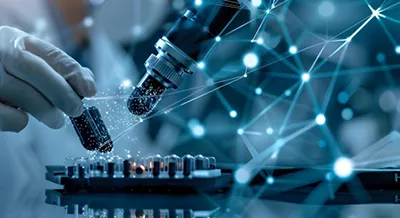
In recent years, artificial intelligence (AI) has emerged as a transformative force in various industries, and the field of drug discovery is no exception. As members of Dr. Samanta’s research team, we frequently discuss the latest advancements in AI and their implications for drug discovery. This article provides a glimpse into our conversations, highlighting the potential, challenges, and future directions of AI-powered drug-discovery platforms.
AI in Drug Discovery: A New Era Begins
The traditional drug discovery process is notoriously lengthy and expensive, often taking over a decade and billions of dollars to bring a single drug to market. However, AI is poised to change this paradigm. By leveraging machine learning algorithms, deep learning models, and large-scale data analytics, AI-powered platforms are accelerating the identification of potential drug candidates, reducing costs, and improving the accuracy of predictions. Some of the key goals that can be achieved with the help of AI are as follows:
Target Identification and Validation: Redefining Precision
One of the most critical steps in drug discovery is the identification and validation of drug targets—proteins or genes essential for disease intervention. AI technologies are significantly improving this process by analyzing vast datasets, including genomic and clinical data, to swiftly pinpoint novel targets. Platforms like AtomNet, for example, utilize structure-based drug design to predict interactions between drug molecules and their targets with remarkable precision. This advancement not only accelerates the discovery process but also enhances the accuracy of identifying viable drug candidates.
Property Predictions and Simulations in Different Environments: Reducing Physical Testing
AI is increasingly employed to conduct high-fidelity molecular simulations, allowing researchers to predict key properties such as toxicity, bioactivity, and pharmacokinetics without relying on extensive physical testing. This capability is particularly valuable in reducing the costs and time associated with traditional chemistry methods. By simulating how molecules behave in different biological environments, AI-powered platforms provide critical insights that guide the development of safer and more effective drugs.
De Novo Drug Design: Discovering the Unknown
De novo drug design, the technique of creating completely novel therapeutic compounds from scratch, is one of the most intriguing advancements in AI-driven drug discovery. Comparing this to the conventional method of screening already-existing chemical libraries is a paradigm shift. AI programs like Alphafold, and platforms with integrated AI-based tools like PepFold and AntiBP2 make it simple and quick to obtain structure and associated data about the characteristics and functions of peptides. By using data from studies such as structure-activity relationships and ML models, researchers can create new leads or design new drugs based on peptide-based drug candidates.
Candidate Drug Prioritization: Streamlining Development
After identifying promising drug candidates, the next challenge lies in efficiently prioritizing them for further development. AI algorithms excel in this area, utilizing advanced ranking techniques to assess the potential of each compound based on a variety of factors, including efficacy, safety, and manufacturability. This prioritization process significantly improves the efficiency of the drug development pipeline, ensuring that the most promising candidates advance quickly through the stages of research and clinical trials.
Synthesis Pathway Generation: Optimizing Drug Manufacturing
AI is also making its mark beyond drug design by optimizing the synthesis pathways for new compounds. This involves generating practical, cost-effective methods for manufacturing drugs at scale. AI-driven platforms can suggest modifications to synthesis pathways, enhancing feasibility and reducing the environmental impact of drug production. This capability is essential for bringing new therapies to market in a sustainable and economically viable manner.
Recent developments in Dr. Samanta’s laboratory
As part of Dr. Samanta's research team, we have been actively contributing to the field of AI-driven drug discovery through our own research initiatives. Our team has focused on integrating AI with computational chemistry and molecular biology to identify novel drug targets and optimize drug design.
• AI-Assisted Lead Identification: In a recent study, we analyzed metagenome data from the human microbiome for the identification of powerful antimicrobial peptides. In addition to demonstrating the way AI can speed up target discovery, this study showcased new avenues for the development of specific treatments against infections that are resistant to drugs.
• Predicting toxicity and generating analogues: Before going to the testing stage, we can improve our lead candidate based on Toxinpred results. ToxinPred is AI-based model that helps predict the bioactivity and toxicity of novel chemicals. We have identified numerous potential peptides as a result of our investigation in this field.
• Creating ML models with larger datasets: Additionally, our group is working on development of AI and ML models for identification of potent peptide inhibitors against targets in drug-resistant bacteria. The uniqueness of our efforts is underscored by the exhaustive data curation which is the main focus of our team.
Challenges and Ethical Considerations
While the potential of AI in drug discovery is immense, our team acknowledges several challenges that must be addressed. The quality and diversity of data used to train AI models are critical; biased or incomplete data can lead to inaccurate predictions. Additionally, there are ethical considerations, such as data privacy and the transparency of AI decision-making processes that must be carefully managed to ensure the responsible use of AI in drug discovery.
The Future of AI in Drug Discovery
Looking ahead, our team is optimistic about the future of AI in drug discovery. We believe that as AI technologies continue to evolve, they will enable more personalized and precise treatments for a wide range of diseases. Collaborative efforts between AI developers, pharmaceutical companies, and academic researchers will be key to realizing this potential.
Conclusion:
The integration of AI into drug discovery is not just a trend but a fundamental shift in how we approach the development of new therapies. As Dr. Samanta’s research team continues to explore these advancements, we are excited about the possibilities that lie ahead. By harnessing the power of AI, we are moving closer to a future where life-saving drugs are discovered faster, more efficiently, and with greater accuracy.
Call to Action:
We encourage our peers and fellow researchers to engage in discussions about AI in drug discovery. By sharing knowledge and insights, we can collectively advance this exciting frontier and contribute to the development of better treatments for patients worldwide.