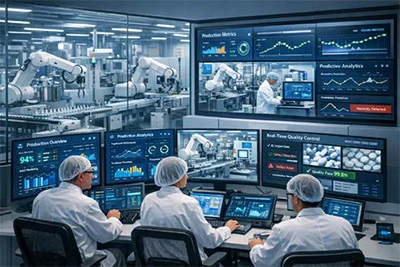
The pharmaceutical manufacturing landscape is undergoing a profound transformation driven by Artificial Intelligence (AI) integration. The market for AI technology in pharmaceuticals is projected to grow from $3.05 billion in 2024 to $18.06 billion by 2029, representing a compound annual growth rate of 42.6%. This explosive growth reflects recognition that AI represents not merely an incremental improvement, but a fundamental reimagining of how medicines are manufactured and delivered to patients.
For decades, pharmaceutical manufacturing relied on batch processing, extensive offline testing, and reactive quality control. Today, machine learning algorithms, Process Analytical Technology (PAT), and advanced sensors enable a shift toward continuous manufacturing, real-time quality assurance, and predictive process control. This transition addresses longstanding industry challenges, reducing time-to-market, minimising waste, ensuring consistent product quality, and enabling rapid responses to public health emergencies.
The Regulatory Landscape and FDA Support
The US FDA established an AI community of practice in 2021, released an updated strategy in 2022, and began execution in 2023, with efforts continuing through 2024. This regulatory evolution demonstrates that AI in pharmaceutical manufacturing is now an operational reality requiring clear guidelines and oversight.
At the 2024 ISPE Biotechnology Conference, FDA officials noted approximately 40% of companies already use AI in various capacities, with many more planning implementations within one to three years. The FDA’s Framework for Regulatory Advanced Manufacturing Evaluation (FRAME) program has designated AI as a priority technology, recognising its potential to enhance manufacturing robustness and supply chain resilience.
The regulatory community has identified three critical questions shaping future AI implementation: ensuring the security of cloud-stored information, determining appropriate regulatory oversight for AI models, and establishing lifecycle considerations for continuously learning systems. Industry position papers emphasise that existing Good Manufacturing Practice (GMP) regulations and Computerised System Validation (21 CFR Part 11) frameworks already provide procedures to manage AI-related risks.
The European Union’s Annexe 22 to Good Manufacturing Practices provides additional clarity, emphasising explainability, deterministic behavior, and human accountability principles that align with the Human-in-the-Loop (HITL) approach manufacturers are adopting.
Process Analytical Technology: The Foundation for AI Integration
PAT represents the essential infrastructure enabling AI-driven manufacturing. The FDA defines PAT as a mechanism to design, analyse, and control pharmaceutical manufacturing through measurement of Critical Process Parameters (CPPs) that affect Critical Quality Attributes (CQAs). While PAT has existed for decades, AI integration has dramatically expanded its capabilities.
Modern pharmaceutical manufacturing monitors hundreds of variables simultaneously—temperature, pressure, flow rates, particle sizes, and chemical concentrations. Traditional PAT methods struggle with the massive data volumes from complex manufacturing, particularly for biopharmaceuticals. AI addresses this through machine learning, artificial neural networks, and deep learning capabilities, enabling continuous quality monitoring, early anomaly detection, and adaptive process control.
The integration of PAT with AI enables prescriptive feedback control. Advanced process control systems coupled with AI solutions like anomaly detection, classification, and predictive analytics automatically analyse complex non-linear process models through neural networks or deep learning algorithms that identify exceptions, provide alerts, and deliver feedback.
Continuous Manufacturing: A Paradigm Shift
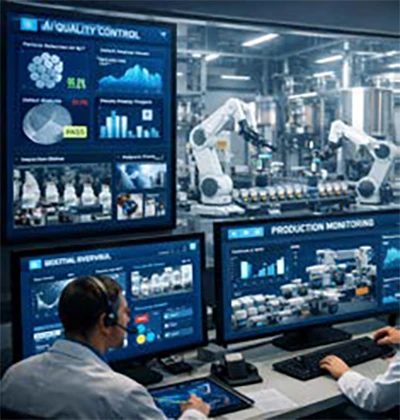
The transition from batch processing to continuous manufacturing represents one of the most significant changes in pharmaceutical production, with AI serving as a crucial enabler. Continuous manufacturing offers increased efficiency, waste reduction, and real-time quality control. Traditional batch manufacturing consists of discrete operations with offline checks and storage between stages, resulting in longer setup times, lower equipment utilisation, higher waste generation, and extended production cycles.
In a Deloitte study, 49% of respondents reported operational benefits as the primary value of smart manufacturing. For pharmaceutical companies, this translates to faster time-to-market, a business priority repeatedly emphasised in 2025.
Continuous manufacturing systems integrate multiple unit operations designed to process ingredients and produce final products without interruption. All operations combine with PAT to monitor and control CPPs, Critical Material Attributes (CMAs), and CQAs in real time, allowing manufacturers to produce consistent quality products while reducing waste and costs.
AI enhances continuous manufacturing by leveraging machine-learning models from process development data to identify optimal processing parameters and scale-up processes more quickly. Advanced Process Control enables dynamic control to achieve desired outputs, while AI methods use real-time sensor data to predict process progression. Digital twin models based on residence time distribution theory train artificial neural network predictive control models that demonstrate excellent performance in set-point tracking and disturbance rejection compared to traditional PID controllers.
Real-Time Quality Control and Release Testing
Perhaps the most transformative AI application in pharmaceutical manufacturing is enabling Real-Time Release Testing (RTRT). Traditional quality control relies on sampling at various production stages, conducting offline laboratory analyses, and making disposition decisions after testing is complete. This approach introduces delays, increases costs, and can result in rejecting entire batches based on post-production testing.
RTRT using PAT manages correlations identified through Quality by Design (QbD), enabling Continuous Process Verification while producing high-quality drug products. This represents a shift from traditional methods, where most testing occurred in laboratories separate from production lines and after manufacturing.
AI strengthens risk management frameworks and enhances compliance by providing deeper insights into vulnerabilities and ensuring adherence to current Good Manufacturing Practice (cGMP) guidelines. Natural Language Processing (NLP) reviews vast amounts of regulatory documents, Standard Operating Procedures (SOPs), and batch records for consistency and compliance. Proactive risk identification systems analyse historical non-conformance data, audit findings, and deviations to predict future compliance risks and suggest preventative measures.
Predictive Maintenance and Equipment Optimisation
Equipment failures can eliminate weeks of production and millions in product value. AI-enabled predictive maintenance has become essential, with algorithms trained on vibration, temperature, and flow data predicting failures before they occur, shifting maintenance from reactive to proactive.
AI-powered algorithms leverage real-time sensor data to monitor critical metrics like temperature, vibration, and pressure. By identifying patterns and anomalies, AI accurately forecasts potential equipment failures, allowing proactive maintenance scheduling and minimising unexpected downtime. This approach reduces downtime costs and extends machinery lifespan. As AI models continuously learn and refine predictions, maintenance occurs precisely when needed, optimising resource allocation and enhancing operational efficiency.
Companies implementing AI-driven predictive maintenance report significant reductions in unplanned downtime and maintenance costs while simultaneously improving equipment reliability and product consistency.
Digital Twins and Batch Manufacturing Enhancement
Digital twins, virtual replicas of manufacturing processes, represent one of the most powerful AI applications in pharmaceutical manufacturing. Digital twins allow teams to simulate scale-up before modifying physical equipment, reducing technology transfer uncertainty by simulating complex processes before committing assets.
Research on wet granulation demonstrated that neuro-fuzzy logic and gene expression programming outperform traditional scale-up rules, enabling accurate modeling across equipment ranging from 25 L to 600 L capacity. AI-driven digital twins simulate manufacturing under varying conditions, enabling virtual experimentation and optimisation supporting process design, scale-up, technology transfer, and Ongoing Process Verification.
While continuous manufacturing represents the future for many products, batch manufacturing remains dominant. AI is transforming batch operations, offering substantial improvements in yield, consistency, and efficiency. A global pharmaceutical company deployed an AI Process Optimisation system predicting key variables for batch harvest readiness three days into the batch, providing insights seven days earlier and enabling a 15% improvement in annual yield. The system virtualised, normalised, and unified four years of historical batch data from three different systems, configuring and testing nine machine learning models.
Challenges and Future Outlook
Despite transformative potential, significant challenges remain. Implementation requires substantial investment in technology and human capital. Organisations must develop expertise in data science, machine learning, and AI system validation. Integration with legacy systems presents another challenge, as facilities often operate equipment installed years or decades ago.
The HITL paradigm ensures human expertise remains embedded in critical decision-making, safeguarding patient safety, product quality, data integrity, and ethical responsibility. Data quality and availability present fundamental challenges, as AI models require large volumes of high-quality, properly curated data representative of full operating conditions.
Looking ahead, AI’s role will continue expanding. The future holds tremendous promise in personalised medicine and drug development, accelerated drug discovery through simulations, continuous manufacturing optimisation through real-time adjustment, advanced quality control systems, and simplified regulatory compliance. The integration of AI with Internet of Things devices, blockchain for supply chain traceability, and advanced robotics will create increasingly sophisticated manufacturing ecosystems.
Conclusion
AI integration into pharmaceutical manufacturing represents a fundamental industry transformation. From PAT enabling real-time quality control to digital twins simulating complex processes, AI addresses longstanding challenges while opening innovation possibilities.
The regulatory environment has evolved to support responsible AI adoption, with the FDA and other agencies providing validation and oversight frameworks. Industry adoption is accelerating, with approximately 40% of companies already using AI and many more planning near-term implementations.
Challenges remain around data quality, system integration, and maintaining appropriate human oversight. However, the benefits, improved efficiency, reduced waste, enhanced quality, and faster time-to-market provide compelling motivation for continued investment. As AI technologies advance, pharmaceutical manufacturers successfully integrating these capabilities will be better positioned to meet evolving healthcare systems and patient demands worldwide.