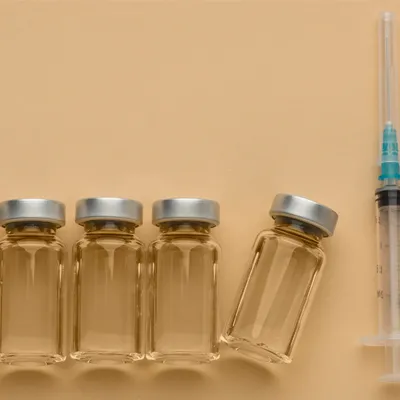
The pharmaceutical industry has experienced a paradigm shift in the methods of injectable medicine development, packaging and delivery. The one that has advanced the most is the increase of single-dose prefilled syringes (PFS) which has the advantage of being convenient, precise, and safe to the patient. The COVID-19 pandemic has also fueled the increase in demand for prefilled syringes, particularly for vaccines and biologics, as speed, sterility, and precision cannot be ignored in using these products.
Manual and even semi-automatic filling and sealing processes are no longer sufficient to suitably meet the modern manufacturing requirements. Such difficulties as risk of contamination, low yield in scalability, human error and high variability have led to the shift to fully automated mechanisms.
This article explores insights as to how the automatic filling and closing machines used in single-dose syringe production have simplified the process. It emphasizes their operating principles, advantages, regulatory aspects, and issues they tend to impose during their adoption as well as provides an idea about the trends in the future that can mold the face of injectable drug delivery.
The Need for Automation in Syringe Filling
Single-dose syringes are slowly gaining popularity in most pharmaceutical subsections because they are convenient and achieve high compliance. But sterile injectable medicine preparation involves:
• High precision on the filling volumes.
• A pollution-free surrounding.
• Compliance with Good Manufacturing Practices (GMP).
The requirements cannot always be satisfied in manual filling systems Semi-automated systems are more rapid but still require the labor of an operator, and furthermore, there is a higher chance of microbial or particulate contamination. Furthermore, as biologics, vaccines, oncology drugs, and personalized medicines are becoming more in demand, scalability and precision have become crucial factors.
Automation is the most viable solution. Automatic filling and closing machines help to achieve efficiency, consistency, and sterility and eliminate the need of manual labor through the integration of robotics, sensors and closed systems.
Working Principles of Automatic Filling and Closing Machines
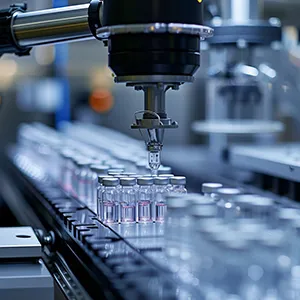
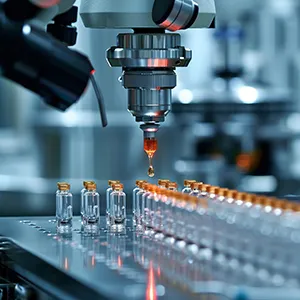
State-of-the-art automatic filling and closing systems are engineered to operate with high throughput but not sacrifice sterility and dose accuracy. They work in several basic phases of their operation
1. Syringe Preparation
• Loads of the syringes are made into the machine either manually in trays or by robotic means.
• De-nesting and positioning are automatically undertaken.
2. Filling Process
• Single-dose drug products are accurately measured and dispensed with high-precision pumps.
• Sensitive biologics can be processed with no shear stress on advanced systems
3. Closing and Sealing
• Automatic plungers or stoppers or caps are used.
• The presence of robotic systems guarantees relative location without a lot of human interaction.
4. In-line quality control.
• Fill volume, stopper location and the integrity of the contained item are checked on cameras and sensors.
• Units that are not conforming are discarded automatically.
5. Sterile Environment
• Aseptic conditions are achieved with laminar airflow or restricted access barrier systems (RABS) or isolators.
• Cleaning-in-place (CIP) together with sterilization-in-place (SIP) are maintained in a sterile state.
Advantages of Automatic Filling and Closing Systems
Automatic systems eliminate the failure of manual systems and semi-automated systems.
Table 1: Manual vs. Semi-Automatic vs. Fully Automatic Syringe Filling
| Feature | Manual | Semi-Automatic | Fully Automatic |
| Throughput | Low | Moderate | High |
| Sterility | High contamination risk | Moderate | Very Low |
| Dosing Accuracy | Variable | Improved | Highly precise |
| Human Intervention | High | Medium | Minimal |
| Scalability | Limited | Moderate | Excellent |
Key Benefits of Automation:
• Speed and Efficiency: The machines are errorless, as they can check the syringes with speed and efficiency.
• Accuracy: Precision fill to exact dosing is critical to high-value biologics.
• Contamination Control: Less touch by human hands minimizes microbial or particulate contamination risk.
• Regulatory Compliance: The automated systems include data integrity, audit trail and electronic batch record.
• Cost Savings: It has a high investment but low operational costs in the long run.
Applications in Pharma and Biotech
Automatic filling and closing apparatuses are a luxury in many areas of therapy:
• Vaccines: Which is very pertinent given the pandemic when billions of doses were needed within a short period.
• Biologics and Biosimilars: Delicate molecules would demand delicate but exact treatment.
• Oncology compounds: Highly effective compounds are fitted to closed systems to prevent exposure of product and worker.
• Emergency Medicines: Single-dose formats can be used to administer medicines in a faster manner in emergency care.
• Clinical Trials: Reproducibility is essential in regulatory filings and this can be achieved through automation.
Regulatory and Compliance Considerations
Space automation has to work by very tight regulatory conditions. The important aspects are the following:
• Good Manufacturing Practices (GMP): The equipment should be able to fit aseptic processing.
• 21 CFR Part 11: The systems have to support secure electronic records and signatures.
• Data Integrity: Parameters of the processes are recorded in an automated way making it traceable.
• Validation: Installation qualification, Operational qualification and Performance qualification.
Table 2: Key Regulatory Checkpoints
| Regulatory Area | Compliance Requirement |
| GMP | Aseptic environment, validated processes |
| Data Integrity | Electronic audit trails, real-time monitoring |
| Validation | IQ/OQ/PQ documentation |
| FDA/EMA Standards | Alignment with sterile injectable guidelines |
Integration with Digital Technologies
Modern automation equipment are not “standalone” devices but components of digital systems:
• Smart Monitoring: The real-time measurement of fill precision, temperature and pressure is gained via sensors.
• Predictive Maintenance: The machine learning models detect the future failure of the components prior to failure.
• Robotics: Increase accuracy in the handling of syringe and stopper placement.
• Automation + MES Integration: Machines exchange data and communicate with Manufacturing Execution Systems (MES) to simplify the process of batch reporting.
The integration will make these aspects more transparent, efficient, and quality-assured.
Sustainability in Syringe Production
Sustainability is a new focus within the manufacturing of pharma. Automatic filling and closing machines are helpful in that:

• Minimizing dosing loss of products
• Reducing raw materials.
• Employing energy-efficient drives and motors.
• Promoting repackaging packaging material.
Challenges and Limitations
While benefits are substantial, several barriers remain:
Table 3: Challenges vs Solutions
| Challenge | Description | Potential Solution |
| High Initial Cost | Large capital investment required | Long-term ROI, leasing models |
| Technical Complexity | Requires skilled operators and engineers | Workforce training programmes |
| Flexibility | Machines may be designed for limited syringe formats | Modular, flexible systems |
| Maintenance | Downtime risks during servicing | Predictive maintenance using AI/IoT |
Future Outlook
The technology of syringe filling and closing will be characterized in the future by:
1. Process Optimization with AI - Artificial intelligence will improve the accuracy of filling and eliminate thrashing by optimizing the performance of filling machines based on the information about the production.
2. Flexible Machinery—Systems that can handle multiple-format syringes and different drugs at once in one production system.
3. Personalized Medicine Readiness—Machines that can process smaller, highly customized runs and be patient-specific therapies.
4. Continuous Manufacturing Models—Continuous manufacture where all the stages (filling, sealing, inspection and labeling) are in an integrated continuous manner.
5. More Automation in Quality Checking—Increased automation using advanced vision systems and inline sensors to inspect in real time.
Conclusion
Single-dose syringes have increased in importance in the pharmaceutical industry due to their precision, sterile manufacturing and economy. Automatic filling and closing machines have become a necessity and they have allowed manufacturers to fulfill global demand and guarantee regulation requirements.
By providing unrivaled precision, diminishing the chances of contamination, and being highly scalable, the machines are transforming injectable production. Despite such remaining challenges as high expenses and technical complexity, the integration of digital technologies, modular designs, and predictive maintenance are bridging the barriers.
In the future, the use of automation in injectable drug delivery will continue to grow and as such, smart, flexible, and sustainable systems will become the new benchmark standards. As it stands, operators that use next-generation fully automatic dosing and capping equipment are positioning themselves to lead the pharmaceutical industry not only in the near future, but in coming years as well.