

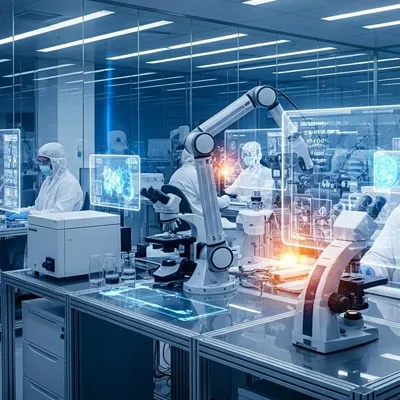
The development of drugs to aid patients is especially in the laboratories of the pharmaceutical sector. They are essential in the discovery, developing and manufacture of medicines. Nevertheless, the requirements of laboratories have been growing. The fact that new therapies are complex and need to be delivered in a more efficient way, as well as the involvement of regulation, demands new approaches. The conventional laboratory approaches are usually laborious, time-consuming and resource-intensive.
As a way of facing these issues, the concept of smart laboratories is developing. These laboratories combine high-throughput experimentation, automation, modelling and artificial intelligence (AI) into systems that are more efficient and able to support rapid discovery. And smart laboratories are not just assemblages of sophisticated instruments. These exemplify a new model of doing research, in which human and machine knowledge combine and enhance the result.
The article discusses the basis of the intelligent laboratories, their use in pharmaceutical research and production and opportunities and threats they pose to the future.
Evolution of Pharmaceutical Laboratories
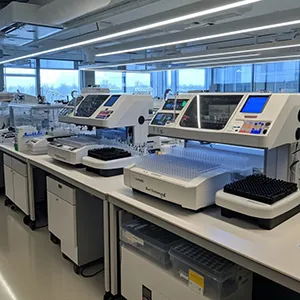
The reliance on laboratories by pharmaceutical giants on manual processes with the support of human expertise has been the norm. Such approaches are still relevant but they carry their own drawbacks:
• Long, time-consuming experiment cycles
• The expensive reagent usage and resources
• Poor capabilities to manage data in bulk
• Human failure with monotonous work
Automation and digitalization have already transformed laboratories in the last 20 years. Automation through the use of robotic arms, automated liquid handlers and computerized analytical systems has decreased manual labor. There are Laboratory Information Management Systems (LIMS) that have aided in the organization of data.
However, such improvements tend to act in silos. The future of smart laboratories is identified to be the combination of these parts into a context-sensitive environment, with a free data circulation and instruments that work in harmony.
Foundations of Intelligent Laboratories
A smart lab is an amalgamation of four fundamental components
1. High-Throughput Experimentation
When multiple tests can be run concurrently, then multiple compounds/excipients/process conditions can be screened within a short period of time.
2. Automation
Automated analyzers and workflows that are controlled and robotized minimize human participation involved in routine processes. This lessens the errors and enhances reproducibility.
3. Theoretical and Computational Tools
Computer models, quantitative modelling and digital twinning help in the decision-making process by eliminating the prolonged time used in trial-and-error processes.
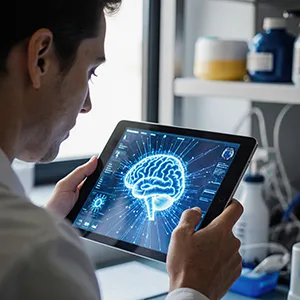
4. AI and Machine Learning
AI algorithms examine complicated sets of data, recognise patterns and recommend experimental directions that humans might not easily determine.
It is the combination of these components that forms laboratories capable of designing, executing and evaluating experiments independently, with the scientists in the role of supervisors and interpreters.
Applications in Pharmaceutical Research
Drug Discovery
Drug discovery means that large numbers of molecules have to be screened to identify their biological activity. A lot of this process can be automated by intelligently designed laboratories under:
• Automated screening platforms that process many samples simultaneously
• Using AI-based analytics to foresee the opinionated substances
• The combination with the omic data to discover the new targets in therapy
This combination not only accelerates the discovery in initial stages but it also brings down the resources required to discover the lead candidates.
Formulation Development
Novelty and efficacy of drug formulations should balance solubility, stability and bioavailability. Smart laboratories are those that use a smartphone application. A smartphone is an application in the phones that makes them smart.
• Model excipients and formulations by simulation software
• Run automatic stability tests with The conditions varying
• Leverage the power of AI to optimize formulations, given experimental data
These systems reduce the time involved in product development and allow the quality of products to be managed.
Bioprocess Development
Optimization of biopharmaceutical production consists of optimizing cell culture conditions, purification procedures and quality control. This is backed by intelligently formed labs.
• Cultural monitoring with sensors and digital twins
• Predictive modelling of yield based on different conditions using machine learning
• Connecting regulatory compliance systems to process data
The practice is in line with that of continuous biologics manufacturing.
Quality Control and Analytical Testing
Pharma quality testing needs to be at a high regulatory bar. by increasing the control of quality in Intelligent laboratories.
• Installation of automatic chromatographic and spectroscopy apparatus
• Applying AI to a fast identification of patterns in test outcomes
• Ensuring data capture, which is real-time tracing
Not only does this enhance reliability but it also shortens the turnaround time in quality assurance.
Applications in Pharmaceutical Manufacturing
Manufacturing is done in intelligent laboratories, which is a major research focus.
Processing Monitoring: Automation causes it to be possible to monitor the manufacturing line continuously with the use of sensors.
Predictive Maintenance: The AI models foresee the failure and allow less downtime.
Digital Twins: Virtual production processes, also referred to as Digital Twins, a virtual model of the production process that enable manufacturers to experiment without interfering with the production process.
Integrated Supply Chain: Digital supply chains can be interlinked with intelligent labs and allow the effective use of raw materials and reagents.
Case Examples of Intelligent Laboratory Use
| Application Area | Traditional Approach | Intelligent Laboratory Approach |
| Drug Screening | Manual testing of compounds one by one | Automated high-throughput screening with AI analysis |
| Formulation Development | Sequential trial-and-error experiments | AI-guided optimization with automated stability studies |
| Bioprocess Optimisation | Manual adjustment of parameters | Digital twins predicting outcomes in real time |
| Quality Control | Manual interpretation of analytical data | Automated analytics with machine learning models |
Advantages of Intelligent Laboratories
• Speed and efficiency: Huge numbers of experiments can be carried out in a relatively shorter time.
• Data Integration: Data are captured seamlessly and this leads to traceability and regulatory compliance.
• Minimized Expenses: With maximized consumption of reagents and minimized failures, expenses are reduced.
• Enhanced Accuracy: Automation reduces the element of human error.
• Scalability: The labs can be added on to as lab needs evolve.
• Human-Machine Collaboration: Scientists work in the design and interpretation of the studies and not repetitive work.
Challenges and Barriers
Although they have vowed intelligent laboratories, there are still issues to be solved:
1. High Initial Investment
Sophisticated tools, robotics and artificial intelligence systems are capital intensive.
2. The Problems of Data Management
Processing large data with safety and flexibility with regulatory compliance can be complicated
3. Interoperability
Instruments of various vendors might not merge well in the absence of standardization.
4. Regulatory Acceptance
Regulatory bodies might require new paradigms to analyze AI-based or autonomous laboratory procedures.
5. Cultural Resistance
Automation of expert decisions presupposes a cultural change in organizations.
Future Outlook: Towards Meta-Laboratories
The vision of the intelligent laboratories is long-term, which extends beyond individual labs. Meta-laboratories refer to the collaborative space in which both man and machine co-exist physically and virtually. In such systems,

• A researcher anywhere on the planet would be able to remotely design experiments.
• The cloud-connected instruments would automatically process them.
• The results would be analyzed, and novel experiments would be proposed by AI.
• Knowledge would filter in between research communities in a near real-time scenario.
In the case of pharmaceuticals, this may translate to an enhanced rate of drug discovery, improved sustainability of drug manufacturing, and open collaboration on solving dire health problems in a global context.
Conclusion
The increased demands of the pharmaceutical industry are quicker innovation, high quality and more efficient ways of doing things. Smart laboratories form the solution to these requirements. The combination of high-throughput testing, automation, computational modelling and AI builds more capable research and manufacturing environments than ever before.
Although the journey has its difficulties, including cost, management of data, and adapting to regulatory frameworks, the trend remains positive. Intelligent laboratories do not mark a new form of existing labs but are a precondition of the second paradigm of research in which human and machine intelligence enter into collaboration.
The future of pharmaceutical laboratories will not only make research and manufacturing processes faster but will also reimagine how science is practiced creating a future where innovation is faster, more collaborative and more sustainable.