

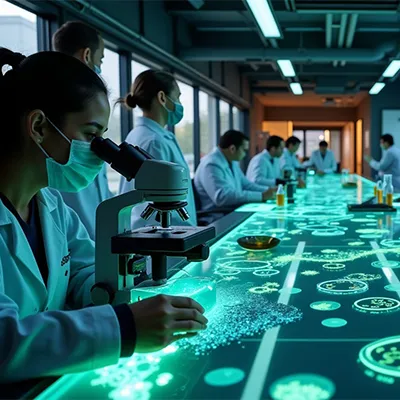
With biopharmaceutical firms under pressure to realise faster scientific advancement and maintain pipelines, it is time the modernisation of research laboratories bears evidence of its virtue. Recent research findings point to increased laboratory output, accuracy, and efficiency, along with a reduction in time it takes to discover new treatments as direct results of lab transformation programmes.
The urgency to change is being supported by the approaching imminent loss of exclusivity in a large number of medicines. In 2030 alone, more than 200 drugs that are covered by patents will lose them, many of them blockbuster products and the associated billions of dollars in sales. The resulting vacuums in company’s pipeline have made external acquisitions a very expensive affair and this fact further makes the case of developing internal research and development functions even stronger.
Previously known as the laboratory of the future, it is essentially the lab with high levels of automation, digital connectivity, and artificial intelligence powered lab. In this type of environment, scientists are able to minimise trial-and-error methodologies, better pool information across data sources, and more rapidly discern prospective drug candidates.
Across the industry, these investments in laboratory productivity have eructed optimism that more investigational drugs will be able to proceed to the approval stage and the rate of discovery accelerated in the next several years. Nonetheless, there are obstacles to be dealt with. Very few organisations have got the level of full predictive laboratories where digital twins, automation/artificial intelligence combination is in a seamless manner in delivering decision-making.
To take the next step, the emphasis will need to be put on establishing robust data bases, enhancing the operational activities, and promoting changes in culture to stimulate the broader use and expansion of digital technologies. These are among the most important things that should be done to unleash the full power of laboratory modernisation.
The Strategic Positioning of AI, Data and Automation
Machine learning and artificial intelligence are the very forms that are starting to transform not only drug discovery but also specific stages involved in target identification and molecular design to lead optimisation. The available underlying AI models could become widespread in the future but the key competitive edge would be access to the proprietary laboratory data to enhance the AI model. High quality, well integrated and well governed data systems will probably make it possible to generate insights much more rapidly, to drive AI-based innovation, and to enhance internal research capabilities.
Organisations should have an approach that will enable them to take advantage of all digital technologies and laboratory data by integrating them effectively with people, processes and technology. Major actions Such as:
• Designing a clear roadmap on laboratory modernisation and that is supportive of the overall research priorities
• Enhancing research data usefulness through treating it as a product with structure and with sharing opportunities
• Enhancing procedures on operations and data governance models
• Positively influencing cultural change to encourage the use of digital across teams
Recent research shows that the gains made by investing in digital tools and modernising the laboratory are already tangible enough to measure.
Lab-of-the-Future Investments Delivering Results
As the cost of research increases and competition intensifies, such investments are necessary in order to maintain innovation. Early signs are encouraging that digitalisation and automation can enhance data quality, elevate efficiency and speed up discovery. The workflow benefits presented herein illustrate how the use of modern laboratory technologies can redefine the way work is done, enhance data integrity and improve overall work output.
With further modernisation, the effect of all the digital technologies combined can create deeper biomedical knowledge, reduce development lead-time, and increase the probability of success in the development of new therapies. Expectations of the industry in the coming years ahead are good with many leaders expecting speedy drug poisoning and fewer investigational drugs to be approved. Planned investment suggests that lab-of-the-future approaches might continue to be of central concern with close interrelation to general research and business objectives.
Advancing Along the Digital Maturity Curve
With the increasing globalisation trend of modernisation, biopharmaceutical research laboratories will need to make a journey up a digital maturity curve, moving beyond fragmented data, towards fully integrated, predictive environments. This has been more than a technological change, but an actual shift in the modality through which scientific research is conducted.
To this end, a practical starting point is to get organisations to appraise their own digital maturity. This will give a clear picture as to where to seek improvements and help in defining priorities in terms of investments. Currently lots of laboratories had not developed fully. Others run with a number of unintegrated systems as others have met a connected level where data is centralised partly integrated, and partially automated.
In future outlook, the main focal point will be toward integrating artificial intelligence and automation practices into everyday practices. The goal of the predictive state is to have even more closely integrated wet and dry laboratory conditions, where experiment and simulations inform each other in real time. Within these environments, digital twins, automation, additional metrics and upstream algorithms can navigate researchers to fairer decisions, curtail experimentation and enhance the profile of drug leads.
It is expected that in the upcoming years more laboratories will improve to this point of being predictive rather than being the small proportion that they currently are. Predictive labs are still a goal of most organisations, however, one that is increasingly becoming possible as digital maturity strengthens.
Considerations for Maximising Impact
The contemporary research laboratory is something more than a complex of new instruments. It is an interconnected environment wherein automation, data analytics and intelligent systems synergise in the support of collaborations, reinforcement of data quality and achievement of compliance as well as advancement of discovery.
The entire tendency towards laboratory modernisation must thus be approached as an all-encompassing transformation, rather than an upgrading process comprising multiple adjustments. Focus across four areas is usually required
• Strategy - ensuring that laboratory efforts are in line with the overall research and development expectations
• Infrastructure - developing the digital and physical infrastructure necessary to support integration and scalability
• Operations - streamlining processes to gain efficiency, governance and data use
• Culture - facilitating behaviour and skills that help a scientist work and cope with new technologies
Establishing a Comprehensive Roadmap
Many journeys to improved research productivity start with a clear vision of laboratory modernisation that has close alignment with the broader research and business priorities. This vision can be transformed into roadmap that connects investments with specified outputs, upholding brief-term ameliorations as well as the transformation in the longer term.
There is evidence that organisations whose roadmaps are more structured have a higher probability of financial success in terms of fewer late-stage failures and increased drugs approved in their investigations. Nonetheless, it is often a challenge to capture the value of laboratory modernisation and communicate the same. Exhibiting returns on investment has also been cited as one of the biggest burdens on maintaining leadership commitment and finance.
To deal with this, tangible success measures are required. These can be things like shorter project turnaround time, superior portfolio decision-making or fewer experimental failures. Although a good number of organisations currently lack strong quantitative key performance indicators to monitor the advantages of modernisation there is a great opportunity to do more.
Enhancing the Value of R&D Data
The productivity of contemporary research laboratories is closely associated with the extent of their capability of organising, integrating, and extracting the most value out of varied data forms. Having a solid data basis is also considered to be a prerequisite of implementation of any new technologies and analytical approaches.
 A number of methods can facilitate this aspiration
• Connected instruments - connecting lab devices to ensure data moves automatically into centralised systems to save repetitive effort and harmonise data.
• Scalable data foundations - the establishment of versatile systems that are able to process various data types, e.g. structured records, images, omics. These systems must also be enabled to have interoperability and reusability in international groups.
• Focus on research data products - transforming raw data into curated, reusable outputs that adhere to a number of recognised principles including the Findable, Accessible, Interoperable, and Reusable (FAIR) principles. This is able to enhance insight generation and improve team work.
Implementing these practices, organisations have a chance to enhance the quality of data, increase the number of people who can effectively use the information, and bolster the ability of R&D work in general.
Focusing on Operational Excellence and Data Governance
Other impediments, like unused gear or absent items like consumables can eat time and drag the mission on. Analytics can support the process of treating laboratory assets as strategic resources to monitor their usage and optimise workflows and reduce inefficiencies and improve productivity.
It is also significant that strong data governance are in place Modern laboratory systems are characterised by high quality, reliable data, especially as organisations implement digital twins and Artificial Intelligence. These tools will be able to capture and analyse research results, enable a learning loop and direct future research. Good governance is what will make such insights precise, timely, and useful in decision-making.
Championing Cultural Change
Laboratory transformation is not just technology, people, culture, and processes must change. None of the sophisticated tools of change management will be applied or used without being accompanied by structured change management. Typical bottlenecks are the inability to scale innovations and the unwillingness of scientists to use approaches new to them.
To overcome these obstacles, research teams need to be a part of the process early, the meaning of transformation needs to be clear, and regular training must be maintained. Providing scientists with the digital ability and resources to support them will help gain credibility and induce persistent engagement in the new practices.
Seizing the Opportunity
The biopharmaceutical research is at a cross road. This convergence of new technologies, high quality databases, and a highly qualified workforce have presented the chance to enhance velocity, precision, and efficiency in discovery.
Laboratories of the future ceased being an experimental idea; they are also already showing tangible outcomes. Institutions can bolster their digital foundations, empower AI-based workflows and incorporate consistent feedback loops between experiment and digitised systems to enhance pipeline speed and strength.
The modernisation of laboratories should be made a strategic priority that is enabled with a correct governance and cultural shift which can help the research organisations position themselves in a manner that they can make optimum use of digital technologies to provide the next frontier of innovative treatments.