Sponsored by:

New Approach Methodologies (NAM’s): Emerging Human-Based Disease Models
Designed to better mimic human biology, NAMs promise improved predictive accuracy for disease models, offering more relevant insights into human health.
Designed to better mimic human biology, NAMs promise improved predictive accuracy for disease models, offering more relevant insights into human health. iPSC-derived cardiac organoids represent a crucial component of NAMs, offering a future where human-specific models enhance the understanding of heart development and disease. Creating and scaling iPSC-derived cardiac organoids is challenging due to the complex differentiation process, variability in manual selection, and the need for robust automation to ensure consistency and scalability in production.
Better Heart Models Through Precision Automation
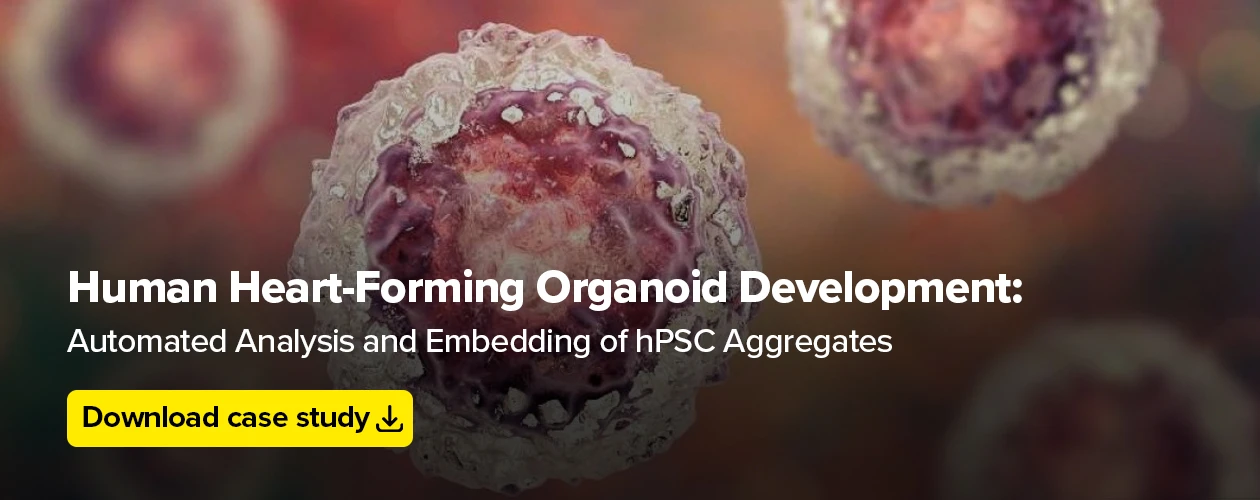
Recent advancements in precision automation are transforming the way cardiac organoids are researched, as illustrated in a study by Hannover Medical School (MHH). This approach is enabling researchers to streamline the generation of heart-forming organoids—complex, three-dimensional models that replicate human heart properties and offer unique insights into developmental processes and disease mechanisms.
Challenges in Manual Selection
Traditionally, the production of heart-forming organoids involves creating cell aggregates from human pluripotent stem cells, selecting suitable ones, and embedding them in a gel matrix. This manual process requires significant expertise, leading to inconsistencies and scalability challenges that can impact research reliability.
Automated Precision in Organoid Development
The study introduces an automated workflow that analyzes, selects, and embeds cell aggregates based on precise criteria—such as size, shape, and absence of undesired cells. This automation ensures high-quality samples progress, enhancing the reliability of human organoid development into heart-like structures. Additionally, it uniformly dispenses the gel matrix, optimizing conditions for successful organoid formation.
Benefits of Automation
Automation provides transformative improvements in organoid research:
- Enhanced identification of high-quality human-heart forming organoids.
- Increased reproducibility and quality of organoid production, aligning with or surpassing manual methods.
- Reduced training time for new staff.
- A more efficient and well-documented process.
With this automated approach, a 90% success rate is achieved, consistently meeting predefined criteria regardless of individual expertise.
Empowering Researchers
The study results provide a valuable framework for integrating automated workflows into complex organoid research, allowing researchers to save significant setup time, achieve expert-level quality, and increase throughput and standardization. These advancements, coupled with the shift in legislation and regulatory guidance favouring the adoption of Non-Animal Methods and New Approach Methodologies (NAMs), signify a transformative future in cardiac research where precision automation meets excellence in organoid development, aligning scientific practices with ethical standards and human-centric approaches.