


Sponsored by:

Discover FlowCam, a high-throughput platform for biologics quality assurance per USP guidelines
USP <788> specifies that companies test the number of subvisible particles larger than 10 and 25 μm present in any commercialized parenteral drug product—including most protein biotherapeutics, viral vectors, and other drug delivery systems.
USP <788> specifies that companies test the number of subvisible particles larger than 10 and 25 μm present in any commercialized parenteral drug product—including most protein biotherapeutics, viral vectors, and other drug delivery systems. It also requires this monitoring to be done using either light obscuration (LO) or membrane microscopy, the former of which is the preferred technique.
Flow imaging microscopy (FIM) is an orthogonal subvisible particle measurement technique offering greater sensitivity to translucent particles as well as information about particle type. USP recommends using FIM as an orthogonal technique to LO as part of routine quality control of biotherapeutics via USP <1788>.
Why Use Flow Imaging Microscopy (FIM)?
- Differentiating protein aggregates from other particles, helping prevent immunogenic responses.
- Identifying sources of particle contamination, whether from the formulation itself or external factors.
- Supporting formulation development by providing insight into stability and compatibility.
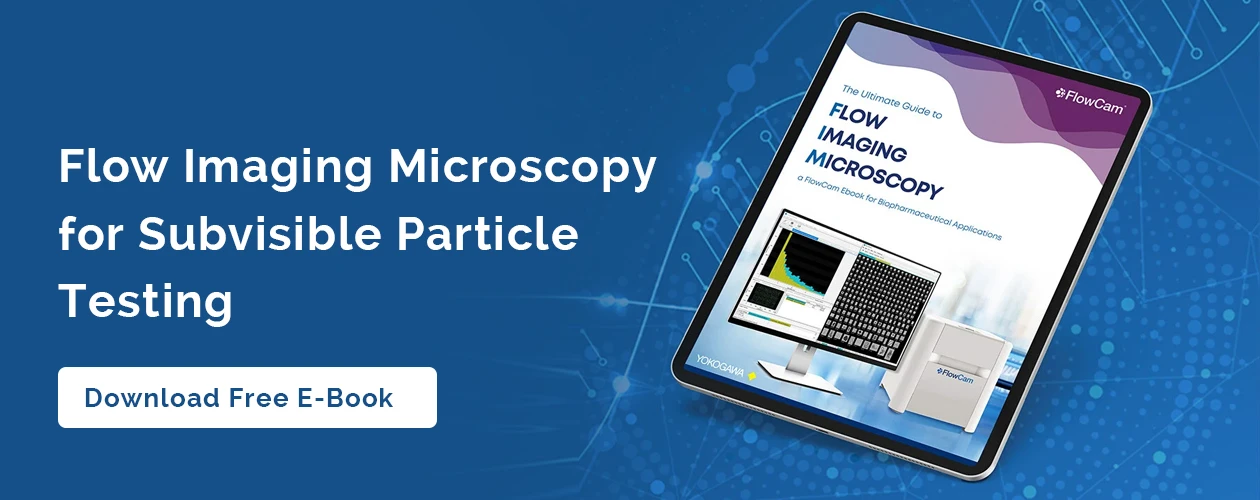
Read our ebook, "The Ultimate Guide to Flow Imaging Microscopy", to learn how this technology can provide insight into the sources of particles in biological drug products and optimize formulations and manufacturing processes to minimize and control particle formation.