


In this work, the digital transformation process is demonstrated through a continuous pre-heating process which is a critical unit operation used in continuous API synthesis. CFD approach has been employed. There are a variety of methods available for controlling the reaction rates in continuous API synthesis. One method used in the pharmaceutical industry involves temperature regulation of reactant streams prior to the reactor by introducing a heat transfer unit operation, such as a preheater. Preheating units have been studied in a variety of different geometries, but one geometry less common in scientific literature is the twisted helix, also known as a bent helix. Consisting of a standard helix twisted into a secondary helix, there are three different diameters present in this geometry that can influence heat transfer. In this article, a preheater of twisted helix geometry used in a continuous API synthesis process is modeled using computational fluid dynamics (CFD) to predict the influence of each diameter on heat transfer efficiency. Experimental data was first used to calibrate the model, then these three design parameters were varied in a standard 23 full factorial design (yielding eight different configurations) at two different flowrates. The efficiency of each configuration was calculated and used to fit empirical correlations between the different diameters and heat transfer efficiency. In addition to the primary effects of primary diameter, secondary diameter, and inner diameter, the correlations incorporate the possibility of two-factor interactions between the design parameters. Effect estimates were generated using statistical analysis software to predict which parameters or interactions have the greatest influence on efficiency. Lastly, model adequacy of the developed correlations is supported through half-normal plots and analysis of variance (ANOVA) tables.
Introduction, background, objectives
In the pharmaceutical industry, temperature regulation is often considered a key or critical process parameter (CPP) in continuous API synthesis as it can influence reaction rates thereby desired product as well as the generation of unwanted byproducts from side reactions. As a result, the importance of temperature control has been widely studied utilizing a wide variety of methods [1-3]. Mathematical models have been found to be useful tool to learn more about heat and mass transfer in manufacturing processes and can reduce the number of experimentations that may be time and resource intensive or infeasible to conduct [4-6].
When considering heat transfer, helices are usually a superior geometry relative to straight tube configurations due to their compact nature and higher heat transfer coefficients, showing promise in multiple fields of process industry [7-9]. Submerged standard helical coils have been widely analyzed in literature using both experimental [10, 11] and modeling approaches [12] but is less common for the twisted helix geometry and its variants [13]. However, heat transfer in even standard helices is difficult to characterize, much less the relatively complex geometry of a twisted helix. This is in part due to the Dean effect, which has the effect of changing the flow regime within helical tubes when operating at different flowrates [14, 15]. The Dean effect describes the development of secondary flows perpendicular to the primary flow, as well as imbedded vortex structures depending on the flow region and regime [16, 17]. As a result, a large amount of data is often required at different flows to perform detailed statistical analysis, which makes CFD modeling an appealing alternative to cost intensive experiments.
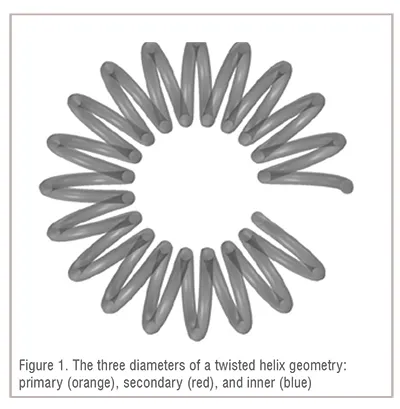
In this work, the digital transformation process is demonstrated through a continuous pre-heating process which is a critical unit operation used in continuous API synthesis. This work help to increase understanding of which design parameters have the greatest influence on heat transfer for twisted helix geometries. In standard helix studies, many have reported empirical correlations for flow regime and heat transfer using the ratio of outer diameter to inner diameter, known as the curvature ratio [9]. In the case of the twisted helix, there are three diameters to consider, and thus three possible ratios that could influence system characterization (see Figure 1).
The resultant variable under investigation is heat transfer efficiency and its relationship with the three diameters. A sensitivity analysis of these three geometric design diameters was performed using a mechanistic model built in COMSOL Multiphysics, calibrated using experimental data and used to perform a three-factor two-level factorial experiment, with analysis of the results performed using Matlab. Constructing a CFD model enables a great deal of data to be collected without costly experimentation, which allows a full factorial approach to be taken at each flowrate. These different flowrates were treated as blocks when generating empirical models to reduce the probability of the Dean effect acting as a nuisance factor, which might otherwise cause these results to be valid at only certain flowrates.
To replicate the approach and analysis described in this article with an experimental setup, eight separate coil configurations of different diameter combinations would be necessary. This highlights the benefits of CFD when performing statistical analysis, especially for design parameters which cannot be changed without difficulty or cost. Oftentimes, to avoid the issue of increasing cost and investment, a fractional factorial approach will be used in experimental sensitivity analysis, which involves conducting experiments at specific combinations of parameters to effectively cover the entire design space with fewer experiments. However, this can come at the cost of accuracy and potentially missed interactions between the parameters under investigation.
Materials and Methods
The twisted-helix preheating unit is directly placed before a custom-built plug-flow reactor (PFR) used in the continuous synthesis of APIs. The unit consists of a steel tank with minimal insulation filled with ethylene glycol and a submerged coil made of PFA tubing in twisted-helix geometry. This coil usually contains the reactant stream to be warmed prior to reaction to minimize variability in reaction rates and improve overall control of the process. The ethylene glycol within the tank is heated using a submerged immersion heater and is highly agitated with a mechanical mixer to ensure the thermal energy is distributed throughout the transfer fluid, aiming to minimize temperature gradients. Within the reactant coil, water was used in place of the usual reactants to focus on heat transfer characterization without the added complexity of reactions generating or absorbing heat. The experimental procedure used to generate calibration data for the CFD model involved varying the reactant stream flowrate at a constant rate of heating until a steady outlet stream temperature was achieved. The CFD model was created with COMSOL Multiphysics and statistical analysis performed using Matlab.
Model Development
The CFD model was calibrated by treating the tank as if it were experiencing convection with different heat transfer coefficients on each side exposed to a different environment. The three “environments” were the bottom surface of the tank (which was resting on an aluminum surface), the top surface of the tank (which experiences increased heat transfer from currents induced by natural convection) and the sides of the tank with minimal insulation (see Figure 2).
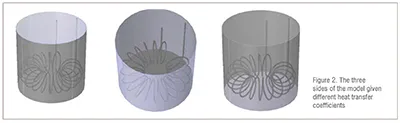
During calibration, different heat transfer coefficients on each side were tested until the outlet stream temperature generated from the CFD model closely matched those gathered experimentally. Upon completion of calibration, the CFD model outlet temperatures at each flowrate differed by less than 5% from those gathered experimentally. Additionally, as COMSOL Multiphysics utilizes a finite-element algorithm for mechanistic modeling, a mesh dependence study was conducted to confirm a fine enough mesh which was used during data generation.
The complete design matrix above was run at two different flowrates, which was treated as a blocking variable to minimize nuisance factors. One factor in particular that comes to mind is the Dean effect, which can cause significant disturbances in flow regime (and thus heat transfer) depending on flowrate in helical systems. By treating the flowrate as a blocking variable, flowrate is separated from the parameters under investigation and minimizes the influence of differences in flow regime. This allows the empirical model to focus solely on the diameters of the twisted helix geometry.
Statistical Analysis Approach
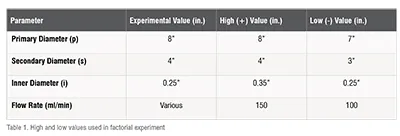
Once calibrated, a low (-) and high (+) value of each diameter in the twisted-helix geometry was selected for use in the three-factor factorial experiment (see Table 1 for values).
Selecting these values required some heuristic approach, as only certain combinations of diameter values are feasible for achieving valid geometries. For example, if the outer diameter is too small relative to the secondary or inner diameter, the coils might overlap and create an impossible geometry. Alternatively, if the outer helix was set too high, it would protrude from the tank walls and invalidate any possible results. Running multiple different geometries in series (such as during a parametric analysis) frequently posed an issue, as there were cases where the model construction would fail when transitioning between configurations due to impossible overlap of system elements.
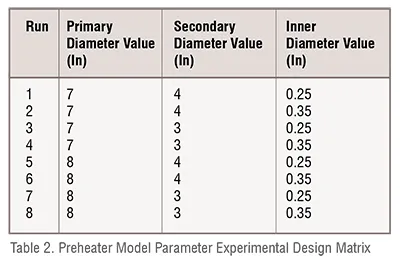
The complete design matrix (Table 2) was run at two different flowrates, which was treated as a blocking variable to minimize nuisance factors. By treating the flowrate as a blocking variable, flowrate is separated from the parameters under investigation and minimizes the influence of differences in flow regime. This allows the empirical model to focus solely on the diameters of the twisted helix geometry.
The outlet temperature of each run was collected and used to calculate a rate of energy transfer based on the reactant stream’s flow rate (V), density (ρ), specific heat capacity (cp) and temperature change (ΔT). Preheater efficiency is defined as the ratio of energy absorbed by the fluid stream to the overall energy added to the system by the immersion heater. Any energy that does not contribute to warming of the outlet stream is lost to the surroundings. Preheater efficiency (µ) was then found using the immersion heater’s power setting (P).
µ=(Vρc_p ΔT)/P (1)
Once the data had been collected, it was used to fit a linear model with two-factor interactions between primary diameter (p), secondary diameter (s) and inner diameter (i) using Matlab’s fitlm() function. A non-interactive blocking term (β) for flowrate was added to account for different flowrates. The one possible three-factor interaction (ABC) was not considered as significance decreases as the term order increases [18]. Inclusion of superfluous terms has been shown to improve fitting and decrease error relative to the dataset, but decreases the applicability of results outside of the specific datasets used [19]. This model is useful to predict the effect of pre-heater design parameters on its efficiency for a given material and heat source.
µ ~ 1+ p+s+i+ps+pi+si+ β (2)
Analysis was performed treating the data as a three-factor two-block full factorial experiment. Term significance was based on a half-normal distribution generated using Matlab’s probplot() function and ANOVA tables with associated p-values. The final step was checking model adequacy through a normal probability plot and predicted vs. residuals plot, which checks for data normality and constant variance respectively (two assumptions required for this statistical approach).
Results and Discussions
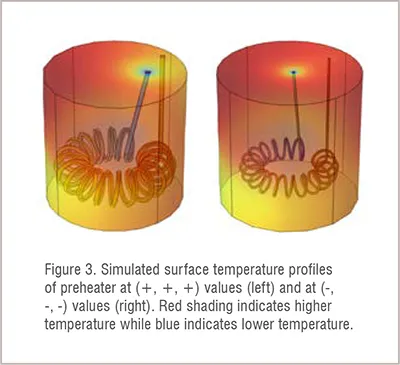
Running a full 23 factorial with two blocks (flowrates) gave 16 efficiency datapoints with six possible significant terms as seen in Equation 2 above (excluding flowrate as a blocking variable). Figure 3 shows surface temperature profile plots generated by the CFD model at low (-) and high (+) values of each diameter as indicated by the design matrix. These profiles are useful for assessing the temperature distribution within the tank and where the majority of heat loss occurs. As shown in Figure 3, there is a visible shift in temperature between the upper half of the tank and the lower half where the coil resides due to the warming reactant stream.
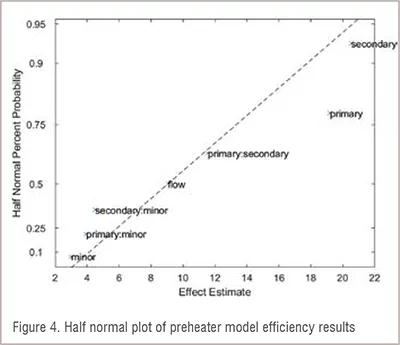
The simulation has been used to identify the significant design parameters. In order to estimate term significance, two approaches were used. The first approach was a half-normal probability plot as shown in Figure 4, which plots the effect estimate of each term (p, s, and i) or two-factor interaction (p:s, p:i, s:i) against the term’s expected location assuming a normal distribution (the dashed line). Points that lie on or near the line are not likely to significantly impact preheater efficiency and do not deviate significantly from the expected normal values. Those further from normality are typically significant terms. In this case the primary diameter, secondary diameter, and the interaction between secondary and inner diameters (secondary: inner) are significant design parameters.
The second method was the traditional ANOVA (Analysis of Variance) table. While there are multiple reasons why ANOVA table is useful, the most salient aspect to this work is the column of p-values used to evaluate the likelihood of these results occurring due to chance. A standard level of significance is 0.05, below which a term is deemed significant. Results indicate that the primary, secondary, and secondary: inner terms likely dominate efficiency, but the inner and secondary: inner terms are also relevant (Table 3). However, the p-values for inner and secondary: inner terms are an order of magnitude larger than the other significant terms, and in the case of the inner effect, is barely < 0.05. Further testing and analysis would be useful in determining just how significant the inner diameter is, particularly at a larger range of diameters.
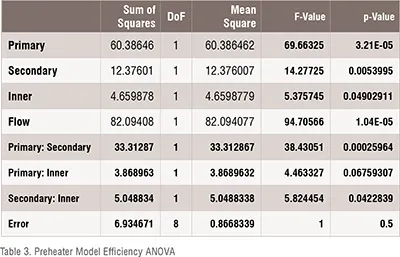
Taken as a whole, these statistical results indicate that the efficiency of the twisted-helix preheater design is heavily influenced by the primary and secondary diameters, which have a significant interaction effect. The inner diameter and its secondary interaction also have an effect on efficiency, but further testing is needed to determine to what extent. The ANOVA table suggests the effect of the inner diameter is significantly less than the other two.
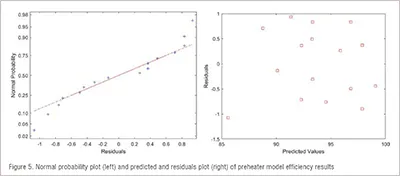
Lastly, in terms of adequacy analysis, the predicted values vs residual plot indicates a relatively constant variance (Figure 5, right), one of the initial assumptions used when performing this statistical analysis. Normality was assessed using a normal probability plot (Figure 5, left), which suggest that while there are some outliers, the majority of data falls within normality.
Conclusions
In this work, the digital transformation process is demonstrated through a continuous pre-heating process which is a critical unit operation used in continuous API synthesis. A CFD model of a twisted helix geometry preheater designed for continuous API synthesis is used to evaluate design parameters influencing preheater efficiency through statistical analysis. CFD allowed a great deal of data to be collected and analyzed without the need for time-intensive and costly experimentation, enabling a full factorial experiment to be conducted. The results indicate that in this particular geometry, the curvature ratio between the secondary and primary diameters plays a larger role in determining heat transfer efficiency than the inner diameter. This result could be applied in future works which develop more detailed correlations for twisted helix geometries or for designing preheater coils with greater efficiencies. Future work includes, further experimentation using CFD modeling to expand the results, such as repeating this experiment with an expanded factorial utilizing three or four different values for each diameter rather than simply one high and one low value.
Acknowledgements
This work is supported by the US Food and Drug Administration (FDA) under contract number 75F40121C00106.
Sources
[1] S. Hall and A. Stoker, "API Chemical Synthesis Trends in Reactor Heat Transfer Design," Pharmaceutical Engineering, vol. 24, pp. 78-90, 2004.
[2] M. Baumann and I. R. Baxendale, "The synthesis of active pharmaceutical ingredients (APIs) using continuous flow chemistry," Beilstein J Org Chem, vol. 11, pp. 1194-219, 2015, doi: 10.3762/bjoc.11.134.
[3] M. S. Lopez, "Critical parameters in manufacturing process validation of different forms of pharmaceutical injectable products to assess products´ risk framework.," Pharmaceutical Engineering, University of Lisboa, 2014.
[4] T. J. Rennie and V. G. S. Raghavan, "Numerical studies of a double-pipe helical heat exchanger," Applied Thermal Engineering, vol. 26, no. 11-12, pp. 1266-1273, 2006, doi: 10.1016/j.applthermaleng.2005.10.030.
[5] S. Sharma et al., "Computational Fluid Dynamics Analysis of Flow Patterns, Pressure Drop, and Heat Transfer Coefficient in Staggered and Inline Shell-Tube Heat Exchangers," Mathematical Problems in Engineering, vol. 2021, pp. 1-10, 2021, doi: 10.1155/2021/6645128.
[6] D. K. Babi et al., "Opportunities and challenges for model utilization in the biopharmaceutical industry: current versus future state," Current Opinion in Chemical Engineering, vol. 36, 2022, doi: 10.1016/j.coche.2022.100813.
[7] N. Shirgire, A. Thakur, and S. Singh, "Comparative study and analysis between helical coil and straight tube heat exchanger," International Journal of Engineering Research and Applications, vol. 4, no. 8, 2014.
[8] D. G. Prabhanjan, V. G. S. Raghavan, and T. J. Rennie, "Comparison of heat transfer rates between a straight heat exchanger and helically coiled heat exchanger," International Communications in Heat and Mass Transfer, vol. 29, no. 2, pp. 185-191, 2002, doi: https://doi.org/10.1016/S0735-1933(02)00309-3.
[9] S. Vashisth, V. Kumar, and K. D. P. Nigam, "A review of potential apps of curved geometries in process industry," Industrial & Engineering Chemistry Research, vol. 47, no. 10, pp. 3291-3337, 2008, doi: DOI: 10.1021/ie701760h.
[10] K. K. Seth and E. P. Stahel, "Heat transfer from helical coils immersed in agitated vessels," Industrial & Engineering Chemistry, vol. 61, no. 6, pp. 39-49, 1969, doi: DOI: 10.1021/ie50714a007.
[11] M. Mahir, A. El Maakoul, I. Khay, S. Saadeddine, and M. Bakhouya, "An Investigation of Heat Transfer Performance in an Agitated Vessel," Processes, vol. 9, no. 3, 2021, doi: 10.3390/pr9030468.
[12] J. Fernández-Seara, C. Piñeiro-Pontevedra, and J. A. Dopazo, "On the performance of a vertical helical coil heat exchanger. Numerical model and experimental validation," Applied Thermal Engineering, vol. 62, no. 2, pp. 680-689, 2014, doi: 10.1016/j.applthermaleng.2013.09.054.
[13] S. W. Chang, P. S. Wu, W. L. Cai, and J. H. Liu, "Turbulent flow and heat transfer of helical coils with twisted section," Applied Thermal Engineering, vol. 180, 2020, doi: 10.1016/j.applthermaleng.2020.115919.
[14] P. Nashine, T. S. Singh, U. Rajak, and T. Verma, "Effect of Dean Number on the Heat Transfer Characteristics of a Helical Coil Tube with Variable Velocity & Pressure Inlet," Journal of Thermal Engineering, pp. 128-139, 2020, doi: 10.18186/thermal.729149.
[15] R. H. Perry, Perry's Chemical Engineers' Handbook, 7th ed. McGraw-Hill, 1997.
[16] D. Rossi, L. Gargiulo, G. Valitov, A. Gavriilidis, and L. Mazzei, "Experimental characterization of axial dispersion in coiled flow inverters," Chemical Engineering Research and Design, vol. 120, pp. 159-170, 2017, doi: 10.1016/j.cherd.2017.02.011.
[17] Y. Agrawal, L. Talbot, and K. Gong, "Laser anemometer study of flow development in curved circular pipes," Journal of Fluid Mechanics, vol. 85, no. 3, pp. 497-518, 2006, doi: 10.1017/S0022112078000762.
[18] D. C. Montgomery, "Two-Level Fractional Factorial Designs," in Design and Analysis of Experiments, 2nd ed.: Wiley, 2019.
[19] A. Schneider, G. Hommel, and M. Blettner, "Linear regression analysis: part 14 of a series on evaluation of scientific publications," Dtsch Arztebl Int, vol. 107, no. 44, pp. 776-82, Nov 2010, doi: 10.3238/arztebl.2010.0776.