


Immunotherapy has reshaped cancer treatment by leveraging immune mechanisms to recognize and destroy malignant cells. Cellular immunotherapy is a rapidly advancing platform in which autologous or allogeneic immune cells are expanded, redirected, or genetically engineered to enhance antitumor activity . Key approaches include CAR-T cells, tumor-infiltrating lymphocytes (TILs), TCR-modified T cells, CAR-NK cells, CAR macrophages, cytokine-induced killer cells, γδ T cells, regulatory T-cell products, and induced pluripotent stem cell (iPSC)-derived immune platforms . The market is growing rapidly, with cellular immunotherapy estimated at approximately USD 8.8 billion in 2026 and projected to approach USD 24 billion by 2033; CAR-T therapy remains the leading segment . Living, genetically modified, and potentially persistent cellular products require careful attention to product characterization, manufacturing controls, release testing, toxicity mitigation, informed consent, equitable access, and long-term surveillance. For sponsors, investigators, Institutional Review Boards (IRBs), and regulators, the central task is to support scientifically justified innovation while protecting participant safety and welfare.
Cellular Immunotherapy Platforms
Cellular immunotherapy platforms differ in cell source, engineering strategy, target biology, manufacturing complexity, and safety profile. These differences directly affect clinical feasibility, participant risk, and oversight expectations.
CAR-T Cell Therapy
CAR-T therapy involves ex vivo or in vivo genetic modification of T lymphocytes to express synthetic receptors that recognize tumor-associated surface antigens independently of major histocompatibility complex presentation. The modular architecture of CAR constructs permits target customization, while incorporation of co-stimulatory signaling domains has enhanced T-cell activation, persistence, and anti-tumor efficacy .
CAR-T platforms may be derived from autologous or allogeneic T-cell sources. First-generation CAR constructs contained only the CD3ζ activation domain and demonstrated limited in vivo persistence. Subsequent second-generation designs incorporated a single co-stimulatory domain, most commonly CD28 or 4-1BB, thereby improving expansion, survival, and clinical activity. Third-generation CARs combine multiple co-stimulatory domains, whereas fourth-generation or “armored” CAR-T cells are designed to secrete immunomodulatory cytokines, incorporate safety switches, or deploy logic-gated circuits to enhance function within immunosuppressive tumor microenvironments.
Tumor-Infiltrating Lymphocyte (TIL) Therapy
TIL therapy uses naturally occurring tumor-reactive lymphocytes isolated from a patient’s tumor, expanded ex vivo, and reinfused after lymphodepleting chemotherapy. It is best established in advanced melanoma and is being studied across additional solid tumors. Unlike CAR-T therapy, TIL therapy depends on endogenous tumor recognition rather than engineered antigen targeting. Main barriers include individualized manufacturing, toxicity from conditioning and supportive cytokines, variable response, and limited predictive biomarkers.
Beyond CAR-T cells and TILs: Emerging Cellular Immunotherapy Platforms
Limitations of conventional CAR-T and TIL therapies, including antigen escape, manufacturing burden, toxicity, and reduced activity in many solid tumors, have increased interest in alternative immune effector platforms designed to improve scalability, potency, and safety.
• CAR-NK cells combine NK-cell cytotoxicity with CAR-directed targeting and may carry lower risks of cytokine release syndrome and neurotoxicity than CAR-T cells, although persistence and potency remain active development challenges .
• CAR cytokine-induced killer and CAR γδ T-cell approaches offer MHC-independent tumor killing and potential allogeneic use, but require stronger evidence for durable expansion, efficacy, and safety , .
• CAR regulatory T cells may support treatment of autoimmune, inflammatory, fibrotic, and transplant-related conditions, but review should address antigen selection, phenotypic stability, persistence, and immune suppression risks .
• CAR macrophages are engineered myeloid cells intended to target tumor cells and reshape the tumor microenvironment, with particular interest in solid tumors .
• iPSC-derived products use renewable starting material to generate consistent, banked immune effectors; oversight should address genomic integrity, residual pluripotent cells, tumorigenicity, and long-term safety .
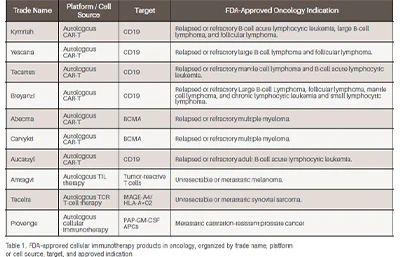
• TCR-modified T cells recognize intracellular tumor antigens presented by HLA molecules, expanding targets beyond surface proteins. Tecelra is FDA-approved for advanced synovial sarcoma, but HLA restriction, antigen escape, and tumor microenvironment suppression remain important barriers.
Together, these platforms show that cellular immunotherapy is moving toward more diverse, engineered, and potential scalable products. For IRBs and regulators, platform differences determine what must be reviewed: manufacturing control, persistence, toxicity, antigen targeting, long-term monitoring, and clinical feasibility. Table 1 summarizes FDA-approved CAR-T cells dominating cellular immunotherapy products in oncology.
Key Safety Considerations Associated with Cellular Immunotherapies
Cellular immunotherapies can produce acute, severe, delayed, or difficult-to-predict adverse events . Risk varies by platform, target, conditioning regimen, manufacturing approach, and genetic modification. The most important recurring concerns for protocol design, monitoring, consent, and IRB review include the following:
Cytokine Release Syndrome (CRS): A systemic inflammatory reaction that may range from fever and flu-like symptoms to hypotension, capillary leak, organ dysfunction, and intensive-care needs.
Immune Effector Cell-Associated Neurotoxicity Syndrome (ICANS): A neurologic toxicity associated with immune activation and blood-brain barrier disruption, presenting with tremor, confusion, agitation, aphasia, seizures, or cerebral edema.
Infection and Cytopenia: Lymphodepletion, immune suppression, B-cell aplasia, and prolonged cytopenias can increase bacterial, viral, and fungal infection risk.
Secondary Malignancy and Genomic Risk: Gene-modified products may raise delayed concerns such as insertional oncogenesis, replication-competent vector, off-target editing, uncontrolled expansion, or immune dysregulation.
Off-Target or On-Target/Off-Tumor Toxicity: Antigen expression on healthy tissues can cause unintended injury, requiring careful target selection and, where appropriate, safety-switch strategies.
Adverse Events Identification and Management
Adverse-event management is central to cellular immunotherapy trials because toxicity can evolve rapidly and require protocol-defined escalation. Management plans should specify early recognition, standardized grading, rescue medications, laboratory monitoring, hospitalization criteria, specialist consultation, sponsor notification, IRB reporting, and long-term follow-up.
Key Strategies Include:
• Use premedication, antimicrobial prophylaxis, or anti-inflammatory therapy when supported by protocol and product risk profile.
• Monitor closely for fever, hypotension, hypoxia, neurologic change, cytopenia, infection, and organ dysfunction.
• Maintain rapid access to tocilizumab, corticosteroids, intensive care, neurology, infectious disease, and other relevant specialists.
• Use standardized toxicity-management algorithms and clear escalation pathways.
• Require long-term surveillance for delayed adverse events, including secondary malignancies, prolonged cytopenias, immune dysregulation, and infection.
Ethical, Regulatory Considerations and Best Practices for IRB Review
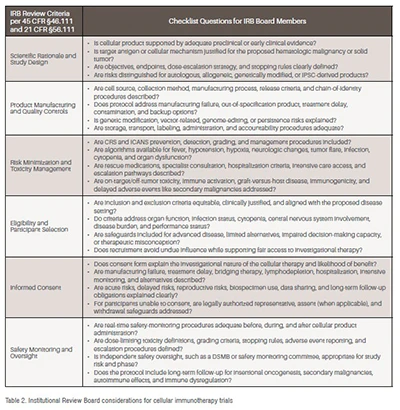
Cellular immunotherapy trials require rigorous ethical and regulatory review. Under 45 CFR §46.111 and 21 CFR §56.111 , IRBs must assess risk minimization, reasonable risk-benefit relationship, equitable participant selection, informed consent, data monitoring, privacy, and safeguards for vulnerable populations. Table 2 provides a practical checklist for IRBs reviewing cellular immunotherapy protocols.
Best Practices for Sponsors and Investigators
Sponsors and investigators should submit protocols that clearly describe the investigational product, mechanism of action, manufacturing process, release criteria, supporting evidence, clinical rationale, eligibility criteria, monitoring plan, toxicity management, stopping rules, and long-term follow-up obligations. They should address manufacturing failure, out-of-specification products, treatment delay, bridging therapy, product accountability, and criteria for delaying or canceling infusion. Safety plans must be operationally ready, with trained multidisciplinary staff, emergency medications, intensive care access, specialty consultation, laboratory capacity, and transparent communication among participants, investigators, sponsors, regulators, and IRBs.
Future Directions
Cellular immunotherapy has transformed oncology and will continue to evolve through scalable and controllable platforms, including allogeneic manufacturing, CRISPR editing, synthetic biology, dual-targeting receptors, safety switches, iPSC-derived products, and improved tumor profiling. These advances may broaden access and improve precision, but they also create new questions about off-target effects, persistence, delayed toxicity, secondary malignancy, immune escape, and manufacturing comparability. Responsible translation requires strong preclinical justification, robust quality and potency assessment, meaningful endpoints, feasible long-term monitoring, toxicity preparedness, and coordinated oversight. As cellular immunotherapy expands, IRB members should remain current on emerging science, safety signals, regulatory expectations, and ethical issues so that innovation proceeds with protecting participants’ rights and welfare.
References
1. Patel KK, Tariveranmoshabad M, Kadu S, Shobaki N, June C. From concept to cure: The evolution of CAR-T cell therapy. Mol Ther. 2025 May 7;33(5):2123-2140. doi: 10.1016/j.ymthe.2025.03.005. Epub 2025 Mar 10. PMID: 40070120; PMCID: PMC12126787.
2. Andreou T, Neophytou C, Mpekris F, Stylianopoulos T. Expanding Immunotherapy Beyond CAR T Cells: Engineering Diverse Immune Cells to Target Solid Tumors. Cancers (Basel). 2025 Sep 5;17(17):2917. doi: 10.3390/cancers17172917. PMID: 40941014; PMCID: PMC12427656.
3. https://www.coherentmarketinsights.com/industry-reports/cellular-immunotherapy-market
4. Zugasti I, Espinosa-Aroca L, Fidyt K, Mulens-Arias V, Diaz-Beya M, Juan M, Urbano-Ispizua Á, Esteve J, Velasco-Hernandez T, Menéndez P. CAR-T cell therapy for cancer: current challenges and future directions. Signal Transduct Target Ther. 2025 Jul 4;10(1):210. doi: 10.1038/s41392-025-02269-w. PMID: 40610404; PMCID: PMC12229403.
5. Sueangoen N, Prasongtanakij S. Emerging CAR immunotherapies: broadening therapeutic horizons beyond cancer. Clin Exp Med. 2025 Aug 4;25(1):274. doi: 10.1007/s10238-025-01820-x. PMID: 40758198; PMCID: PMC12321946.
6. Tas L, Jedema I, Haanen J.B.A.G. (2023) Novel strategies to improve efficacy of treatment with tumor-infiltrating lymphocytes (TILs) for patients with solid cancers. Curr Opin Oncol 35:107-113.
7. Hou Y, Hu S, Liu C, Chen X, Wang Y, Li Y, Fu Z, Feng C, Gong Y, Liu Z and Peng S (2025) Beyond CAR-T Cells: exploring CAR-NK, CAR-M, and CAR-γδ T strategies in solid tumor immunotherapy. Front. Immunol. 16:1675807. doi: 10.3389/fimmu.2025.1675807
8. Peng, L., Sferruzza, G., Yang, L. et al. CAR-T and CAR-NK as cellular cancer immunotherapy for solid tumors. Cell Mol Immunol 21, 1089–1108 (2024). https://doi.org/10.1038/s41423-024-01207-0
9. Ghanbari Sevari F, Mehdizadeh A, Abbasi K, Hejazian SS, Raeisi M. Cytokine-induced killer cells: new insights for therapy of hematologic malignancies. Stem Cell Res Ther. 2024;15: 254. 10.1186/s13287-024-03869-z.
10. Wang L, Li J, Xuan Y, Zhang J, Wang X, Hu W, Xiu L. Prospects for γδ T cells and chimeric antigen receptor γδ T cells in cancer immunotherapy. Front Immunol. 2025;16:1554541. 10.3389/fimmu.2025.1554541.
11. MacDonald KG, Hoeppli RE, Huang Q, Gillies J, Luciani DS, Orban PC, Broady R, Levings MK. Alloantigen-specific regulatory T cells generated with a chimeric antigen receptor. J Clin Invest. 2016;126:1413–24. 10.1172/jci82771.
12. Noy R, Pollard JW. Tumor-associated macrophages: from mechanisms to therapy. Immunity. 2014;41:49–61. 10.1016/j.immuni.2014.06.010.
13. Karagiannis P, Kim SI (2021) iPSC-Derived Natural Killer Cells for Cancer Immunotherapy. Mol Cells 44:541-548.
14. Drakes DJ, Rafiq S, Purdon TJ, Lopez AV, Chandran SS, Klebanoff CA, Brentjens RJ. Optimization of T-cell Receptor-Modified T Cells for Cancer Therapy. Cancer Immunol Res. 2020 Jun;8(6):743-755. doi: 10.1158/2326-6066.CIR-19-0910. Epub 2020 Mar 24. PMID: 32209638; PMCID: PMC7269835.
15. Parums DV. A Review of CAR T Cells and Adoptive T-Cell Therapies in Lymphoid and Solid Organ Malignancies. Med Sci Monit. 2025 Feb 2;31:e948125. doi: 10.12659/MSM.948125. PMID: 39893510; PMCID: PMC11800685.
16. Jain, M. D., Smith, M. & Shah, N. N. How I treat refractory CRS and ICANS after CAR T-cell therapy. Blood 141, 2430–2442 (2023).
17. https://www.ecfr.gov/current/title-45/subtitle-A/subchapter-A/part-46/subpart-A/section-46.111
18. https://www.ecfr.gov/current/title-21/chapter-I/subchapter-A/part-56/subpart-C/section-56.111
19. FDA guidance on Considerations for the development of chimeric antigen receptor (CAR) T cell products. https://www.fda.gov/media/156896/download
Read the full article — it's free
Register with Pharma Focus America to unlock expert insights, research articles and in-depth industry analysis.