Sterile pharmaceutical manufacturing is a complex process governed by stringent regulations to ensure product sterility and patient safety. The success of this process hinges on the reliable performance of sophisticated equipment like filling lines, isolators, and sterilizers. Equipment failures can disrupt production, lead to product recalls, and pose significant financial and reputational risks. Traditional Preventive Maintenance (PM) programs involve scheduling routine maintenance tasks based on manufacturer recommendations or predetermined operating hours. While PM is essential, it has limitations:
• Inefficiency: Scheduled maintenance can occur unnecessarily, leading to production downtime and wasted resources.
• Rigidity: PM schedules may not account for actual equipment usage or degradation, potentially leading to missed failures.
• Reactive Approach: PM addresses issues after they occur, increasing the risk of product contamination and production delays.
The Promise of Predictive Maintenance and State-of-the-Art: AI/ML in Predictive Maintenance
Predictive maintenance (PdM) offers a paradigm shift from reactive to proactive equipment management. PdM leverages data analytics to predict equipment failures before they occur, enabling targeted interventions to optimize productivity and ensure sterility. Artificial Intelligence (AI) and Machine Learning (ML), subfields of AI, hold immense potential for PdM in sterile manufacturing. AI algorithms can analyze vast amounts of data from sensors embedded within equipment, including vibration, temperature, pressure, and power consumption. By identifying subtle changes in these parameters that precede failures, AI/ML models can predict equipment issues with high accuracy. The application of AI/ML for PdM is gaining traction across various industries, with demonstrably positive outcomes. Table 1 summarizes relevant fields showcasing the effectiveness of AI/ML in diverse industrial settings.
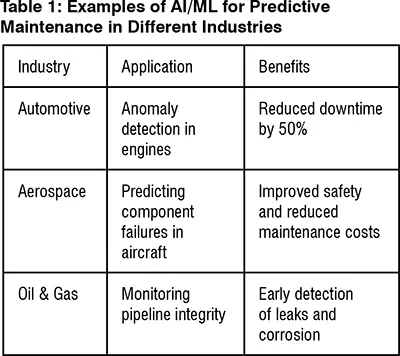
Nevertheless, AI/ML demonstrated limited application in pharmaceuticals. AI/ML While AI/ML demonstrates success in other sectors, its application in sterile pharmaceutical manufacturing remains nascent. This is partly due to the stringent regulatory environment, the complexity of sterile processes, and the historical reliance on traditional PM practices. However, recent advancements indicate growing interest in AI/ML for pharmaceutical PdM.
Framework for AI/ML-based PdM in Sterile Manufacturing
Implementing AI/ML for PdM in sterile manufacturing requires a structured approach. This framework outlines the key steps involved:
Data Acquisition
The foundation of any AI/ML system is high-quality data. Data for PdM can be sourced from various sensors embedded within equipment, including Vibration sensors: Detect changes in bearing health and potential imbalances. Temperature sensors: Monitor critical process parameters and identify potential overheating issues. Pressure sensors: Track pressures within isolators and sterilizers to ensure containment and proper sterilization cycles. Power consumption sensors: Analyze fluctuations in power usage that may indicate equipment malfunctions.
Data Preprocessing
Raw sensor data often requires preprocessing to ensure its suitability for AI/ML models. This may involve:
• Cleaning: Removing outliers, inconsistencies, and missing values.
• Feature Engineering: Extracting relevant features from the data that can be used for model training.
• Normalization: Scaling data to a common range for optimal model performance.
Model Selection and Training
Choosing the appropriate AI/ML model for PdM depends on the specific equipment and desired outcomes. An overview of popular choices as a general guiding principle:
Supervised Learning: These models require labeled historical data, where each data point is associated with a known outcome (e.g., equipment failure or normal operation). Common supervised learning algorithms for PdM include:
• Decision Trees: These algorithms create a tree-like structure to classify data points based on a series of decision rules. They can be effective for identifying root causes of equipment failures (Ref: [6]).
• Support Vector Machines (SVMs): SVMs create a hyperplane that separates data points belonging to different classes (e.g., normal operation vs. failure). They are well-suited for high-dimensional data and can handle limited datasets.
• Random Forests: These ensemble methods combine multiple decision trees to improve prediction accuracy and robustness.
Unsupervised Learning: These models can be used when labeled data is scarce. They identify patterns and anomalies in the data to predict potential failures. Common unsupervised learning algorithms for PdM include:
• K-Means Clustering: This method groups data points into clusters based on their similarity. It can be used to identify deviations from normal operating conditions.
• Principal Component Analysis (PCA): PCA reduces data dimensionality by identifying the most significant features, allowing for efficient model training.
Model Evaluation and Validation
Once a model is trained, it needs to be evaluated on unseen data to assess its generalizability and effectiveness. Commonly used evaluation metrics for PdM models include:
• Accuracy: The proportion of correctly predicted outcomes (e.g., failures).
• Precision: The proportion of true positives among all predicted positives.
• Recall: The proportion of true positives identified by the model.
• F1 Score: A harmonic mean of precision and recall, balancing both metrics.
Model Deployment and Monitoring
Following successful evaluation, the model can be deployed for real-time PdM. This involves integrating the model with the existing data acquisition system and production line controls. The model continuously analyzes sensor data and triggers alerts when it predicts a potential failure. Continuous monitoring of the model's performance is crucial. Over time, equipment behavior and failure patterns may change. The model needs to be periodically retrained with new data to maintain its accuracy and effectiveness.
Challenges and Considerations
Several challenges need to be addressed for successful implementation of AI/ML-based PdM in sterile manufacturing:
• Data Quality: High-quality, well-labeled data is essential for training effective AI/ML models. Ensuring data integrity and consistency across diverse equipment types is critical.
• Regulatory Considerations: The pharmaceutical industry operates under stringent regulatory guidelines. Regulatory bodies like the FDA may require clear documentation and validation of AI/ML models used for PdM to ensure product quality and patient safety.
• Ethical Implications: AI/ML algorithms are susceptible to bias present in the training data. It is crucial to ensure fairness and explainability of the models to avoid unintended consequences.
• Infrastructure and Expertise: Implementing AI/ML requires investments in data infrastructure, computational resources, and specialized expertise in data science and machine learning.
Future Prospects
AI/ML has the potential to revolutionize PdM in sterile manufacturing. With continued advancements in AI technology, data collection capabilities, and regulatory frameworks, there some positive outcomes that could be expected:
• Improved Accuracy and Reliability: AI/ML models will become more sophisticated, leading to more accurate and reliable predictions of equipment failures.
• Enhanced Process Optimization: PdM can be integrated with other manufacturing processes to optimize overall production efficiency and resource utilization.
• Real-time Decision Making: AI-powered systems can enable real-time decision making, allowing for immediate intervention and mitigation of potential problems.
• Advanced Analytics: Integration of AI/ML with other data analytics tools can provide deeper insights into process performance and equipment health.
Expanding the Framework: Illustrative Examples with Data and Tables
To further solidify the concepts presented, exploring illustrative examples with data and tables that showcase the potential of AI/ML for PdM in sterile manufacturing would demonstrate the benefits.
Example 1: Predicting Aseptic Filling Line Failures
Aseptic filling lines are critical equipment for sterile product manufacturing. Early detection of potential failures in this equipment is crucial to prevent product contamination and ensure sterility.
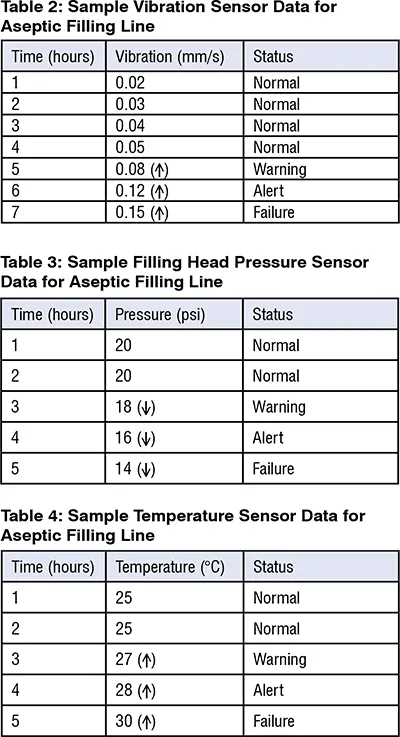
Data Acquisition: Sensor data can be collected from various points within the filling line, including:
• Peristaltic pump vibration sensors: Monitor for potential bearing wear or imbalances that could affect filling accuracy. (Table 2)
• Filling head pressure sensors: Track pressure fluctuations during product dispensing, potentially indicating blockages or leaks. (Table 3)
• Temperature sensors: Monitor critical parameters within the filling chamber to ensure aseptic conditions. (Table 4)
Model Selection and Training:
A supervised learning model like Random Forest can be trained using historical data labeled with equipment status (normal, warning, alert, failure). The model learns to identify patterns in sensor data that precede failures, enabling prediction before issues escalate.
Benefits:
• Early detection of potential filling line failures allows for preventive maintenance, minimizing production downtime and waste.
• Proactive interventions can prevent product contamination and potential product recalls, ensuring patient safety and product quality.
Example 2: Anomaly Detection in Sterilizers
Sterilization is a critical step in ensuring product sterility. Anomaly detection using AI/ML can be applied to monitor sterilizer performance and predict potential malfunctions.
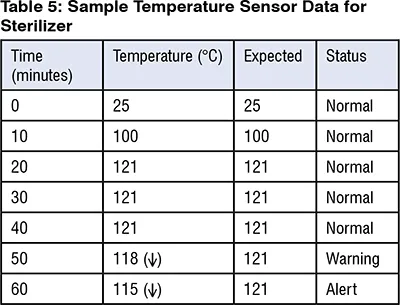
Data Acquisition:
• Temperature sensors: Track temperature profiles within the sterilizer chamber during sterilization cycles. (Table 5)
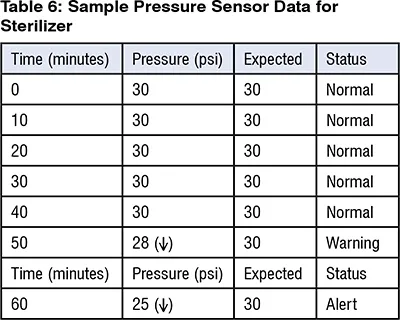
• Pressure sensors: Monitor pressure fluctuations that could indicate leaks or malfunctioning valves. (Table 6)
Model Selection and Training:
An unsupervised learning model like K-means clustering can be used to identify deviations from the expected temperature and pressure profiles during sterilization cycles. The model can detect anomalies that may indicate potential equipment malfunctions before they compromise product sterility.
Benefits:
• Early detection of sterilizer anomalies allows for corrective actions before a failed sterilization cycle, preventing wasted product and ensuring sterility assurance.
• Proactive maintenance based on AI/ML insights can extend the lifespan of sterilizers and optimize equipment utilization.
These examples demonstrate how AI/ML can be used with sensor data to predict equipment failures and anomalies in sterile manufacturing. The specific data points, models, and benefits will vary depending on the equipment and desired outcomes.
Additional Considerations and Future Research Directions
While the potential of AI/ML for PdM in sterile manufacturing is promising, several areas require further exploration:
• Integration with Existing Systems: Seamless integration of AI/ML models with existing Manufacturing Execution Systems (MES) and Process Control Systems (PCS) is crucial for real-time decision making and automated responses to predicted failures.
• Standardization and Interoperability: Standardization of data formats and communication protocols across diverse equipment types would facilitate wider adoption of AI/ML in the industry.
• Cybersecurity Considerations: Robust cybersecurity measures are essential to protect sensitive data from cyberattacks that could disrupt operations or compromise product quality.
• Explainable AI: Developing explainable AI models can enhance trust and transparency in the decision-making process, addressing concerns about potential bias in AI algorithms.
Conclusion
Traditional PM methods are being challenged by the transformative potential of AI/ML for PdM in sterile manufacturing. By leveraging AI/ML, pharmaceutical companies can achieve proactive equipment management, optimize production processes, and ensure the highest standards of product quality and patient safety. While challenges exist, ongoing research and collaboration between industry stakeholders and regulatory bodies can pave the way for a future where AI/ML empowers a more efficient, reliable, and data-driven sterile manufacturing environment.