

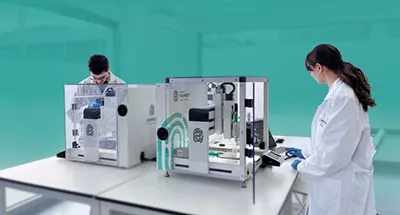
Pharmaceutical 3D printing, a technology vital for small-batch, personalised medicine, has matured significantly over the past decade. The lengthy process of academic research is now yielding tangible, translational results, bringing this innovative technology closer to widespread application. Formulation development has been converted into a high throughput process and 3D printed medicine is now reaching patients as part of routine practice. The pharmaceutical field has really entered into a new age of technology and it is amazing to see the benefits and wonder how far we can go. With compounding being automated and sister fields such as genetic testing accelerating precision medicine, more and more treatments will be personalised, launching the pharmaceutical field into an exhilarating new era of truly individualized healthcare for all.
Updates from the field
Routine pharmaceutical 3D printing in community pharmacies has broken ground in Spain in the past year and a recently published case study reports the economic benefits for Minoxidil treatment, a commonly prescribed compounded drug for hair loss. The Spanish team recorded pharmacy staff involvement, time taken and calculated cost per capsule. They compared standard compounded prescription preparation, specifically by-hand filling of capsules with powder, versus using a pharmaceutical 3D printer to automate their capsule filling processes; maybe not the traditional layer by layer 3D printing initially thought of, but a simpler way for immediate implementation with faster production speeds and lower cross-contamination risks. Manual labor was reduced by 55% and overall production time reduced by 10%. This led to 35% cost savings per capsule, all while involving additional in-built quality control technology to ensure each capsule was correct and safe to administer to patients. In addition, pharma-ink, the feedstock material needed for the printer, was prepared in batches. This is because the dose is personalised by changing the amount of pharma-ink being printed into each capsule, rather than having to manually, evenly distribute a powder mix with a patient-specific concentration between all capsules. Just imagine the benefits when pharmaceutical 3D printers are set up in a busy US compounding pharmacy; the cost savings and freed up staff time could be transformative in creating more reliable compounded medicine for even more patients.
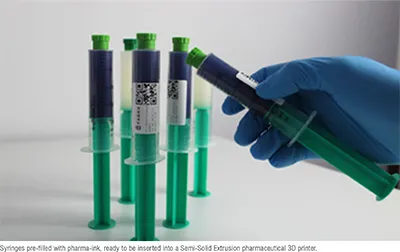
Syringes pre-filled with pharma-ink, ready to be inserted into a Semi-Solid Extrusion pharmaceutical 3D printer.
Compounding suppliers are now also getting involved. Well-known US and EU excipient and compounding base mix suppliers are now working with pharmaceutical 3D printing companies to develop 3D printing protocols for their commonly used excipients and compounding base mixes. In fact, a commonly used US compounding base mix was used in the Minoxidil case study in Spain alongside a PEG formulation to ensure relevancy in different countries. This highlights the ability to immediately implement 3D printing directly into pharmacy workflows, using reliable and familiar products already found in pharmacist supply chains. With more excipient suppliers becoming interested in the field of pharmaceutical 3D printing, it will become easier to print what pharmacists are used to handling in their pharmacy and more protocols for more drugs will become available.
Gustave Roussy Institute, Europe’s top oncology hospital, is also leading the charge, being the world's first hospital to 3D print multiple treatments within normal compounding workflows for standard patient care. Their most recent article outlines their next plans for Sulfamethoxazole and Trimethoprim for pediatric patients; as the new chewable formulations are now validated, the implementation into standard practice is relatively straightforward under compounding regulation. This will improve treatment adherence for hundreds of children in their care, and in the future, thousands across France. In their words, “Current oral dosage forms, such as tablets and suspensions, pose significant challenges: tablets are frequently difficult to swallow for children, and the bitter taste of suspensions often leads to refusal, undermining treatment efficacy”. Their 3D printed chewable tablets will change this, as previous studies with 3D printed chewable tablets show vast improvements in treatment acceptability.
Also being the world's first hospital to own multiple pharmaceutical 3D printers, the Parisian Gustave Roussy team is very much steaming ahead, also undertaking clinical trials for more complex multi-drug capsules auto-filled with their pharmaceutical 3D printers. These polypills are set to make breast cancer treatment more personalised and nicer for patients to take, combining breast cancer medication with anti-side effect medication for improved treatment adherence, both with an individualized patient dose to improve treatment efficiency. Although preparation is possible in practice with standard compounding techniques, the slow nature of these methods make polypills unrealistic and uneconomical in a busy pharmacy practice. Pharmaceutical 3D printing changes this, making it an affordable and efficient way of improving treatments for patients. Without pharmaceutical 3D printing, these polypills just wouldn’t be realistically feasible. One day more drug combinations for more treatments will be printed, reducing pill burden and medication complexity for millions.
St Jude Children’s Research Hospital is also going public with their interest in implementation, set to become one of the first hospitals in the US to do so. Brooke Bernhardt, Chief Pharmacy Officer and Associate Member Director, Division of Pharmaceutical Services from St. Jude Children’s Research Hospital has recently taken part in a number of seminars and webinars, discussing her plans and perceived benefits for the US market, her most recent being hosted by FABRX this August.
Big pharmaceutical companies in the US have started exploring how 3D printing can be used to prepare small batches of medicine, retaining the drug’s amorphous or crystalline structure. The agility that pharmaceutical 3D printing will bring to clinical trials will reduce costs and allow them to become more dynamic, producing new batches with varying doses or drug products extremely rapidly. This could mark a new boom in clinical trial batch manufacture, increasing turn-around time, reducing waste and reducing costs for pharmaceutical companies but also large contract development manufacturing organizations (CDMOs) interested in expanding their portfolio to clients.
In 2023, the world’s first international society for pharmaceutical 3D printing was set up, The International Pharmaceutical 3D Printing Initiative, with their first in-person conference happening July 2025. This initiative paves the way forward for international knowledge sharing and community drive. The July conference featured talks from all stakeholders, including industry, world leading hospitals and regulatory bodies, illustrating the impact recent field growth has had to successfully bring people together. Arguably the most beneficial talk for US pharmacists was by the US Pharmacopeia’s Director for Advanced Pharmaceutical Manufacturing Technologies, Dr Pali De Silva Indrasekara. Dr Indrasekara discussed the US Pharmacopeia’s point-of-view and future plans, marking an exciting turning point for US pharmacists. Although not required for implementation, guidance from the US Pharmacopeia will give more confidence to smaller pharmacies nervous about implementing new technology.
A step by step guide for immediate implementation
Implementing pharmaceutical 3D printing into pharmacies of all sizes has become very straightforward in the past few years, with pharmaceutical 3D printing companies streamlining workflows and simplifying user experience. Many protocol developers, often leading research active hospitals, universities and even industry, are keen to share their validated pharma-ink recipes and printing protocols to all pharmacies interested in 3D printing. Some pharmaceutical 3D printer suppliers now offer protocol sharing platforms as part of their software to aid knowledge sharing and field growth in a hub & spoke, or Spotify-like model. As mentioned earlier, excipient suppliers have also begun to get involved, meaning pharmacists can print materials already in their current supply chains. The below steps will help pharmacies, big and small, to implement pharmaceutical 3D printing into their workflows:
1. Choose your 3D printing technology
There are multiple different 3D printing technologies out there with some companies offering exchangeable printheads for multiple technologies in one machine as well as easy cleaning. Direct powder extrusion for thermoplastic powders, fused deposition modelling for thermoplastic filaments and semi-solid extrusion for pastes or gels are the three main technologies for small batch medicine manufacture, whether for personalised medicine or clinical trials. Some companies also offer other non-3D printing technologies, for example a pellet dispenser for pre-manufactured pellets. Although not 3D printing, this printhead technology increases the versatility of printer auto-capsule filling processes.
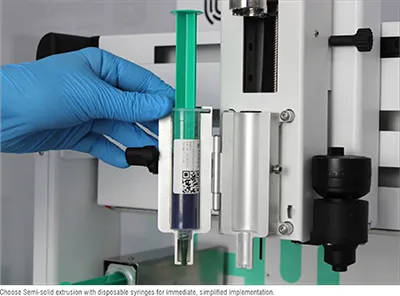
For immediate implementation, semi-solid extrusion is the technology to choose. Direct powder extrusion and fused deposition modelling, despite offering useful benefits, are more in the research phase of development. Semi-solid extrusion is the technology being used right now across the world for actual patient care under compounding regulation. It is as straightforward as it sounds, the extrusion of a gel or a paste, at room temperature or up to approximately 190°F (90°C) depending on the excipients used, setting into a solid on cooling or drying. It is easy to understand and the most GMP versus the other printing technologies. If using a syringe-based semi-sold extruder, it is even better as the syringes are often disposable or easily cleaned. When used alongside automatic direct-blister filling, mold filling or capsule filling, the pharma-ink does not touch the printer at all, simplifying cleaning further.
Choose Semi-solid extrusion with disposable syringes for immediate, simplified implementation.
2. Choose your 3D printer supplier
A number of different pharmaceutical 3D printer suppliers have popped up in the past few years, all offering different products and services and many focusing on semi-solid extrusion. Their distinct accessories, bespoke software and varying implementation strategies are important to consider.
Software is a key component to take into consideration. Questions such as “is it easy-to-use”, “can I print any protocol or just yours,” “does it make auditing simple and automated”, and “is quality control easy to manage and understand", are all important questions to ask. Regarding quality control, some printers have in-built quality control technologies such as balances, near-infrared spectrometers and pressure sensors. For immediate implementation, a balance in-built into the print bed and a pressure sensor in-built into the semi-solid extrusion printhead are important features to track and ensure quality in a fully automated fashion.
Experience in the field and access to validated protocols are also important aspects to consider. Can you use excipients and compounding bases from any supplier or are you required to use a specific brand? Some companies require you to use their internal compounding bases, restricting options and reducing drug loading due to small portfolios on offer. Other companies partner with suppliers from all over the world to ensure usability, affordability, clinical relevancy and easy access.
3. Identifying which drugs to 3D print
Identifying which drugs to print can seem like a daunting task, but many stakeholders are keen to simplify the process and help out. For pharmaceutical compounding, evaluate which drugs would benefit from automation, compounded drugs in high demand or ones that have a low therapeutic index and would benefit from automated precision to reduce over- or under-dosing risk.
As mentioned above, some printer suppliers offer protocols that are internally developed or developed by research active pharmacies, shared via Spotify-like, hub & spoke software platforms. Some of these companies also offer formulation and protocol development services. These tend to be fee-for-services for larger pharmaceutical companies looking to retain IP, but for smaller pharmacies they are often free as part of knowledge-sharing initiatives to help drive the field forward or included in subscription packages. In the future, pharmaceutical companies and 503B compounding pharmacies may supply pre-made pharma-ink prefilled into syringes, similar to the Nespresso coffee pods. Some have already started along this path alleviating even more workload and risk from 503A pharmacies; it is always a good idea to get in touch with your local 503B pharmacy now to see how they can help you.
World experts in the field have yet to find a drug that cannot be 3D printed, by using different excipients and compounding bases from multiple supplier’s worldwide, even difficult drugs can be printed. New protocols are being developed every day. Our recommendation is to talk to your chosen printer supplier, they can usually provide a lot of help and support for the individual needs of pharmacies. In fact, some companies develop new protocols for the drugs, excipients and compounding bases on request, providing pharmacists the freedom to print exactly what they already have in their supply chains for immediate implementation.
4. Getting started
You have chosen your printing technology, your printer supplier and your drugs to print, but how to get started? Luckily, printer suppliers often do a lot of the heavy lifting, providing ample training and standard operating procedures for everything from general workflow to cleaning. Ideally pharmacies should designate key pharmacists or technicians to look after the system, ensure workflows are properly followed by other staff members and act as the administrator if the printer software allows for user logins. Some software can also create profiles for non-printing users, for example for quality sign off and remote auditing. As with most new things, it is recommended to start gradually, with an initial drug of interest, moving onto additional treatments once you are confident with your first. Although not necessary, meeting others in the field can boost confidence and knowledge sharing. Visit pharma3dpi.org/conferences to join The International Pharmaceutical 3D printing Initiative and sign up to any upcoming events if you would like to meet other printing-active pharmacists directly, or contact us to find out more.
References:
Advancing medication compounding: Use of a pharmaceutical 3D printer to auto-fill minoxidil capsules for dispensing to patients in a community pharmacy; Xela Rodríguez-Maciñeiras, Carlos Bendicho-Lavilla, Carlos Rial, Khalid Garba-Mohammed, Anna Worsley, Eduardo Díaz-Torres, Celia Orive-Martínez, Ángel Orive-Mayor, Abdul W. Basit, Carmen Alvarez-Lorenzo, Alvaro Goyanes; International Journal of Pharmaceutics, Volume 671, 2025 (2025) DOI:10.1016/j.ijpharm.2025.125251
Clinical implementation of a paediatric 3D-printed combination of Sulfamethoxazole and Trimethoprim; Maxime Stoops, Bernard Do, Stéphanie Ramos, Bing Xun Tan, Nicholas Yong Sheng Chua, Roseline Mazet, Nicolas Guiblin, Alexandre Michelet, Stephen Flynn, Samuel Abbou, Alvaro Goyanes, André Rieutord, François-Xavier Legrand, Maxime Annereau; International Journal of Pharmaceutics, Volume 676, 2025 (2025) DOI:10.1016/j.ijpharm.2025.125581
Developing an innovative 3D printing platform for production of personalised medicines in a hospital for the OPERA clinical trial; Lucas Denis , Anna Kirstine Jørgensen, Thomas Fleury, Emmanuel Daguet, Inès Vaz-Luis, Barbara Pistilli, André Rieutord, Abdul W Basit, Alvaro Goyanes, Maxime Annereau; International Journal of Pharmaceutics (2024) DOI:10.1016/j.ijpharm.2024.124306
Automated Therapy Preparation Of Isoleucine Formulations Using 3D Printing For The Treatment Of MSUD: First Single-Centre, Prospective, Crossover Study In Patients;
Goyanes A, Madla CM, Umerji A, Duran-Pineiro G, Giraldez-Montero JM, Lamas-Diaz MJ, Gonzalez-Barcia M, Taherali F, Sanchez-Pintos P, Couce ML, Gaisford S, Basit AW; Int. J. Pharm. (2019) DOI:10.1016/j.ijpharm.2019.118497
https://fabrx.co.uk/webinars
https://pharma3dpi.org/conferences