


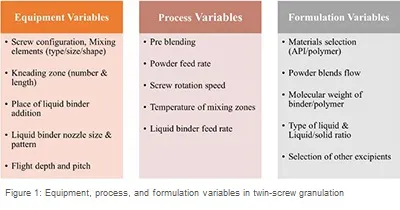
Melt granulation using hot-melt extrusion is one of the promising alternative approaches to producing granules. It is known as a solvent-free green technique, which is scalable utilizing continuous manufacturing techniques. The twin-screw extruder is a highly versatile and customizable mixer used for continuous granulation, well-known as twin-screw granulation (TSG). It achieves this using various conveying, kneading, and distributive mixing elements in different combinations. TSG is an innovative granulation method with advantages such as reduced processing time and cost, effective management of formulations with high drug loads and poor flow properties, less binder to produce suitable granules, minimized lot-to-lot variation, and compatibility with continuous manufacturing processes [1]. Based on temperature and binder utilization, twin-screw granulation is classified into twin-screw dry granulation (TSDG), twin-screw wet granulation (TSWG), and twin-screw melt granulation (TSMG). TSG can develop denser granules with improved homogeneity, compressibility, and flowability through all three types of granulations. Depending on equipment, formulation, and process, final granule properties may differ, and these variables are shown in Figure 1.
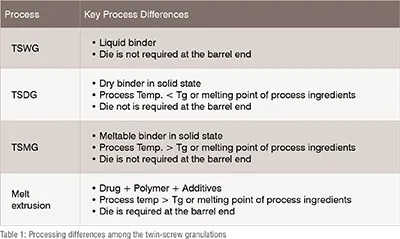
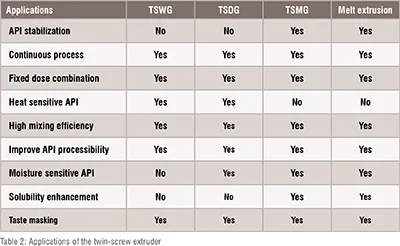
All three types of twin-screw granulation could be widely used for various pharmaceutical applications. TSG has several applications and benefits in the pharmaceutical industry. Some of the key applications of twin-screw granulation include improved granule properties in terms of uniformity in size and shape, better control over the density of granules with enhanced dissolution rate, and reduced processing steps. TSG enables easy scalability, continuous processing, and reduces material waste [2]. Table 1 and 2 shows a comparison of different types of TSG with conventional HME for its pharmaceutical applications.
Despite the above advantages and widespread applications, TSG has some significant challenges to overcome such as maintenance and cleaning of equipment, temperature control, dust control, and regulatory compliance. Granulation equipment components, such as screws, wear over time. Consistent performance requires maintaining tooling integrity to avoid costly replacements. Material feed rate and screw speed, and equipment size are the crucial factors in the scale-up and large-scale production. It is of utmost importance to meet regulatory requirements in the pharmaceutical industry. Complying with Good Manufacturing Practice (GMP) standards by documenting and validating the granulation process can be a challenging and time-consuming task.
In conclusion, twin-screw granulation is a highly effective and efficient alternative to traditional granulation methods in the pharmaceutical industry. Due to innovative TSE applications and extensive research in scaling up the process, there has been a rise in the number of approved HME products in the market. The authors anticipate this trend to continue.
References:
1. Bandari S, Nyavanandi D, Kallakunta VR, Janga KY, Sarabu S, Butreddy A, Repka M. Continuous twin-screw granulation – An advanced alternative granulation technology for use in the pharmaceutical industry. International Journal of Pharmaceutics, 2020. DOI: 10.1016/j.ijpharm.2020.119215
2. Patil H, Vemula SK, Narala S, Lakkala P, Munnangi S, Narala N, Jara M, Williams R, Terefe H, Repka M. Hot-Melt Extrusion: from Theory to Application in Pharmaceutical Formulation-Where Are We Now? AAPS PharmSciTech, 2024. DOI: 10.1208/s12249-024-02749-2