
Pharmaceutical excipients are involved in a drug formulation that is not entitled to medical activity, but plays an important role in ensuring effective distribution, stability and production of active pharmaceutical ingredient (API). As defined by Pharmacopeia in the United States, the materials that are deliberately added to drug products and have been evaluated for security.
In recent years, the increasing complexity of drug molecules has faced more and more formulation challenges, causing demand for new and more functional excipients. These novels are necessary to support the development and production of advanced drug distribution systems. However, it is not clear to define what a 'new excipient' is, and there is still no standalone regulatory approval route for such ingredients. This lack of clear guidance prevents widespread adoption and integration.
Despite these regulatory and practical barriers, many new excipients have been used in modern medicines. This article examines some current challenges related to his application and highlights the examples where they have added value to advanced drug distribution systems.
Challenges with the Use of New Excipients:
New excipients are quickly important to improve the distribution of drugs, but their adoption is difficult to use. These ingredients, although inactive, can increase how a drug is absorbed or released. However, if they have a lack of sufficient safety data for the proposed dose, period or use of use, they are considered 'new' under regulatory definitions.
Many types of new excipients have emerged, including new chemical structures, co-processed materials, modified versions of existing excipients and former substances used in food or veterinary applications. Others include materials produced using different sources or processes, or novels are suitable for administrative routes. This innovation provides benefits, but they also provide challenges.
One big question is that the market takes time to accept new excipients. While such materials can be developed and quickly launched, the adoption is slow. This delay limits commercial benefits and exclusivity periods for manufacturers investing in them.
Pharmaceutical companies are often cautious due to growth and regulatory risks. Security problems mean that further testing is needed, often expanded as a placebo to assess possible side effects with additional clinical test groups. There is also uncertainty about approval of the authorities, which cannot be confirmed until a complete drug application is reviewed. Even known excipients used on high doses or through new routes can be regarded as 'new' by regulators.
To reduce these risks, manufacturers usually prefer to use excipients already listed in the Inactive Ingredients Database of the FDA (IIG), including only pre-approval, known levels of use and specific administrative routes. Similar practice exists in Europe and Japan, although these regions do not have publicly available IIG colleagues.
Cost is another barrier. Ownership is more expensive and often available from the company that develops them. For example, while β-cyclodextrin is relatively cheap, new versions such as hydroxypropyl β-cyclodextrin are quite expensive. The formulator should justify this additional cost and often face limited access to information, especially if the details of the functionality of the excipient are owned.
Finally, limited production experience provides further risks. Without long-term data, it can be difficult to predict variation in quality and performance. Single-supplier dependency and lack of installed quality control frameworks as designs in design combine uncertainty.
Progress in Formulations and Drug Delivery Systems:
Recent developments in medicines and drug distribution methods can be widely classified in three areas:

(A) Early and controlled release dosing forms
(B) Nanotechnology-based and specialized delivery systems
(C) Biologics
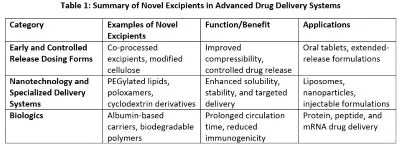
In each of these regions, novels have examples of an important role in improving product performance, stability and patient results. The following sections describe specific progress and highlight examples where new excipients has contributed to progress in these areas. The summary of these examples is presented in Table 1.
Improvement in Dosing Forms for Traditional Instant and Controlled Liberation:
The development of new excipients continues to increase the efficiency of the production of drugs and extend the shelf life of traditional doses.
Collected excipients, which are mixed with existing materials, have become important to improve both performance and production efficiency. These excipients, often multifunctional, combine ingredients to connect materials to different excipient classes. For example, a co-processed excipient may include a filler-binder (such as microcrystalline cellulose or lactose), a binder (such as hydroxypropyl methylcellulose or povidone), and a resolution (such as crospovidone). This approach enables the replacement of many excipients in a given formulations, reduces the complexity. The use of co-transmitted excipients can lead to simplified formulations, including only active medications, stimulants and a lubricant. In 2009, USP Excipient Monographs Expert Committee published a document on co-processed excipients, and invited public input and prepares the criteria for their acceptance. Some examples of co-processed excipients, such as Silicified Microcrystalline Cellulose and Polyvinyl Acetate Dispersion, were included in the discussion.
New grades with excipients are also introduced, designed to provide better performance or close control. The Hydroxypropyl methylcellulose which is often used in formulations of controlled resolution, is a hydrophilic polymer that presents challenges in direct compression due to its poor flow properties. These problems often require granulation, but it provides complications to the production process. Recent development results in new grades of HPMC, such as K4M and K100M DC, which improves large particle size and better flow properties, which enable direct compression and reduce the need for rashes. These new grades have been shown to produce lower weight variability and similar release profiles compared to traditional HPMC grades.
In addition, new excipient grades are developed with strict specifications to remove specific stability problems.
To reduce this, new crospovidone grades with fairly low peroxide levels have been introduced. These ultra-pure grades are manufactured, dried and packed under inert conditions to reduce peroxide formation, ensuring better stability for receptive medications.
Nanotechnology and Specialized Delivery Systems:
Nanotechnology, which is usually defined as manipulation and understanding of the case at the dimensions of about 1 to 100 nanometers, enables new applications in medical and drug distribution. Ku et al. A widely quoted review was published in the discovery of the role of nanotechnology in targeted drug distribution and imaging. They explained how the nanoscale delivery system and both physical properties of the biological system can be designed to help the diseased tissues and cells and distribute medicines.
General types of nanoscale drug delivery systems include liposomes, micelles, nanoemulsions, nanoparticles, nanocrystals, dendrimers, and nanogels. These systems can be divided on the basis of materials used to continue.
Recent progress in nanotechnology for drug delivery has focused on four main areas:
1. Improvement in Production and Strengthening: This involves processing existing systems such as liposomes and nanoparticles to make production more consistent and reliable.
2. Increasing Stability: Problems with stability, especially due to chemical instability, are still a challenge, especially in phospholipid-based systems. Strategies such as PEGylation improve vivo stability and reduce the immune system reactions. The PEGylation alternative is also studied. For example, freeze-drying PEGylated micelles, including camptothecin, showed no major changes in drug concentration or misconception on reorganisation. This indicates that freezing drying can help preserve the integrity of the system, which is likely to be due to the constant effects of the PEG chains.
3. New Content for Better Performance: Researchers modify existing polymers, such as poloxamers, fine-tuning of drug dissolution and site-specific or time-controlled drug release.
4. Goal Distribution: Many new targeting technologies have been designed to lead more accurate medicines for affected organs or tissues.
Since several new drug candidates are soluble with poor water, special drug delivery systems and solubilisers have quickly become important. Polyoxyl 15 Hydroxystearate is a new solubiliser, with better tolerability than traditional agents such as polysorbate 80. In particular, it was the first excipient that was reviewed under the IPEC Novel Excipient Safety Evaluation Procedure that was launched in 2007.
Biologics:
The recent biologics progress has focused on most injections (parenteral) delivery methods. The purpose of research is to improve the stability of biological medicines in both storage and inside the body, to reduce how often doses should be given, which enables the distribution of high drug volume and improves production processes, especially to preserve protein activity during scale-up.
The main types of distribution systems used in biologic formulations include:
1. Microspheres.
2. Liposomes.
3. Hydrogels.
In the field of systemic siRNA delivery, three main categories of materials are being used:
1. Lipid-based systems.
2. Polymer-based systems.
3. Peptide and protein-based systems.
Conclusions
Medicines include many important factors in developing and using new excipients. First, production and commercial viability should be considered. This includes the additional costs of introducing a new excipient, how easily it can be expanded for large-scale production, and whether reliable supply chains can be protected especially because such materials often come from the same supplier.
Secondly, there are regulatory requirements. To generate this data, it usually requires collaboration between the excipient producer and the pharmaceutical company.
Third, due to limited safety data, new excipients can only be approved for use in specific concentration areas or distribution paths until more evidence is available.
The fourth, environmental and handling risk should be considered specifically for new excipient such as carbon nanotubes, which requires strict control for health, safety and disposal due to their possible risks.
Finally, stability problems with new excipients may require special packaging solutions to ensure broad durability studies and long-term quality.