


Drug delivery systems (DDS) are technologies that improve how medicine works in the body. They can target specific areas, release drugs slowly over time, and reduce side effects. DDS are crucial for many diseases but face challenges like biological barriers and a lack of standard testing methods. More research is needed to overcome these hurdles and unlock the full potential of DDS to revolutionize medicine.
The limitations of conventional drug delivery and the challenges it presents
Conventional drug delivery struggles with poorly absorbed drugs, short lifespans, and unintended side effects. Oral drugs face stomach acid, enzymes, and first-pass liver metabolism. Many drugs can't reach their targets or require frequent dosing. They also struggle to deliver delicate molecules or target specific locations within cells.

Unleashing the Potential: Nanorobotics in Drug Delivery Revolution
Nanorobotics stands at the forefront of a groundbreaking shift in drug delivery and targeting. With the capability to precisely navigate within the body, these minuscule machines hold the promise of transforming the way drugs are delivered and targeted. From enhanced targeting abilities to on-demand release and real-time monitoring, nanorobotics offers a spectrum of advantages that could revolutionize the effectiveness of therapeutic treatments. Some of the major highlights for the potential of nanorobotics in revolutionizing drug delivery and targeting could be in the following areas:
1. Enhanced targeting ability: nanorobots can be precisely guided to target tissues, organs or cells. They can incorporate targeting ligands to home in on biomarkers overexpressed on diseased sites. This allows the selective accumulation of drugs at areas of interest.
2. Ability to cross biological barriers: The small size of nanorobots allows them to extravasate from leaky vasculature and potentially traverse barriers like the blood-brain and blood-tumour barriers, facilitating delivery to previously inaccessible sites.
3. Improved intracellular delivery: Nanorobots may be capable of transporting therapeutic payloads across cell membranes and navigating within cells and organelles. This enables the targeting of intracellular pathogens or the delivery of drugs directly to the site of action.
4. On-demand and controlled release: Nanorobots can be designed to only release their payload upon receiving external commands or stimuli like temperature, specific enzymes or reductive environments at target sites. This ensures drugs are released only when and where needed.
5. Sustained dosing: Using refillable reservoirs or the production of drugs on-site, nanorobots may provide sustained release of drugs over extended periods, improving therapeutic compliance and outcomes.
6. Real-time monitoring and feedback: Nanorobots can incorporate diagnostic sensors to monitor physiological parameters, release profiles and therapeutic responses in real time. This enables closed-loop, personalized delivery based on individual patient needs.
7. Protection from degradation: The protective chassis of nanorobots can shield fragile cargo from degradation in circulation and at sites of delivery, improving pharmacokinetics.
8. Targeting of multiple biomarkers: Multiple targeting moieties can facilitate homing to tissues expressing a combination of biomarkers for enhanced specificity.
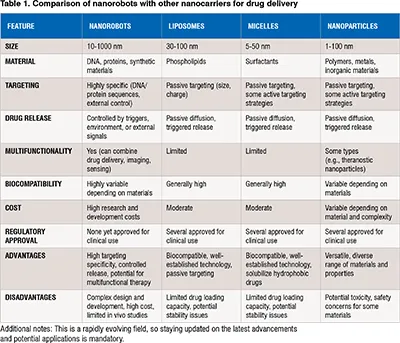
So, in summary, nanorobotics offers unprecedented control over drug delivery for maximizing therapeutic benefits. In the future, it is possible to co-administer a miscellaneous group of nanobots that could serve complementary functions in the drug treatment targeting approach and working in harmony through the control of Artificial Intelligence (AI). Table 1 provides comparison between nanorobots with other nanocarriers for drug delivery.
Nanorobotics for Drug Delivery: Types of nanorobots and their design
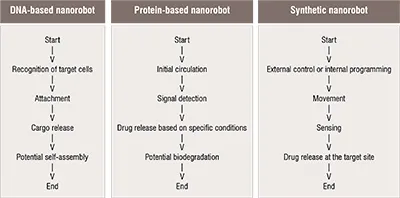
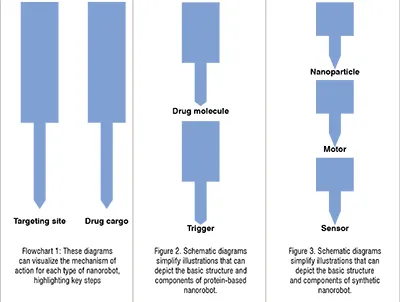
Scientists are developing tiny robots for drug delivery. These come in different forms, like DNA or protein-based, and each has its strengths. They can target specific areas and respond to body signals for precise drug release (Figure 1-3). Advancements allow these robots to handle multiple tasks and hold promise for personalized medicine. The future of drug delivery might involve these robots working with AI for real-time treatment.
Nanorobotics and its key principles in drug delivery applications: Targeting strategies
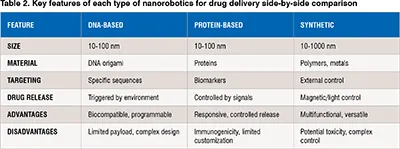
Nanorobotics involves the use of specific ligands or antibodies to guide the nanorobots to their intended targets within the body. These targeting strategies ensure that the drugs are delivered directly to the affected areas, minimizing side effects and increasing treatment efficacy (Table 2). Additionally, nanorobotics also allows for the controlled release of drugs, where the nanorobots can be programmed to release the drugs at specific times or in response to certain stimuli, further enhancing their precision and effectiveness in drug delivery.
Tiny robots are being designed to travel through the body, acting like doctors on a microscopic scale. These "nanorobots" can deliver drugs directly to diseased cells, treat blood clots, and even fight infections. This technology has the potential to revolutionize medicine by offering more precise and effective treatments.
Key design considerations for safe and effective nanorobots in treatment
Design considerations for nanorobots include biocompatibility, which ensures that the materials used in their construction do not cause harm or elicit an immune response when introduced into the body. Maneuverability is another important factor, as nanorobots need to be able to navigate through complex biological environments to reach their target. Payload capacity refers to the number of therapeutic agents or drugs that can be carried by the nanorobot, allowing for effective treatment. Lastly, drug release mechanisms are crucial for controlling the timing and dosage of medication delivery, ensuring optimal effectiveness and minimizing side effects. These considerations are essential for developing safe and efficient nanorobots for treatment and control of various medical conditions.
Targeting Strategies with Nanorobots
Nanorobots use various methods to target drug delivery. Special coatings or attached molecules help them find and bind to diseased cells. Doctors can also use magnets or sound waves to guide them. This improves treatment effectiveness and avoids harming healthy cells.
The potential of nanorobots for overcoming biological barriers and reaching specific diseased tissues
Tiny robots could deliver drugs directly to diseased areas by navigating through our body's barriers. These nanorobots would be controlled to reach specific targets, improving treatment effectiveness. Challenges remain in guiding them precisely, but success could revolutionize medicine.
The potential benefits and limitations of nanorobotic drug delivery.
One potential benefit of nanorobotic drug delivery is the ability to precisely target and deliver medications to specific cells or tissues within the body. This targeted approach can potentially minimize side effects and maximize the therapeutic effects of drugs. Additionally, nanorobots can be programmed to release drugs in a controlled manner, allowing for sustained release over a desired period.
However, there are also limitations to consider. One limitation is the potential for immune system response or rejection of the nanorobots. The body's immune system may recognize these foreign particles as threats and attempt to eliminate them, which could hinder their effectiveness. Another limitation is the current limitations in the manufacturing and scalability of nanorobots. Producing large quantities of nanorobots with consistent quality and functionality can be challenging.
Overall, while nanorobotic drug delivery holds great promise for revolutionizing medical treatments, further research and development are needed to address these limitations and ensure their successful implementation in clinical settings.
Economic feasibility and cost considerations of nanorobotic drug delivery
Nanorobotic drug delivery is promising but expensive due to development costs, complex manufacturing, and regulations. However, potential benefits like reduced side effects and personalized medicine could lead to long-term cost savings. Public and private investments, collaboration, and value-based pricing models are needed to overcome economic challenges and make this technology more affordable.
Safety and Ethical Considerations
Nanorobotic drug delivery promises medical advancements, but safety and ethics are crucial. Ensuring these tiny robots don't harm patients and addressing privacy concerns are key. Thorough testing, clear guidelines, and open communication are needed before widespread use.
Future Perspectives, lessons learned and conclusion
Nanorobots hold promise for precise drug delivery and personalized medicine. Overcoming safety, manufacturing, and regulation hurdles is crucial. Integrating them with other technologies like biosensors could revolutionize healthcare by enabling real-time monitoring and improved patient outcomes.