

From breakthrough therapies to broader platforms
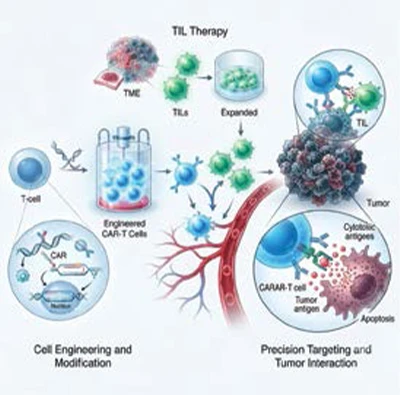
Immunotherapy has transformed the treatment of cancer and other serious diseases. The first wave of approved cell therapies, particularly chimeric antigen receptor (CAR) T-cell therapies, showed that a patient’s own immune cells could be collected, engineered, expanded, and returned as a living medicine. These therapies delivered remarkable responses in certain hematologic cancers and established immune cell engineering as a viable therapeutic modality.
Innovation is now moving beyond early autologous CAR-T approaches toward a broader range of engineered and non-engineered immune platforms, including next-generation CAR-T cells, engineered T-cell receptors (eTCRs), tumor-infiltrating lymphocytes (TILs), natural killer (NK) cell therapies, macrophage-based therapies, in vivo immune engineering, and multi-targeted approaches designed to address tumor escape.
This evolution is necessary because autologous CAR-T therapies remain operationally complex, costly, and difficult to scale. Individualized manufacturing, specialized logistics, long vein-to-vein timelines, and high production costs have limited access. CAR-T therapies have also had limited success in solid tumors, autoimmune diseases, and allogeneic settings, where new platforms must improve trafficking, function within challenging microenvironments, and scale to larger patient populations.
The expanding cell therapy landscape
While CAR-T therapy remains the most visible engineered cell therapy platform, it is no longer the only center of innovation. Older, but reenvisioned, and new CAR designs are being developed to improve persistence, reduce exhaustion, and broaden activity beyond B-cell malignancies. Dual-targeted and logic-gated CARs are being explored to address antigen loss and improve selectivity. Armored CAR-T cells, which secrete cytokines or other immune-modulating molecules, are designed to improve function in hostile tumor microenvironments.
Engineered T-cell receptor therapies are also gaining momentum. Unlike CAR-T cells, which typically recognize surface antigens, TCR therapies can target intracellular proteins presented by human leukocyte antigen molecules, expanding the target universe. However, TCR therapies require careful attention to specificity, HLA restriction, off-target recognition, and patient selection.
Tumor-infiltrating lymphocyte therapy represents another important approach. TILs are immune cells naturally found within tumors. The therapeutic concept is to isolate those cells, expand the most tumor-reactive populations, and return them to the patient in sufficient numbers to drive an anti-tumor response. TIL therapy is especially relevant for solid tumors, where conventional CAR-T strategies have struggled because of antigen heterogeneity, trafficking barriers, and immune suppression.
Natural killer cell therapies offer a different opportunity. NK cells can kill abnormal cells without prior antigen sensitization and may be suited to allogeneic, off-the-shelf approaches. Engineered NK cells may provide a safer and more scalable alternative in selected settings, although persistence and potency remain key questions.

Macrophage and myeloid cell therapies are earlier in development but attractive for solid tumors because they can infiltrate tumor tissue and interact directly with the tumor microenvironment. The common theme across these platforms is clear: immunotherapy is shifting from single-product innovation to platform-based immune engineering.
Why solid tumors remain difficult
Hematological malignancies provided the first major successes for CAR-T therapy because target antigens such as CD19 are accessible and expressed on cells circulating in blood or lymphoid tissue. Although CD19 is also expressed on normal B cells, on-target B-cell aplasia has generally been manageable. Solid tumors present a different set of challenges.
First, tumor antigens are often heterogeneous. Not every tumor cell expresses the same target, and antigen-negative cells can survive treatment and drive relapse. Second, many target antigens are also expressed at low levels on normal tissues, creating safety concerns. Third, engineered immune cells must traffic into tumor tissue, survive there, and maintain function despite hypoxia, nutrient limitation, and suppressive immune signals. Fourth, the tumor microenvironment can inhibit T-cell function through checkpoint pathways, suppressive cytokines, and regulatory cell populations.
Next-generation platforms are being designed around these barriers. Multi-targeted CARs may reduce antigen escape. Logic-gated systems may improve selectivity by requiring combinations of signals before activation. Armored cells may secrete molecules that counteract local immune suppression. Combination strategies may pair cell therapies with checkpoint inhibitors, cytokines, oncolytic viruses, or targeted agents.
The future of solid tumor immunotherapy will likely depend less on one perfect receptor and more on integrated design: target selection, cell type, engineering strategy, dose, route of administration, and combination regimen.
In vivo immune engineering
One of the most important emerging concepts is in vivo immune engineering, sometimes called in vivo CAR-T. Instead of removing immune cells from the patient, modifying them outside the body, and re infusing them, in vivo strategies seek to deliver genetic instructions directly to immune cells inside the patient.
This approach could reduce manufacturing complexity, shorten treatment timelines, and expand access. It could also enable repeat dosing or reprogramming of different immune cell types in a more flexible way. Delivery systems under investigation include viral vectors, lipid nanoparticles, targeted nanoparticles, and other synthetic platforms. Viral vectors can offer efficient gene delivery but may raise concerns around immunogenicity, payload size, and manufacturing complexity. Lipid nanoparticles are modular and scalable but require precise targeting to reach the desired immune cell population.
Safety is critical. In vivo immune engineering requires tight control over bio distribution, cell specificity, expression level, and duration of activity. Unintended engineering of off-target cells could create unacceptable risk. Developers will need strong preclinical models, sensitive bio distribution assays, robust potency testing, and clear regulatory strategies. Even with these challenges, in vivo engineering represents a major direction for the field.
Gene editing and synthetic biology
Gene editing has become an important enabling technology for next-generation immunotherapies. CRISPR-based systems, base editors, and other nuclease platforms can be used to knock out inhibitory receptors, remove endogenous TCRs, improve persistence, or enable allogeneic cell therapy.
Allogeneic cell therapy is one of the most attractive goals. In this model, cells from healthy donors are engineered, expanded, banked, and administered to multiple patients. This could reduce cost, improve scheduling, and support more consistent manufacturing. However, allogeneic therapies must address immune rejection and graft-versus-host risk. Editing strategies may help, but every additional modification creates new manufacturing, analytical, and regulatory complexity.
Synthetic biology adds another layer of sophistication. Engineered cells can be designed with inducible switches, safety controls, logic circuits, and programmable response pathways. These tools may allow therapies to activate only under defined conditions, shut down if toxicity emerges, or respond dynamically to the tumor environment.
This sophistication raises the bar for characterization. Developers must demonstrate not only that the cell product has the desired function, but also that the engineered system behaves predictably across manufacturing lots, patients, and clinical contexts.
Manufacturing as a strategic bottleneck
As immunotherapies become more advanced, manufacturing becomes more important, not less. The next generation of products may involve complex vectors, large plasmids, multiple edits, sensitive cell types, and tight release specifications. A therapy cannot succeed clinically if it cannot be manufactured reliably.
Autologous therapies require rapid, patient-specific manufacturing with minimal failure rates. Allogeneic therapies require scalable batch production, cell banking, and comparability across lots. In vivo platforms require high-quality genetic payloads and sophisticated delivery systems. Viral vector programs depend on reliable plasmid DNA supply, vector production, purification, and analytics. mRNA and nanoparticle-based approaches require template quality, RNA integrity, capping, purity, encapsulation, and stability.
The manufacturing challenge is not confined to the final cell product. It extends across the supply chain: plasmid DNA, viral vectors, mRNA templates, enzymes, raw materials, closed processing systems, analytics, quality systems, and logistics with expectations for regulators to increase expectations regarding supplier qualification, material traceability, lot-to-lot consistency, adventitious agent control, impurity control, documentation, and justification of material suitability.
Automation will play a central role. Closed systems can reduce manual variability, support standardized workflows, and lower contamination risk. Electronic batch records, in-process analytics, and improved process control can help developers understand critical quality attributes earlier and make manufacturing more predictable. However, automation alone is not enough. Scalable immunotherapy manufacturing requires fit-for-purpose process development, strong analytical methods, defined release criteria, and early alignment between research, CMC, and clinical strategy.
Analytics and quality expectations
Analytical development is often underestimated in emerging immunotherapy programs. As products become more complex, identity and viability are no longer sufficient. Developers must assess potency, phenotype, persistence, VCN, editing efficiency, residual impurities, replication-competent virus risk, safety, and other product-specific attributes.
Potency testing is particularly challenging. It must reflect the therapy’s intended mechanism of action while remaining robust, reproducible, and practical for manufacturing release. This is especially difficult for living therapies, where function may depend on cell state, target expression, micro environmental conditions, and patient biology. Cell-based assays are often required, but they can be time-consuming, variable, and difficult to standardize. Surrogate assays offer a practical alternative, but they require substantial data to demonstrate correlation with biological activity.
For in vivo and nucleic acid-based approaches, analytical expectations also include payload identity, sequence integrity, purity, delivery efficiency, bio distribution, expression kinetics, and immune activation.
Regulatory authorities increasingly expect developers to understand how process parameters influence product quality. Delayed attention to analytics can slow clinical progression, complicate comparability, and increase cost.
Commercialization and access
The scientific promise of next-generation immunotherapy will have limited impact if products remain inaccessible. Cost, infrastructure, reimbursement, and treatment complexity all influence adoption. Many hospitals are not equipped to deliver complex cell therapies. Patients may need to travel long distances to specialized centers. Manufacturing slots, release timelines, and logistics can create additional delays.
Next-generation approaches must address both clinical and operational value. Shorter manufacturing timelines, improved reliability, outpatient-compatible regimens, lower toxicity, off-the-shelf availability, and more standardized manufacturing could expand access and reduce costs. Developers must also show durability, safety, quality-of-life impact, and value compared with existing standards of care.
For years, the advanced therapy community has argued that a $2M cure is more valuable than a $100,000 annual disease-management program lasting decades. However, that argument has not saved the industry from therapies limited by reimbursement barriers, manufacturing constraints, and slow clinical uptake.
The road ahead
The next era of immunotherapy will be defined by convergence. Cell engineering, gene editing, delivery technology, synthetic biology, automation, and analytics are no longer separate disciplines; they are interconnected parts of a holistic therapeutic design.
The central question is no longer whether the immune system can be engineered to fight disease. The question is how to make these therapies more efficacious, safer, more scalable, more durable, and more accessible.
Progress will require balanced innovation. Better receptors and cell designs must be matched with practical manufacturing. Sophisticated gene editing must be matched with strong safety controls. Powerful in vivo delivery must be matched with precision targeting. Clinical ambition must be matched with regulatory and commercial realities.
Next-generation immunotherapies are moving the industry beyond the first chapter of engineered cell therapy. The field is building a broader therapeutic toolkit that may eventually reach more cancers, more patients, and more disease areas. The winners will likely be those platforms that combine biological insight with manufacturability, quality, scalability, and a clear path to clinical use, ultimately delivering meaningful value to patients, physicians, and developers alike.
Read the full article — it's free
Register with Pharma Focus America to unlock expert insights, research articles and in-depth industry analysis.