



Personalized medication, also referred to as precision medicine, is revolutionizing the landscape of medical science and gaining significant traction globally. This innovative approach focuses on tailoring medical treatments to each individual, taking into account their unique needs, lifestyle choices, genetic predispositions, and personal circumstances. Unlike traditional therapeutic models, which often rely on uniform treatment modalities applied across entire populations, personalized medicine emphasizes a more customized approach. It ensures that patients receive treatments specifically designed to address their unique health profiles, ultimately leading to more effective and efficient healthcare.
Now a days, patients are actively seeking therapies that consider their genetic makeup, environmental factors, and individual preferences, acknowledging that health is not universally the same for everyone. As we move toward a future of more individualized care, advancements in molecular, and data science play a critical role in enabling this shift. These technologies allow for the identification of specific biomarkers that can predict how patients will respond to particular treatments, providing a more targeted and less trial-and-error-based approach to healthcare.
The importance of personalized medicine cannot be overstated. By tailoring treatments to the individual, it has the potential to minimize adverse effects, improve efficacy, and optimize overall treatment outcomes. This personalized approach not only enhances the patient's health but also leads to greater cost-effectiveness in the long term by reducing unnecessary treatments and hospitalizations. Moreover, it empowers patients by making them active participants in their healthcare journey, as it recognizes the value of the patient's unique biological and genetic characteristics.
Biomarkers for personalised medication
Modern medical research is increasingly focused on the integration of biomolecular science into personalized medicine, recognizing its potential to transform healthcare. By harnessing the advancements in molecular biology and bioinformatics, researchers are now able to design highly tailored therapeutic solutions based on an individual’s profile. Central to this approach are biomarker-based medication systems, which are revolutionizing the way diseases are diagnosed, monitored, and treated. Biomarkers, as measurable indicators of physiological and pathological processes, provide invaluable data on the underlying molecular mechanisms of disease. It is defined as biological molecules found in bodily fluids or tissues, indicating the presence of a normal or abnormal process, condition, or disease. Their significance lies in their ability to offer deep insights into disease pathogenesis, enabling the precise identification of therapeutic targets and guiding the development of targeted treatments that are more likely to yield successful outcomes for each individual.
Delivering clinically sound and impactful therapies requires a comprehensive understanding of the underlying causes of a condition. By identifying the nature and extent of the problem, it becomes possible to design and implement precise treatment strategies that maximize therapeutic efficacy. This knowledge facilitates targeted interventions focused on modulating biomarker levels—either by increasing or decreasing them as needed—to effectively address and alleviate the condition.
These biomarkers span a wide array of molecular entities, including nucleic acids such as DNA, mRNA, microRNA, and siRNA, which provide insight into genetic alterations and gene expression profiles. Proteins, proteoglycans, and lipids, including sphingolipids, are often used as indicators of cellular functions and alterations in metabolic pathways. These molecular markers are complemented by cellular markers, which help elucidate immune responses or cellular dysregulation, and even imaging features that reflect the physiological and morphological changes in tissues over time. Each of these biomolecules offers distinct and complementary insights into the molecular mechanisms governing disease processes and the therapeutic responses to interventions.
The integration of biomarker-based systems into personalized medicine enables a paradigm shift from generalized treatments to precision medicine, where therapies are selected based on the specific molecular characteristics of a patient's disease. This approach ensures that each intervention is optimized for the individual’s biological makeup, minimizing the risk of adverse effects and enhancing the likelihood of therapeutic success. These are used across various stages of disease progression. By providing a dynamic measure of therapeutic efficacy, biomarkers help clinicians assess how well a treatment is working and whether adjustments are needed to optimize outcomes. Biomarkers thus serve as a critical tool in stratifying patients, not only for the selection of the most effective treatments but also for monitoring disease progression and assessing treatment response over time. For instance, in cancer treatment, biomarkers can be used to track tumour size or the presence of specific mutations that affect response to targeted therapies. In chronic diseases like diabetes, biomarkers such as HbA1c levels can help monitor how well glycemic control therapies are working, allowing for timely modifications, and genetic biomarkers such as the HER2 gene in breast cancer can predict which patients will respond to HER2-targeted therapies, improving the chances of treatment success.
Biomarkers can be categorized based on their specific purposes, emphasizing their diverse roles in disease management. Here are some key types of biomarkers, each contributing uniquely to enhancing clinical outcomes: (Table 1)
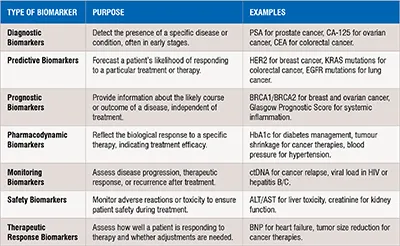
Biomarkers for clinical investigation.
Biomarkers also plays a critical role in bridging the gap between preclinical research and clinical application, serving as indispensable tools in drug development and personalized medicine. By integrating biomarkers into the drug development process, they can facilitate informed decision-making at every stage, from initial drug discovery to regulatory approval. However, despite advances in biomolecular research, the successful translation of preclinical biomarkers into clinical practice remains a significant challenge. Nevertheless, it can revolutionize personalized therapy, ensuring tailored interventions for patients and driving innovation within the biopharmaceutical industry.
While the promise of biomarkers in precision medicine is immense, the drug development pipeline faces critical bottlenecks. Despite substantial investments in biomedical research, the pharmaceutical industry's ability to translate discoveries into approved therapies is hindered by a staggering attrition rate. Clinical trials see failure rates exceeding 90%, with the likelihood of a candidate drug or biologic successfully progressing from Phase I trials to market being a mere 5%. These sobering statistics underscore the urgent need to refine biomarker-driven approaches, optimize trial design, and enhance predictive capabilities.
The Integration of Biomarkers with Drug Delivery Systems
Traditionally, injectables have been a preferred choice for biomarker-based therapies, especially in areas like oncology, autoimmune diseases, and rare genetic disorders. However, a paradigm shift is emerging as conventional dosage forms, such as capsules, gain prominence in delivering biomarker-driven treatments. This evolution represents a remarkable leap forward in precision medicine, as capsules offer unparalleled advantages in therapeutic precision, targeted release, and optimized bioavailability. By tailoring doses and release profiles to align with specific biomarkers, capsules ensure that the medication reaches its intended target at the precise moment and in the ideal amount. This approach not only enhances therapeutic outcomes but also paves the way for more accessible, patient-friendly treatments, redefining the future of biomarker-based therapies. Capsules offer unparalleled versatility through various encapsulation strategies, making them an ideal choice for personalized treatment regimens. They can be tailored for delayed release to achieve optimal therapeutic outcomes or designed with multi-compartment configurations to accommodate complex combination therapies, all based on individual biomarker profiles.
For chronic or long-term treatments, capsules offer a patient-friendly, non-invasive, and easy-to-administer solution, which significantly improves adherence. This is particularly important in the case of biomarker-driven therapies, where the need for precision in targeting specific disease pathways or controlling drug release is critical.
Advanced capsule technologies, such as enteric-coated and multi-layered systems, have significantly enhanced their applicability in site-specific drug delivery, guided by biomarkers. These systems are designed to release the drug precisely at the targeted location in the body, thereby optimizing therapeutic efficacy. For instance, in gastrointestinal diseases, biomarkers such as calprotectin can guide the use of delayed-release capsules to ensure the drug is released specifically in the colon, maximizing localized therapeutic outcomes.
Multi-layer capsules represent a sophisticated approach to achieving sequential or controlled drug release, making them highly suitable for conditions requiring staggered or sustained release profiles. These capsules are engineered with multiple compartments or layers, each tailored for distinct release characteristics or to physically separate incompatible ingredients. A prominent example is the capsule-in-capsule (CiC) format, where a smaller capsule is enclosed within a larger one. This design enables dual-release profiles, where the contents of the inner and outer capsules can be released at different times or targeted to distinct sites in the body.
Another variation includes layered beadlet capsules, where the capsule contains beadlets or pellets coated with specialized layers. Each layer is designed to dissolve under specific physiological conditions, such as pH, enzymatic activity, or time. This allows for controlled, delayed, or sequential drug release. For example, in chronic conditions like hypertension, a multi-layer capsule can deliver an immediate release of the drug followed by sustained release over stipulated period. Similarly, in inflammatory bowel disease (IBD), these capsules can deliver therapeutic agents to targeted regions of the gastrointestinal tract based on the stage or site of inflammation.
Multi-layer capsules also provide enhanced drug stability by isolating sensitive formulations within separate compartments or layers, preventing potential interactions or degradation. Advancements in biodegradable polymers have further improved the efficacy of these systems by enabling precise control over drug release kinetics. These capsules offer a promising platform for personalized and biomarker-guided therapies, paving the way for more effective and patient-centric treatment options.
Smart capsules with biosensors are an innovative leap in biomarker-driven drug delivery, designed to provide real-time, responsive treatment. These capsules are embedded with miniature biosensors that detect specific biomarkers, such as enzymes, proteins, or pH levels, directly in the patient’s body. Based on this detection, the capsules dynamically adjust drug release, ensuring precise dosing and minimizing side effects. For instance, in diabetes management, such capsules could monitor glucose levels and release insulin accordingly, eliminating the need for frequent monitoring or injections. Similarly, in oncology, smart capsules could deliver chemotherapy drugs only when tumour biomarkers are elevated, reducing off-target effects. While still under development, these systems hold immense promise, though challenges such as miniaturizing biosensors, ensuring biocompatibility, and integrating wireless monitoring systems need to be addressed to realize their full potential.
Additionally, capsules offer a cost-effective, scalable, and highly customizable solution to meet the diverse needs of biomarker-specific treatments. The growing emphasis on capsule-based drug delivery systems highlights their potential as a versatile and effective platform for advancing biomarker-driven therapies. This development is paving the way for more personalized, targeted treatment regimens, and transforming the future of precision medicine. The increasing focus on capsule-based drug delivery systems underscores their potential to serve as a versatile and effective platform for advancing biomarker-driven therapies. By aligning treatment with individual biomarker profiles, this dosage from enables the development of highly personalized treatment regimens, which is revolutionizing patient care and improving outcomes across a wide range of diseases.

Summery
The synergy between biomarkers and drug delivery systems is revolutionizing personalized medicine, redefining therapeutic paradigms, and pushing the boundaries of patient care. By enabling highly tailored and effective treatment regimens, this integration is shaping the future of healthcare, offering innovative solutions for managing complex and chronic diseases. Advanced capsule and encapsulation technologies play a pivotal role in this transformation. With their ability to support controlled release, multi-compartment formulations, and targeted delivery, capsules have become indispensable for optimizing drug performance and enhancing patient outcomes.
This convergence of biomarker-driven therapies and capsule systems is paving the way for healthcare that is more precise, efficient, and aligned with the unique needs of each patient. Biomarkers, by stratifying patients based on disease characteristics or therapeutic responses, are key to developing treatments that are not only effective but also highly specific. Coupled with advancements in biomolecular science, biomarker validation, and collaborative efforts across academia, industry, and regulatory bodies, this integration promises to reshape modern medicine. Together, biomarkers and advanced drug delivery platforms hold immense potential to transform personalized medicine and redefine the future of healthcare.