

Pharmaceutical innovation uses energetic chemistries: transformations that enable access to new molecular scaffolds, complex intermediates, and breakthrough therapies. Reactions such as nitrations, diazotizations, azide formation, and cross-couplings open doors to therapeutic possibilities that might otherwise remain out of reach.
But these same chemistries introduce significant hazards. Many involve unstable intermediates, exothermic pathways, or combustible powders that, if mishandled, can escalate into catastrophic events. The challenge for the industry is clear: how do we continue to harness the power of energetic chemistry while ensuring safe, reproducible, and scalable processes?
Why Scale-Up of Energetic Reactions Is High Risk
What works at the gram scale in a research lab does not always translate safely to kilogram or ton-scale production, unless process safety programs are incorporated from the start with experienced teams. At larger volumes, heat and gas releases behave differently. A reaction that seems controllable in development may present unexpected risks when scaled.
Industry records highlight the ongoing challenges associated with energetic chemistry. Between 1985 and 2019, at least 73 documented incidents in pharmaceutical manufacturing were linked to this field, resulting in significant loss of life, with the majority connected to explosive events. Unfortunately, such risks remain present, as illustrated by a major incident at a pharmaceutical facility in India in July 2025 that caused numerous fatalities. Such events highlight that process safety failures are rarely theoretical; they are tangible, devastating, and preventable when risks are systematically identified and managed. Importantly, these incidents have also driven significant advances in process safety science, creating opportunities for the industry to apply hard-earned lessons and move forward with greater confidence and control.
A structured approach to process safety begins with comprehensive hazard identification. An expert team should systematically evaluate risks across six distinct, yet interrelated, categories and recommend effective controls that prioritize safety while minimizing process disruption
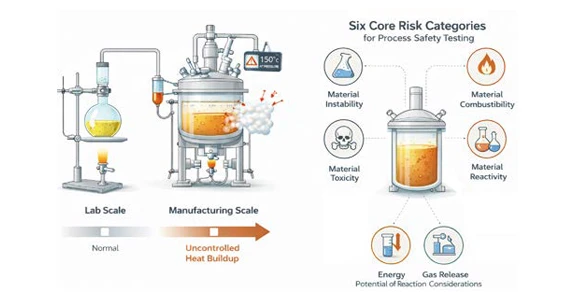
Six Core Risk Categories for Process Safety Testing
• Material Instability – Identifies decomposition thresholds, and instability, examining how substances behave under thermal, mechanical, or chemical stress. Understanding decomposition onset temperatures, self-accelerating decomposition behavior, and sensitivity to impurities is essential for determining safe operating windows and storage conditions.
• Material Combustibility – Assesses how readily a substance ignites or sustains combustion, including parameters such as minimum ignition energy (MIE), dust explosivity, and flammability limits. These data are critical for preventing fires and secondary explosions, particularly when handling powders or solvents at scale.
• Material Reactivity – Addresses the potential for hazardous interactions between process components, including reagents, solvents, catalysts, cleaning agents, and construction materials. Incompatibilities can trigger unexpected exotherms, gas generation, or violent reactions, especially during deviations or upset conditions.
• Material Toxicity – Evaluates exposure thresholds and both acute and chronic health risks associated with exposure. While toxicity is often considered separately from process safety, it directly influences emergency response planning, containment strategies, and personal protective equipment requirements during normal operations and abnormal events.
• Energy Potential of Reaction– Examines the energy potential of reaction energetics, quantifying heat release rates, adiabatic temperature rise, and accumulation hazards. Reaction calorimetry plays a central role in determining whether a process can be safely controlled under worst-case scenarios or if additional safeguards, such as semi-batch dosing or enhanced cooling, are required.
• Gas Release Considerations – Addresses the type, rate, and volume of gaseous byproducts generated during reactions or decomposition events. Inadequate venting or mischaracterized gas evolution can lead to over-pressurization, vessel rupture, or explosive atmospheres, making this category essential for equipment design and emergency relief systems.
Evaluating all six dimensions provides the data needed to design appropriate safeguards, engineering controls, and emergency protocols.
From Process Safety Data to Risk-Based Decisions
Collecting safety data is only half of the battle. Interpretation is what transforms numbers into actionable insights. A calorimetry profile or ignition energy measurement means little without context: What is the probability of the event? How severe would the outcome be?
Decision-makers in pharma increasingly rely on risk-based frameworks that weigh likelihood and consequence together. This approach not only strengthens safety but also supports operational efficiency, avoiding over-engineering controls where risks are minimal and focusing resources where they matter most.

Why Process Safety Is a Strategic Advantage
The economics of process safety are often overlooked. Beyond protecting lives, preventing incidents safeguards uptime, avoids unplanned shutdown costs (which can reach millions of dollars per hour), and protects brand reputation in a tightly regulated industry.
In a world where both innovation speed and safety are non-negotiable, process safety is no longer a box to check; it is a strategic enabler of long-term success.
Partnering for Safer Pharmaceutical Manufacturing
As energetic chemistry continues to define the pharmaceutical landscape, organizations must align with partners who not only understand the science but also the inherent risks. That means leveraging expertise in hazard identification, scale-up, and safe facility design.
An expert team should systematically evaluate how to mitigate the risks across the six distinct, yet interrelated, core categories and recommend effective controls that prioritize safety while minimizing process disruption. The evaluation of materials, products and process risk ensures maximum hazard mitigation and safety.
References
1. Global process safety incidents in the pharmaceutical industry - ScienceDirect
2. Fatal explosion and fire at Indian pharmaceutical ingredients plant | Business | Chemistry World
Resources
• Stoessel, F. Thermal Safety of Chemical Processes, Wiley-VCH.
• Crowl, D.A., Louvar, J.F. Chemical Process Safety: Fundamentals with Applications, Pearson.
• Center for Chemical Process Safety (CCPS). Guidelines for Risk Based Process Safety.
• U.S. Chemical Safety Board (CSB) Incident Investigation Reports.
• ICH Q11: Development and Manufacture of Drug Substances.